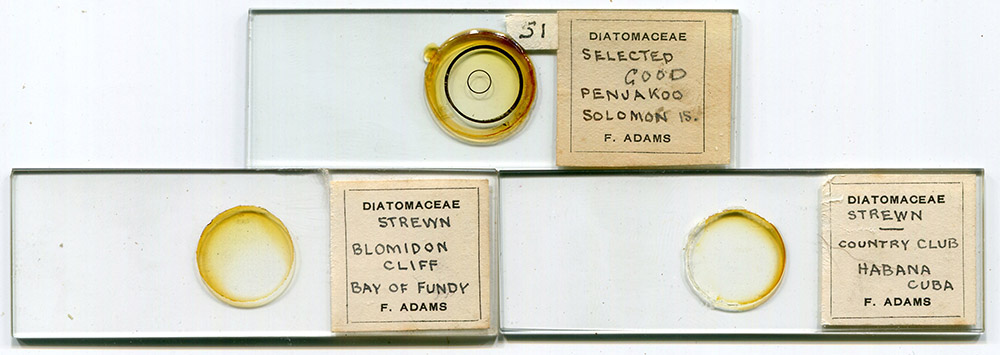
Figure 1. Microscope slides by Frederick Adams. They are not dated, but were likely produced during the 1920s-30s, when Adams was a very active microscopist.
Frederick Adams 1867 – 1938
by Brian Stevenson
last updated September, 2025
Frederick Adams was a widely-recognized expert on diatoms, and an avid amateur microscopist. Originally from London, he spent much of his life working as a civil engineer in Mexico. Around 1920, Adams became a Fellow of the Royal Microscopical Society and a member of both the American Microscopical Society and the Quekett Microscopical Club. He amassed a substantial collection of microscope slides of diatomaceous material, consisting of both his own mounts and productions of other diatomists. On his death, he donated some 23,000 slides to the British Museum, and others to the Royal Microscopical Society. Microscope slides by Frederick Adams are not often seen outside of those collections, and probably originate from Adams’ exchanges with colleagues or were “liberated” from the RMS. They are generally of very good quality, consisting of arranged type slides and mixed strews (Figures 1-2).
Figure 1.
Microscope slides by Frederick Adams. They are not dated, but were likely produced during the 1920s-30s, when Adams was a very active microscopist.

Figure 2.
Type-slide arrangement of selected diatoms from Penjakoo (now Penjuku), Solomon Islands, by Frederick Adams (see Figure 1).

Figure 3.
Frederick Adams grew his collection of microscope slides by preparing his own, acquiring slides from other makers, and by purchasing collections from other microscopists. Advertisements such as this 1926 example could have brought him hundreds of interesting specimens.
Frederick Adams was born on January 30, 1867, in the Bromley area of Middlesex (now London). He appears to have been the sixth child, and fifth son, of John Henry and Sarah Adams. Father John was described in the 1871 national census as a “railway superintendent and civil engineer”, a career that was also pursued by Frederick. The father died in 1877. The 1881 census shows 14 year-old Frederick as a “scholar”, living with his widowed mother and his sister in Stoke Newington, sustained by the mother’s “dividends”.
According to a memorial of Adams’ life, he began working around 1884 on construction at Newport Docks, Wales. In about 1886, he worked on railway construction in Venezuela. During 1888, he moved to Mexico as chief engineer for construction of the Inter-Oceanic Railway.
Adams joined the Institution of Civil Engineers in 1892. Records often include the initials “M.I.C.E.” after Adams’ name, indicating his membership. The 1893 list of I.C.E. members, and several other records, gave Frederick Adams’ mailing address as 60 Queen Victoria Street, London. This was the business address of his eldest brother, Henry Adams (1846-1935), who was also engineer. Frederick’s use that address makes sense in that he frequently moved his home, while Henry’s business remained fixed at that location for several decades.
A 1901 issue of The Railway Age provided information on the Tehuantepec National Railway of Mexico. Sir Weetman D. Pearson (1856-1927, later Viscount Cowdray) of the construction firm S. Pearson & Son was listed as the “concessionaire”. Frederick Adams, who had been working for some time with Pearson, was general manager of the railway enterprise. At the time, Adams lived in Coatzacoalcos, Mexico.
In 1909, “Mr. Frederick Adams, managing director of Messrs. Pearson & Sons, England, met the directors of the Mexican Northern Power Co., Ltd., in Montreal recently and signed a contract for the development of a large site in the northern part of Mexico on the Conchos River, to supply power and light to the mines in that territory. The contract involves an outlay of five million dollars”, and “The Mexican Northern Power Co., which is a Canadian company, proposes to build a large dam across the Conchos River, in the state of Chihuahua. Contracts have been let to S. Pearson & Son, Ltd., for building the dam, also for building 20 miles of railway from the dam to Santa Rosalia, on the National Railways of Mexico. Frederick Adams is chief engineer of S. Pearson & Son, with headquarters at Mexico City”.
Adams managed construction of another dam in 1910, as reported, “S. Pearson & Sons, Ltd., City of Mexico, have about completed the exploration work in connection with the Nazas River dam project for the Laguna irrigation system which is to be constructed for the Mexican government. A site has practically been settled upon at Caja Pinto, where at a very satisfactory depth, there is every indication that a perfectly good and safe foundation has been found, and it will be but a short time before all operations are concluded to complete the plans for foundation as presented to the government by Frederick Adams, City of Mexico, the managing director of the construction department of S. Pearson & Sons. The dam when it is constructed, will have a storage capacity of 1,800,000,000 cu. meters of water. It is planned to hold sufficient water to more than irrigate the entire Laguna district and enable the planters there to double the yield of cotton per acre”.
Other major construction projects with which Adams was associated include the harbor works in Vera Cruz and Salina Cruz.
I identified several records of Adams traveling between England and Mexico, indicating that he went back-and-forth every few years. One especially notable transit record noted that Frederick left Liverpool on August 5, 1911, and appears to indicate that he was accompanied by his wife (although her name is not on the passenger list). This is the earliest mention of Mary Naomi Adams that I have located; her maiden name and date/location of their marriage remain unknown. Mary regularly accompanied Frederick on later trips across the ocean. The pair do not appear to have had children. The 1912 records of the couple’s crossing from Mexico to Laredo, Texas, described Frederick as 5 foot 8 inches (1.73 m) tall, fair complexion, brown eyes and hair, while Mary was 5 foot 4 inches (1.63 m), also fair with brown hair and eyes. It also notes that Mary was born in London. For transit records on which a home address was required, the Adams routinely used brother Henry’s business address of 60 Queen Victoria Street, London.
A memorial to Adams stated, “Throughout his life he was greatly devoted to microscopical science. In youth he was keenly interested in pond-life, but later he applied himself to the serious study of bacteriology. Finally, diatoms claimed his entire devotion”.
The period of 1919-1921 marked an apparent increase in Adams’ enthusiasm for microscopy. In 1919, he joined the American Microscopical Society, in 1920 became a Fellow of the Royal Microscopical Society, then in 1921 joined the Quekett Microscopical Club. He was living in Mexico City during those years, but evidently found benefits in being a corresponding member of those three groups.
In 1924, Adams published two articles in the popular science magazine English Mechanics, “The gathering and cleaning of diatoms”, and “Diatoms”. The second paper shared methods for mounting diatoms, and indicated that he was already a skillful mounter. For selecting and arranging single diatoms, Adams made the following tool: “Place on the end of a cedar pen-holder a minute piece of beeswax; bore vertically, with a pin, a small hole through the wax into the holder and insert a glass hair projecting outside about 1/2 in… This is the tool (and several should be made of various lengths) with which the diatoms may be lifted”. He also recommended, although apparently did not own, “a mechanical finger … by the Spencer Lens Co., of Buffalo, New York, which fastens by a collar between the objective and the tube of the microscope. Its use takes more time than the simple holder indicated above, but it is very accurate, and the smallest diatom can be picked up and placed in an exact position, and is used entirely by the professional mounters, such as Moller, of Wedel, and explains the accuracy of their beautiful work”. Adams also recommended that diatomists us “a Greenough binocular microscope, as it has a larger field, and there is more room on the stage for moving the slides”, and “a two-thirds objective, and a x10 or x15 ocular.”
His obituary in The Journal of the Quekett Microscopical Club described Adams as “a consummate artist in the selecting and mounting of diatoms, and he built up a wonderfully fine collection of type slides of his own making, of material from localities all over the world. In addition to these slides he from time to time acquired slides from the collections of Bessell, Truan, Kitton, and others, many of the slides being of great interest historically as well as intrinsically. At the time of his death his entire collection numbered between 20,000 and 30,000 slides. Precision was Mr. Adams’ guiding principle in life, and these slides and their mounted forms are all catalogued and card-indexed”. The Journal of Botany wrote, “He was a keen and alert business man and equally so in the pursuit of his hobby… he never regarded the purchase of a collection as a bargain to be driven and the payment he made for collections was always such that he had the market”. Related to the latter comment, Adams advertised in popular scientific magazines that he was interested in purchasing other people’s diatom collections, an effective way of building a large and diverse collection (Figure 3).
Adams used his knowledge of the Spanish language to translate Ernesto Caballero Bellido’s 1897 work on diatom mounting, which was published by The Journal of the Royal Microscopical Society in 1926 as “The technique of mounting diatom and other type slides”.
Frederick and Mary established a home in Maidstone, Kent, England ca. 1926. He retired from work in 1931, and the couple settled in St Saviours, Jersey, Channel Islands.
In 1935-36, he traveled to Barbados for the specific purpose of examining the island’s famed diatomaceous material. On his return, he wrote “A note on the Barbadoes diatom deposits” for The Journal of the Quekett Microscopical Society.
Frederick Adams died in Jersey on November 14, 1938, at the age of 72.
Resources
Adams, Frederick (1924) The gathering and cleaning of diatoms, English Mechanics, page 98
Adams, Frederick (1924) Diatoms, English Mechanics, page 127
Adams, Frederick (1936) A note on the Barbadoes diatom deposits, Journal of the Quekett Microscopical Club, pages 209-210
Bracegirdle, Brian (1998) Microscopical Mounts and Mounters, Quekett Microscopical Club, London, page 1
Caballero Bellido, Ernesto (1926) The technique of mounting diatom and other type slides, translated by Frederick Adams, Journal of the Royal Microscopical Society, pages 9-28
Charter, Supplemental Charters, By-laws, and List of Members of the Institution of Civil Engineers (1893) “1892 Mar. 1. Adams, Frederick, 60 Queen Victoria Street, E.C.”, page 96
The Electrical Engineer (1909) Note on contract between Pearson & Sons and the Mexican Northern Power Co., Ltd., page 738
Engineering-Contracting (1910) Note on construction of the Nazas River dam, page 42
England census and other records, accessed through ancestry.com
English Mechanics (1926) Exchange offers from Frederick Adams, June 4 and other issuesJournal of the Quekett Microscopical Club (1922) “Nov. 8, 1921, Adams, Frederick, M.I.C.E., F.R.M.S., Apartado 560, Mexico D.F., Mexico"
Journal of the Quekett Microscopical Club (1927) “Nov. 8, 1921, Adams, Frederick, M.I.C.E., F.R.M.S., Larkfield Hall, Maidstone, Kent"
Journal of the Quekett Microscopical Club (1933) “Nov. 8, 1921, Adams, Frederick, M.I.C.E., F.R.M.S., Beauvoir, St. Saviours, Jersey, C.I."
Journal of the Quekett Microscopical Club (1938) Frederick Adams, pages 128-129
Journal of the Royal Microscopical Society (1920) Election of Frederick Adams, pages 103-104
Journal of the Royal Microscopical Society (1921) “1920, Adams, Frederick, M.Inst.C.E., 4 Calle de Panuco, Mexico City, Mexico”
Journal of the Royal Microscopical Society (1926) “1920, Adams, Frederick, M.Inst.C.E., Apartado 560, Mexico D.F., Mexico, and Larkfield Hall, Maidstone, Kent”
Minutes of Proceedings of the Institution of Civil Engineers (1892) Associate Members, page 245
Minutes of Proceedings of the Institution of Civil Engineers (1908) “Adams, Frederick, Obras del Puerto, Salina Cruz, Oaxaca, Mexico”, page 65
Passenger records of inbound and outbound ships, etc., accessed through ancestry.com
Railroad Age Gazette (1908) Note on contract between Pearson & Sons and the Mexican Northern Power Co., Ltd., page 828
The Railway Age (1901) Note on the officers of the Tehuantepec National Railway, page 765
Ramsbottom, John (1939) The Adams Collection of Diatoms, Journal of Botany, pages 154-156
Transactions of the American Microscopical Society (1920) “Adams, Frederick, C.E., ’19, Plaza Necaxa, Colonia Cuauhtenac, Mexico, D.F., Mexico”, page 244