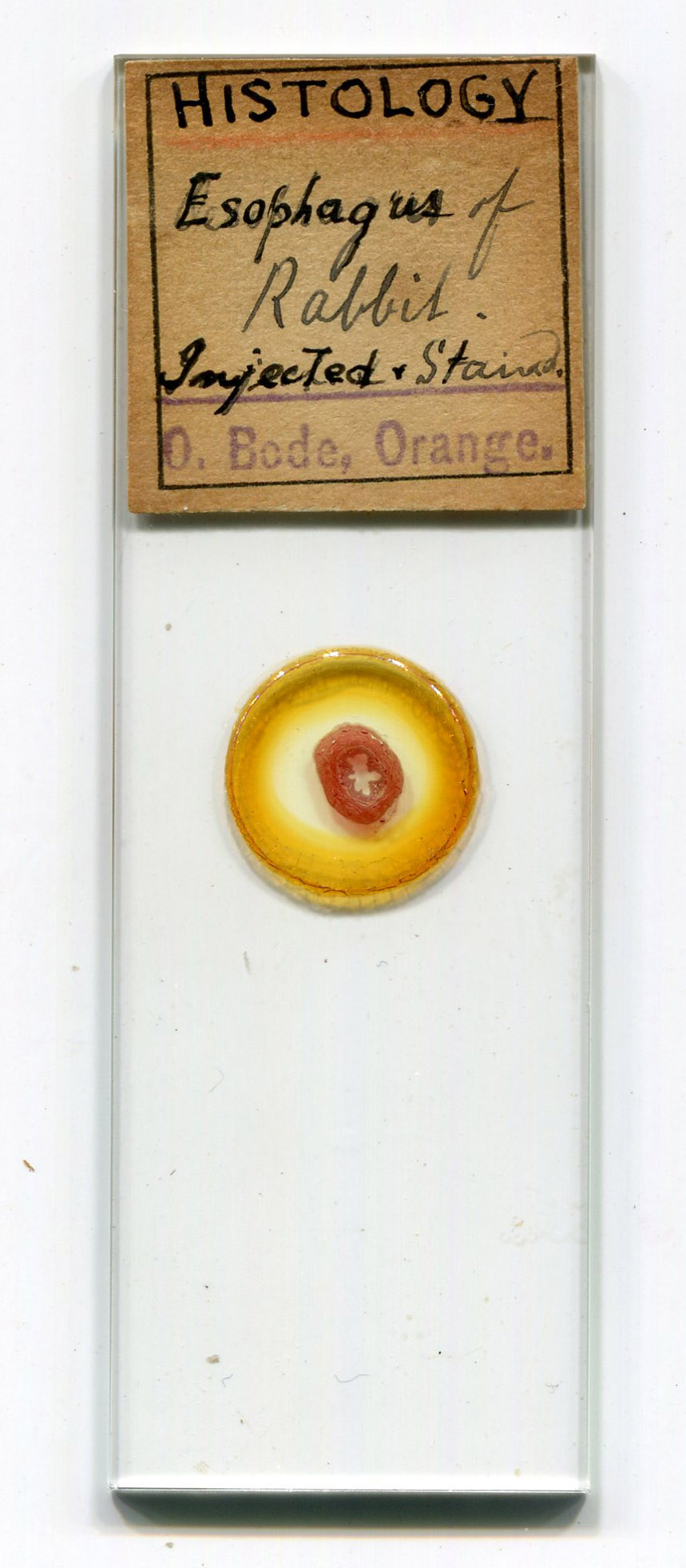
Figure 1. Microscope slide by Oscar Bode, prepared ca. 1890.
Friedrich Oscar Bode (O. Bode), 1857 - 1905
by Brian Stevenson
last updated February, 2026
Oscar Bode was an owner of a major painting and decorating business in Orange, New Jersey during the latter 1800s. He was also a member of the Department of Microscopy of the Brooklyn Institute of Arts and Sciences in 1889 and 1890. Although travelling between his home and Brooklyn would have taken quite some time in those days, he would have met with many skillful microscopists, specimen preparers, and mounters. Bode evidently learned to prepare good quality microscope slides, and very likely acquired the skills necessary to inject, stain, and section anatomical specimens such as shown in Figures 1-4.
Figure 1.
Microscope slide by Oscar Bode, prepared ca. 1890.
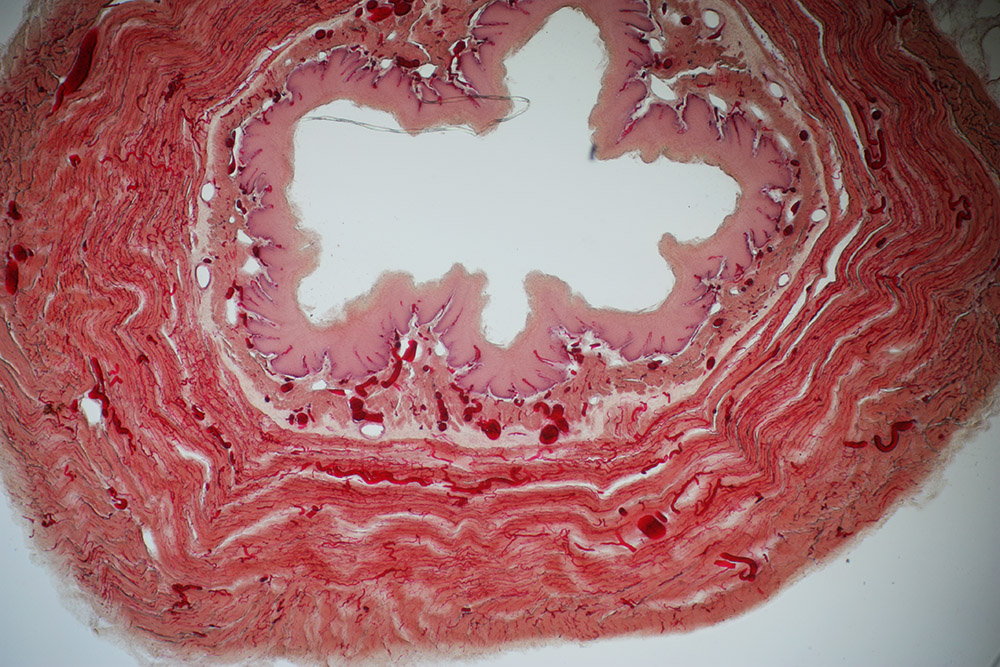
Figure 2.
“Esophagus of Rabbit, Injected and Stained”, mounted by Oscar Bode ca. 1890 (see Figure 1). Imaged with a 3.5x objective lens and C-mounted digital SLR camera on a Leitz Ortholux II microscope.
Friedrich Oscar Bode was born on March 2, 1857, in Orange, New Jersey. He was the eldest of four children of Adolph and Caroline Bode. Both parents were originally from Germany. Father Adolph operated a painting and decorating business, of which Oscar and a brother later became partners.
Oscar and his brothers appear to have had thoughts toward careers other than decorating. The 1880 census listed 23 year-old Oscar’s occupation as “clerk, store”, with brother Alfred working as a “piano tuner”.
That changed in 1882, when Oscar formed a partnership with his father, described as, “Adolph Bode & Son, Fresco Painters, Decorators, Paper Hangings, etc., No. 52 Main Street. - Prominent among the solid, substantial business men and citizens of Orange is Mr. Adolph Bode, who has since 1866 given his special attention to the interior decorations of public buildings and private residences, and has achieved an enviable reputation for his artistic ability and the high class of his workmanship. In the spring of 1882 Mr. Bode admitted his son, Oscar, to an interest in the business, which since that time has been carried on under the firm-name of Adolph Bode & Son. They occupy a large store having a frontage of forty with a depth of sixty feet and keep the finest stock of wall papers, including those of English, Japanese, and other designs, also borders and friezes and interior decorations of all kinds, to be found in this part of New Jersey. They also have all kinds and styles of window shades and also all the newest and leading designs in tapestry, Wilton, Brussels, and other kinds of carpets. A special branch of their business is fresco painting, in which they excel for originality of design and beauty in the harmonious blending in color and shades. They give their personal supervision to all kinds of interior decorations and employ in their respective departments workmen of acknowledged skill and ability, and furnish estimates for all kinds of work in this line of business. Mr. Adolph Bode and his son Oscar, the members of the firm, are well known in this vicinity and are highly respected and esteemed by all who have dealings with them. Mr. Adolph Bode is a German by birth and a practical, scientific fresco painter and decorator, and since he has been in Orange has achieved popularity and is now the able representative of the First Ward in the Board of Aldermen, and has always been active in promoting and assisting in advancing the best interests of Orange. His son is a native of Orange, and is a young gentleman of fine artistic and business ability."
“…the copartnership being still further augmented in 1884 by the admission of a second son, Mr. Alfred Bode, the firm style being changed to Adolph Bode & Sons. The spacious premises occupied are comprised in a double store having a frontage of 40 feet and a depth of 60 feet, elegantly and artistically fitted up. Here they display an immense assortment of carefully selected paperhangings of both foreign and domestic manufacture, window shades, and other interior decorations. Here also is to be found a vast variety of dry and mixed paints, oils, varnishes, brushes, and artists' materials and painter' supplies of every description. The firm is possessed of a wide range of experience in all branches of plain and decorative painting. They are celebrated for the beauty and exquisite good taste of their fine paperhangings and interior decorations. Estimates are furnished for all kinds of work in their line, and all contracts entered into are performed promptly, skillfully, and satisfactorily. Mr. Adolph Bode, the senior member of the firm, is a native of Germany, but has resided about thirty years in Orange. He has served as a member of the city government, performing his duties with acceptability. His sons, Messrs. Oscar and Alfred Bode, are natives of Orange, and are young men of energy and enterprise”.
Oscar Bode is recorded to have been a member of the Brooklyn Institute’s Department of Microscopy in their 1889 and 1890 Yearbooks. This was a major scientific society in the region, and Bode would have benefitted greatly from collegial interactions with many pre-eminent microscopists. It is not known when Bode joined the society, or when he left, but it is reasonably to date his microscope slides to circa 1890.
Oscar married Emma Garnaus on March 2, 1882. The couple had two children, a girl and a boy.
In 1905, “F. Oscar Bode, one of the most prominent business men of Orange, N. J., died there on Oct. 22, after a long illness. He was born in Orange in 1857. and when he went into business became identified with the firm of Adolph Bode & Sons, dealers in painters' supplies. He was President of the Master Builders and the Master Painters' Ass'n of the Oranges”. He was 48 years old.
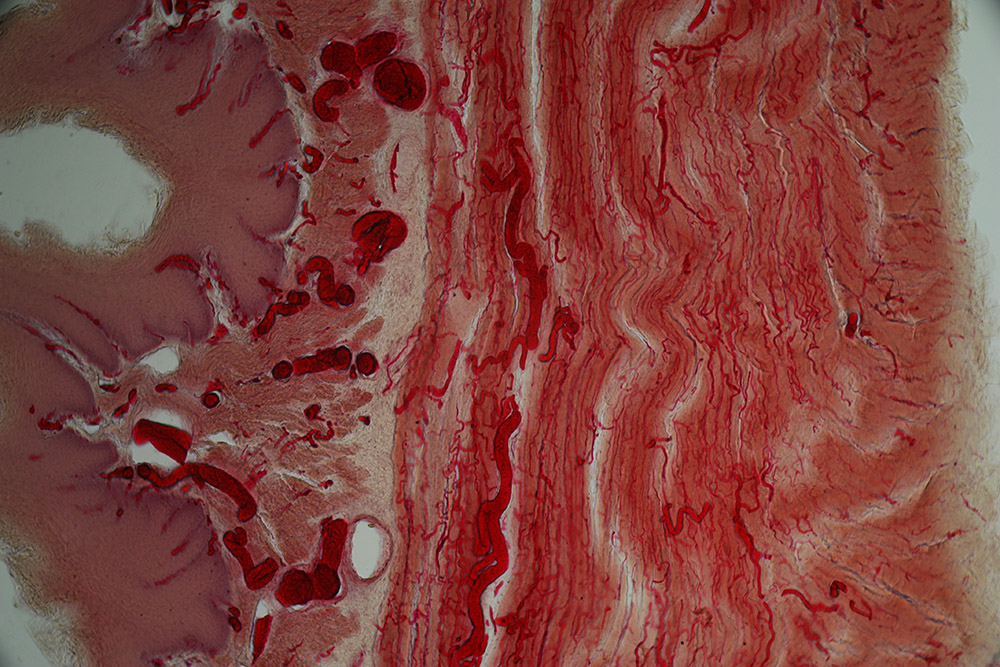
Figure 3.
“Esophagus of Rabbit, Injected and Stained”, mounted by Oscar Bode ca. 1890 (see Figure 1). Imaged with a 10x objective lens and C-mounted digital SLR camera on a Leitz Ortholux II microscope.
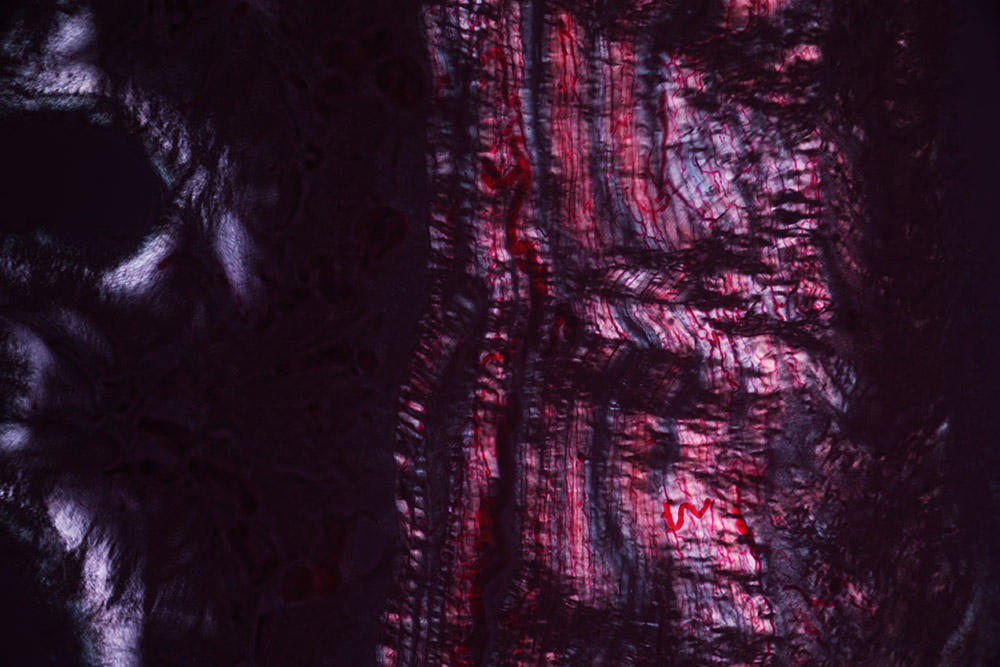
Figure 4.
“Esophagus of Rabbit, Injected and Stained”, mounted by Oscar Bode ca. 1890 (see Figure 1). This is the same field as shown in Figure 3, except between crossed polarizing filters that highlight the muscle fibers.
Resources
Building Trades Employers’ Association Bulletin (1905) F. Oscar Bode, page 268
Industries of New Jersey: Essex County, Including Newark (1882) Historical Publishing Co., New York, page 754
Quarter-century's Progress of New Jersey's Leading Manufacturing Centres (1887) International Publishing Company, New York, page 178
US census and other records, accessed through ancestry.com
Yearbook of the Brooklyn Institute Institute of Arts and Sciences (1889) Department of Microscopy, pages 29-30
Yearbook of the Brooklyn Institute Institute of Arts and Sciences (1890) Department of Microscopy, page 55