Thomas Craggs, 1838 - after 1893
by Brian Stevenson
last updated July, 2026
During the mid-1860s, Thomas Craggs produced expertly-prepared microscope slides of thin-sectioned fish teeth, which he found in coal that had been mined near his home of Gateshead, Durham, England. He often applied professional-quality labels to his slides, suggesting that he sold them commercially.
Craggs also provided specimens to paleontologist Richard Owen (1804-1892), who wrote several articles and named species of extinct fish that were based on Cragg’s specimens. Many of those preparations are now housed in the British Museum.
Craggs worked as a school teacher during the time that he produced microscope slides. Around 1869, he changed to brokering iron and copper, and appears to have ceased involvement in microscopy.
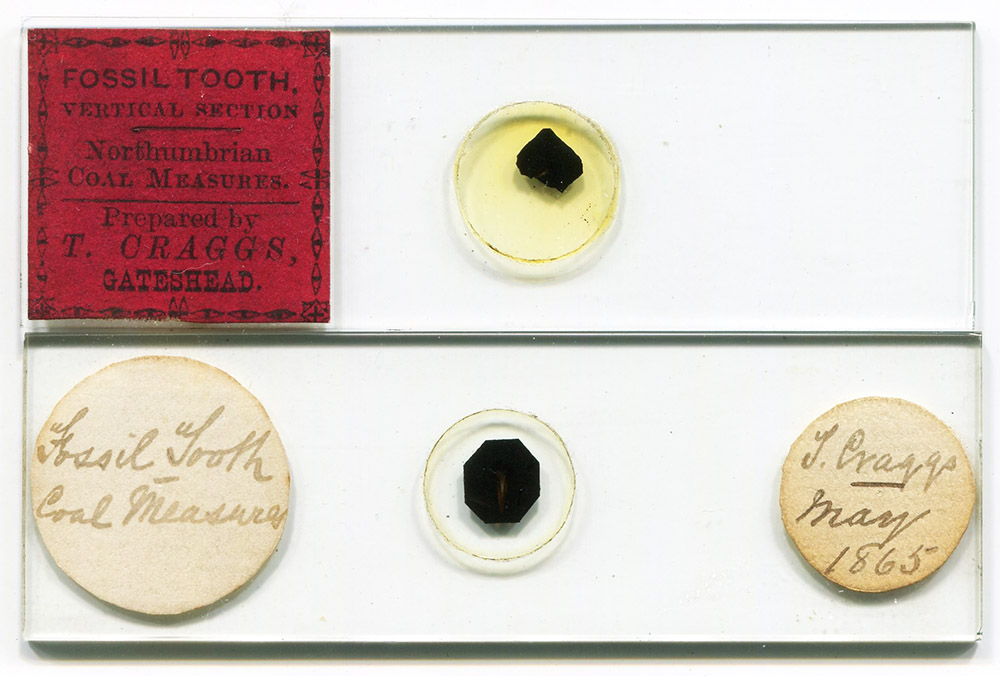
Figure 1.
Microscope slides of thin-sectioned fossil fish teeth from coal, prepared by Thomas Craggs. The upper slide carries his professional-style label, reading “Fossil tooth, vertical section, Northumbrian coal measures, prepared by T. Craggs, Gateshead”, and was probably prepared in ca. 1867-68. The lower slide has handwritten labels, “Fossil tooth, coal measures, T. Craggs, May, 1865”.
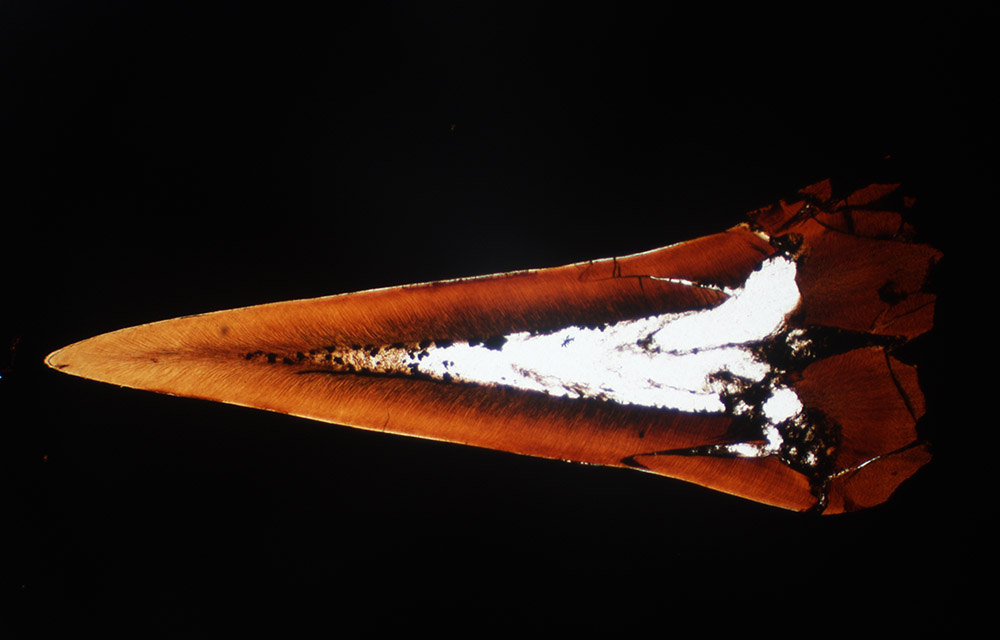
Figure 2.
Vertical section of a fossilized fish tooth from coal, prepared in 1865 by Thomas Craggs (see Figure 1, lower slide). Imaged with a 3.5x objective lens and C-mounted digital SLR camera on a Leitz Ortholux II microscope.
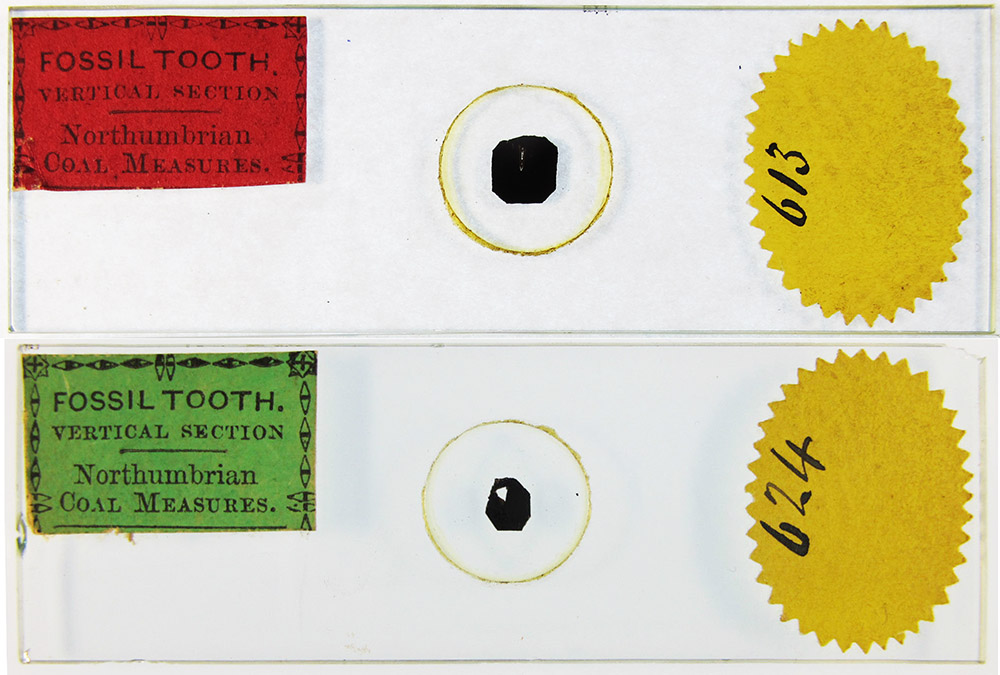
Figure 3.
Figure 3. Two ca. 1867 microscope slides of fish teeth, by Thomas Craggs. His name has been removed from the labels, possibly because a re-seller did not want to give attribution to the actual preparer (a common practice), or possibly because an owner personally disapproved of Craggs. As discussed below, Craggs clashed with other area fossil collectors/paleontologists over who should get credit for discoveries. Images adapted for nonprofit, educational purposes from an internet auction site.
Thomas Craggs was born in late 1838 in Sunderland, Northumberland, the first of four children of Henry and Winifred Craggs. Father Henry was a master shoemaker and, by 1861, also owned a “beer house”.
Thomas initially trained to be a teacher. The 1861 national census recorded 22 year-old Thomas as being a “school master”, boarding with a family in Gateshead, Durham. An entry in an 1859 magazine indicated that he was then living in Gateshead, and presumably already teaching there.
Thomas Craggs married Jane Ann Brason in 1861. They did not have any children.
He joined the Tyneside Naturalists' Field Club in 1865. Members of this group were primarily amateurs, and included many regional fossil diggers and collectors.
Craggs was experienced in mounting a wide variety of objects. He published an article in Hardwicke’s Science-Gossip on “Mounting in balsam” in 1867, dismissing those who claimed that slide-making is a laborious activity:
“I am convinced by my own experience that any-one who wishes to attain proficiency in preparing microscopic objects, must rely upon himself, and not upon directions in books. The latter are often more a hindrance than a help. A ‘mounting instrument’, a ‘water-bath’, a ‘spirit-lamp’, a ‘slider-forceps’, an ‘air-pump’, and all the other implements usually recommended, are expensive to obtain, and practically useless when got. For most purposes, a penknife, a camel-hair brush, a pin, and a candle, will be found sufficient. To follow the advice of some writers, it would require a month or six weeks to prepare the proboscis of a fly. First it must be steeped in potash, then it must be washed in water, after which it will take a fortnight to dry. Then it must be steeped in turpentine for another week, and dried again before it is mounted. To harden the balsam, the slide has now to be put ‘in a warm situation’, where it may remain from ‘May till September’, and then not be hard. By the plan I adopt the whole of this business may be performed in a few minutes. The length of time the object must remain in the potash will depend upon its texture; but when it is taken out of the potash, if it is washed with turpentine instead of water, it may be mounted immediately. … Having washed the object with turpentine until the milky appearance is gone, place a little balsam upon the glass slip, hold it over the candle until the balsam boils, then place the object in it, and put on the cover. When the slide cools, the balsam will be perfectly hard, and the specimen may at once be cleaned for the cabinet. The whole of this process, from the taking of the object out of the potash to the finish, may be performed in about five minutes. Of course, expertness at the work is gained only by experience; and every preparer will have a way peculiar to himself.”
In 1867, Craggs exhibited “a very fine variety of injected preparations, by A.B. Stirling, Esq., of Edinburgh” at the Conversazione and Microscopical Soirée of the Newcastle-upon-Tyne Mechanics’ Institution. (Alexander B. Stirling, 1811-1890, was famous for his microscope slides of anatomical preparations).
At the same exhibition, Craggs also displayed “fossil teeth and fossil jaws from the Northumberland coal measures”.
During June, 1867, Richard Owen gave a presentation to the Odontological Society of London, "On the dental characters of genera and species, chiefly of fishes, from the Low Main Seam and shales of coal, Northumberland." Owen was a well-known paleontologist and anatomist, who is credited for coining the word, “dinosaur”. Owen wrote, “So far as such materials have reached me, I believe that to Mr. Craggs belongs the merit of the discovery of these accessions, if I have rightly construed their nondescript character, to Carboniferous Palaeontology. Mine has been merely the task of comparison and description of the fossils, to the collection and preparation of which he has devoted much time and peculiar skill; and I feel deeply indebted for the opportunity thus kindly afforded me of studying several unexpectedly novel modifications of dental form and structure.” Owen’s talk was published in the influential British Journal of Dental Science and The Geological Magazine, and as a stand-alone book.
Owen’s reports infuriated Newcastle fossil-hunter and collector Thomas Atthey (1814-1880), who promptly complained to The Geological Magazine, “I have been engaged for many years in collecting fish and other remains from the Northumberland Coal-field, and have obtained a vast number of specimens, both entire and fragmentary, from the shale in connection with the Low Main Seam at Newsham, West Cramlington, and other places. Mr. T. Craggs, who was cognizant of my operations, gathered, a short time ago, a few specimens of fish-remains, principally teeth, from the same localities; and sent prepared microscopical sections of some of them to Professor Owen, who has, from these materials, described twelve or thirteen new genera, several of which I believe to be founded upon remains previously described, while others are, apparently, the result of an examination of the varied sections of the same forms. I believe there are no remains noticed in Professor Owen's list, so far as the concise account in the Report enables me to judge, of which there are not numerous specimens in my collection.”
Another Newcastle paleontologist, Thomas Pallister Barkas (1819-1891), wrote to Hardwicke’s Science-Gossip in Atthey’s defense in 1868, stating, “Mr. Atthey's arduous and long-continued researches have been attended by most unexpected and unequalled success. He has now - I think it may be said without controversy - the best private collection of fossil carboniferous fauna in the world, and several of his specimens are absolutely unique, being new to science, and the only specimens of the kind in the possession of any geologist.", and "Professor Owen's paper is based upon microscopical preparations of fossil teeth found by Mr. Craggs in the coal shale overlying the Low Main seam of coal at Cramlington colliery, Northumberland. The paper contains a description of twelve new genera, all of which, or nearly all of which, have been in the possession of Mr. Atthey for years, and the whole of which certainly do not form the one hundredth part of his vast collection.”
Barkas’ letter pointed out, perhaps inadvertently, that priority of discovery generally goes to the first person who publishes on a topic: “The publication of the paper referred to has apparently roused Mr. Atthey to the importance of at once describing his numerous discoveries; and the two papers read before the members of the Tyneside Naturalists' Field Club - one of which was published in the Annals of Natural History for February, and the second will probably appear in the same magazine in April - gave but a faint idea of the numerous and remarkable discoveries made by this indefatigable labourer in a comparatively neglected field of scientific investigation.”
Craggs responded to Barkas with a letter to the same magazine, accusing Barkas of exaggerating the extent of Atthey’s collection, and for neglecting to mention Atthey’s co-authors.
Craggs also complained to Owen, “Mr. Barkas' letter, that he and others of the Tyneside naturalists, have all along censured me for sending the fish remains to you. They had the hope that some local comparative anatomist would eventually have the honour of describing them. In this I have never concurred; and whenever I have found a new variety, I have persistently forwarded it to you. If you should have occasion to write to Mr. Barkas I should like you to ask where the descriptions he refers to are to be found. But he has already acknowledged to me that it is only hearsay. I have over and over again urged Atthey to submit his collection to you, but he would never listen to me. As, however, I have sectioned twice as many teeth as he has done I consider it probable that everything in his cabinet is already described in your paper. Really, Sir, I cannot help feeling humiliated in having to write in this strain - but the mean attempt of Mr. Barkas - who himself is a mere smatterer in everything - has impelled me to it.” and “Mr. Atthey and I were friendly until I sought information from you; but since that time he has never allowed me to see his cabinet. There are members of the ‘Tyneside’, too, who have done what they could to widen the breach between us. The effect of your paper will be to cause Mr. Atthey to submit his collection to someone who will be likely to make a proper use of it, and I shall take steps to induce him to send it to you. It may be that it contains something you have not described; but I think it extremely probable that I have as great a variety as he has. This ‘proving and finding’, as we say down here, is unpleasant to me, but I am afraid it cannot be otherwise than sickening to yourself. I trust however that you will not be further troubled on this subject, at all events you shall not be troubled again by me. When you hear from me again, I hope it will be about something at once profitable and interesting.”
This bickering among Northumberland/Durham paleontologists might have soured Craggs on the field. I have not located any references from Craggs on fossils after 1867. He remained a member of Tyneside Naturalists' Field Club until at least 1872, though.
Craggs changed occupations ca. 1869. When he joined the Gateshead Mason’s lodge in 1869, Craggs gave his occupation as “brass fitter”. The 1871 census listed him as “metal broker”. This new business was evidently profitable, as Thomas and Jane Ann employed a domestic servant. He may have decided that collecting and mounting fossils was no longer worth his time.
Their finances took a major hit in 1877, when Craggs filed for bankruptcy protection. His businesses were listed as Park Lane Brass Works, Gateshead, Durham, and Beamish Forge, Beamish, Durham, “iron and brass founder and shovel manufacturer”. His business seems to have continued for at least two more years, with an 1879 directory listing Craggs as “brassfounder & coppersmith”, at Park Lane.
It appears that Thomas and Jane Ann separated around this time. The 1881 national census listed both as living in Gateshead, but with Thomas as a boarder at 163 Askow Road, and Jane Ann at 1 New School Street. Thomas’ occupation was listed as “commission agent”. Jane Ann was a “provision dealer beer retailer”.
The 1891 census listed Jane Ann Craggs as “married” but living alone, working as a “provision dealer, neither employer nor employed”, and still living on New School Street. I have yet to identify Thomas in that year’s census.
Jane Ann died on December 29, 1893. The probate of her will stated that she was “wife of Thomas Craggs”. But her brother, Robert Brason, “metal merchant”, was the executor, without mention of Thomas.
Description of Jane Ann as Thomas’ “wife”, rather than “widow”, implies that he was still alive in 1893. I have not found any firm evidence of Thomas after that.
Resources
Atthey, Thomas (1867) Some remarks on the report of Professor Owen’s paper on fish remains found in the Northumberland coal-field, The Geological Magazine, 378-381
Barkas, T.P. (1868) Reptiles and fish remains from the coal measures, Hardwicke’s Science-Gossip, pages 104-105
Barkas, T.P. (1868) Fossil reptiles and fish from the Northumberland coal-measures, Hardwicke’s Science-Gossip, page 214
Barkas, T.P. (1869) Notes on various species of Ctenodus found in the Low Main Coal-shale, Newsham Colliery, Northumberland, The Geological Magazine, pages 314-316
British Journal of Dental Science (1867) Report of the Odontological Society of Great Britain
Craggs, Thomas (1858) Enigma, The Lady's and Gentleman's Diary, page 33
Craggs, Thomas (1867) Mounting in balsam, Hardwicke’s Science-Gossip, Vol. 3, page 21
Craggs, Thomas (1868) Reptiles and fish remains from the coal measures, Hardwicke’s Science-Gossip, page 142
England census and other records, accessed through ancestry.com
The Geological Magazine (1867) On the dental characters of genera and species, chiefly of fishes, from the Low Main Seam and shales of coal, Northumberland, by Professor Owen, pages 323-326
Gruber, Jacob W. (1992) Richard Owen Commemoration: Three Studies, Natural History Museum, London, page 56
Hardwicke’s Science-Gossip (1868) Editor’s note: Reptiles and fish remains, page 167
London Gazette (1877) “In the matter of proceedings for liquidation by arrangement or composition with creditors, instituted by Thomas Craggs …”, Sept 7, page 5171
Natural History Transactions of Northumberland and Durham (1865) Report of the Tyneside Naturalists' Field Club, page 266
Natural History Transactions of Northumberland and Durham (1872) List of members: "Craggs, Thomas, West Cramlington", page 531
Newcastle Guardian and Tyne Mercury (1861) Marriage: “Thomas Craggs, teacher, West Cramlington, to Miss Jane Ann Brason, of Gateshead”, July 6 issue
Owen, Richard (1867) On the Dental Characters of Genera and Species, Chiefly of Fishes, from the Low Main Seam and Shales of Coal, Northumberland, Wyman & Sons, London
Post Office Directory of Durham and Northumberland (1879) “Craggs Thomas, brassfounder & coppersmith, Park lane”, page 106
Probate of the will of Jane Ann Craggs (1893) “Craggs Jane Ann of 69 School-street Gateshead (wife of Thomas Craggs) died 29 December 1893 Probate Durham 28 May (1896) to Robert Brason metal merchant Effects £6 10s”, accessed through ancestry.com
Quarterly Journal of Microscopical Science (1867) Report on the Conversazione and Microscopical Soirée of the Newcastle-upon-Tyne Mechanics’ Institution, pages 179-182
The Recreationist (1873) “Prize awards, Acrostical enigma - John Craggs, Park Lane Brass Works, Gateshead", page 144