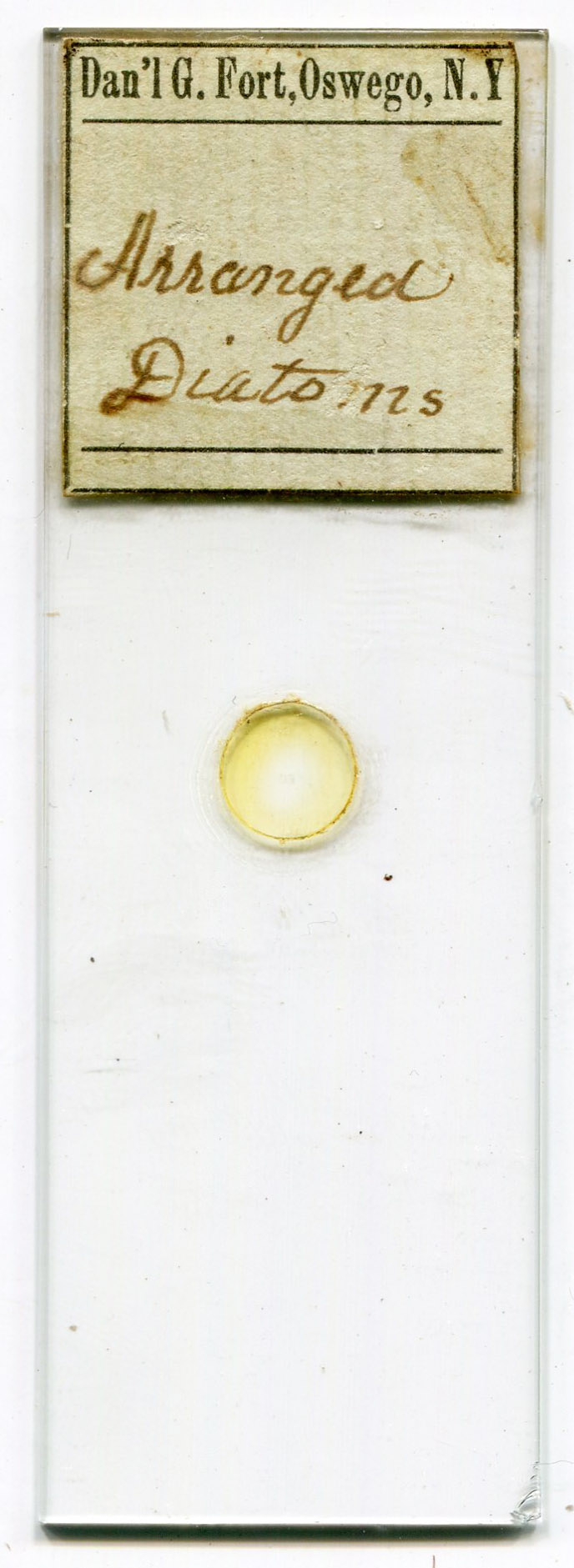
Figure 1. Microscope slide by Daniel G. Fort, ca. 1881.
Daniel Garrit Fort, 1827 - 1884
by Brian Stevenson
last updated April, 2026
Daniel G. Fort was a banker and businessman in Oswego, New York, USA. He served as Mayor of that city in the early 1860s, and represented the region in the State Assembly during the 1870s.
He was a founding Vice President of the Central New York Microscopical Club, in 1880. He was especially interested in diatoms, and advertised to exchange his prepared slides for raw diatomaceous materials. His known mounts are of good quality, with custom-printed labels.
Figure 1.
Microscope slide by Daniel G. Fort, ca. 1881.
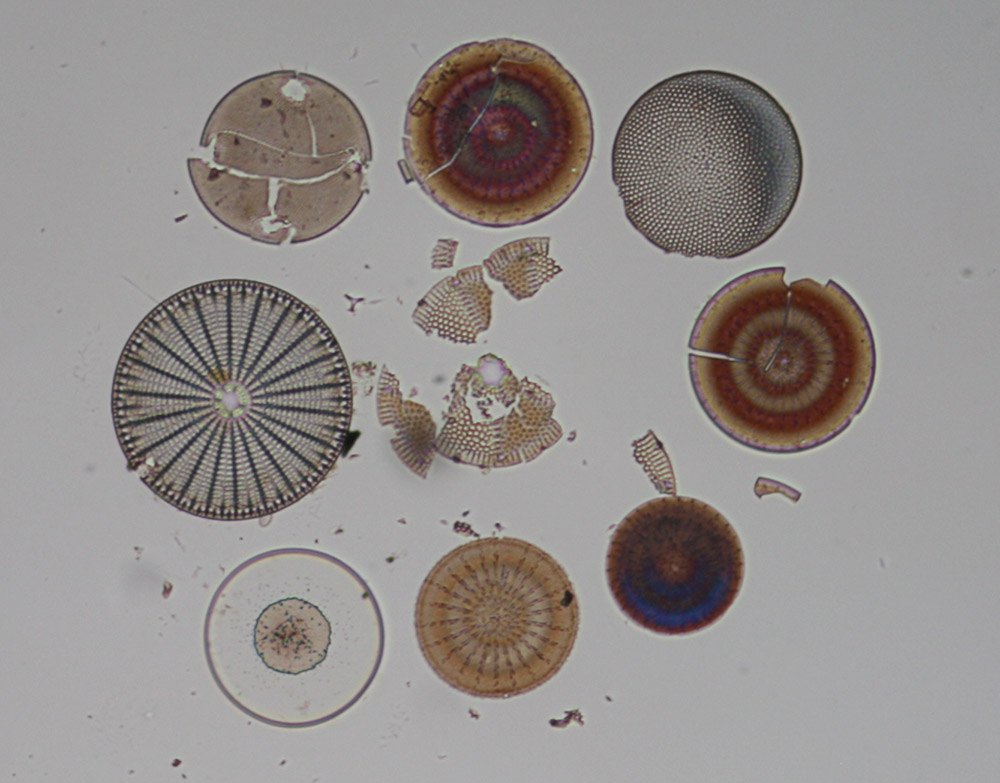
Figure 2.
“Arranged diatoms”, by Daniel G. Fort (see Figure 1). The broken diatom frustules degraded and drifted after mounting, as is evident from presence of all the fragments. Imaged with a 10x objective lens and C-mounted digital SLR camera on a Leitz Ortholux II microscope.
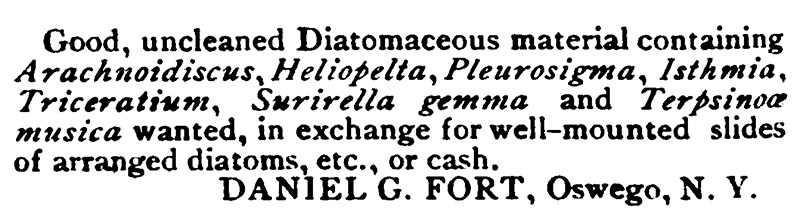
Figure 3.
Daniel Fort advertised to exchange his “well-mounted slides of arranged diatoms” for raw material, during 1881 and 1882. From “The American Monthly Microscopical Journal”, 1882.
Daniel Garrit Fort was born on January 27, 1827, in Clifton Park, near Albany in eastern New York state. He was a son of Garrit and Anna Maria (nee Mors) Fort. The father was a farmer. When Daniel was still a child, the family moved west to the town of Fabius, near Syracuse.
He married Lorinda Clark on October 5, 1848. The couple had three children over the next twelve years.
Around 1855, Daniel and his family moved to Syracuse, with Daniel taking work as a salesman and accountant. A few years later, they moved to Oswego, on the shores of Lake Ontario. Fort worked at The Lake Ontario Bank, and became the institution’s Cashier in 1863.
Fort was elected Mayor of Oswego in 1862. “While Mayor he became acquainted with the working of the laws for the support of the poor of the city, and matured the plan which was subsequently adopted, under which the poor of the city are now supported. This system, non-partisan in operation, is unlike that of any other city in the State. … it has proved a great success in every respect, saving the tax payers of the city thousands of dollars annually, while the poor are more comfortable and better provided for than ever before. This system has been so successful in Oswego that no one now asks for its repeal, and other cities are looking into its features with a view to its adoption”. After his term as Mayor ended, Fort was elected to the city’s Board of Education.
A biographer wrote that “no man in his section of the State has been more active in promoting the success of the Republican party. A ready, popular and effective speaker, the opening of every campaign has been the signal for him to take the field in behalf of the principles and candidates of his party. During every political canvass during the past few years there is no speaker in his county whose services have been so frequently called for in every section, and during the late national political canvass his services were frequently called for by the State Republican Committee to address meetings in various parts of the State. These calls he has always responded to very acceptably to the people whenever his business duties would permit”.
In 1871, he was elected to the New York State Assembly. He was promptly assigned Chairmanship of the Committee on Canals, then membership on the Committee on Ways and Means “and other important committees”.
A wooden, two-masted schooner named “Daniel G. Fort” was launched in 1869, and based in Oswego. Those details imply that our microscopist was a significant owner of the ship. She carried grain and other goods around Lake Ontario. The ship was destroyed during a storm near Oswego harbor in 1894.
Fort was involved with other business enterprises, including the Boston and Oswego Railroad.
He was appointed Oswego port customs collector in 1877, serving through 1882.
In 1880, Fort was instrumental in founding the Central New York Microscopical Club in Syracuse, serving as the initial Vice President. The Oswego Microscopical Society was founded the following year, and it can be assumed that Fort was a member of this local club.
His interest in microscopical investigation of diatoms was shown by an 1881 letter to The American Journal of Microscopy, on a “new test-plate of diatoms” that was made by H.C. Maine, of Rochester, New York. Later that year, and into 1882, Fort published advertisements to exchange his microscope slides for unmounted diatomaceous materials (Figure 3).
“Early in October, 1884, Daniel G. Fort died very suddenly while attending to business in Chicago”. Fort was only 57 years old. His death record states that he died from “apoplexy, cerebral” (i.e. a stroke). The record also stated his occupation as “electric lighting”, indicating yet another aspect to his diverse business interests.
Resources
The American Journal of Microscopy (1880) A microscopical society at Syracuse, page 93
The American Journal of Microscopy (1881) New microscopical society in Oswego, N.Y., page 128
The American Journal of Microscopy (1881) Exchange offers from Daniel G. Fort, multiple issues
The American Monthly Microscopical Journal (1882) Exchange offers from Daniel G. Fort, page 160
Biographical Sketches of the State Officers and Members of the Legislature of the State of New York (1873) Daniel G. Fort, page 202
Death record of Daniel G. Fort (1884) Cook County, Illinois, accessed through ancestry.com
Fort, Daniel G. (1881) A new test-plate, The American Journal of Microscopy, pages 15-16
Great Lakes Shipwreck Files (accessed April, 2026) Daniel G. Fort, https://greatlakesrex.wordpress.com/f/
Historical Sketches Relating to the First Quarter Century of the State Normal and Training School at Oswego, N.Y. (1888) Oliphant, Oswego, page 203
The Naturalist’s Directory (1883) “Fort, Daniel G., Oswego, Pond Life. C. Ex.”, page 42
Proceedings of the Boston & Oswego Railroad Convention (1871) pages 1-2
US census and other records, accessed through ancestry.com