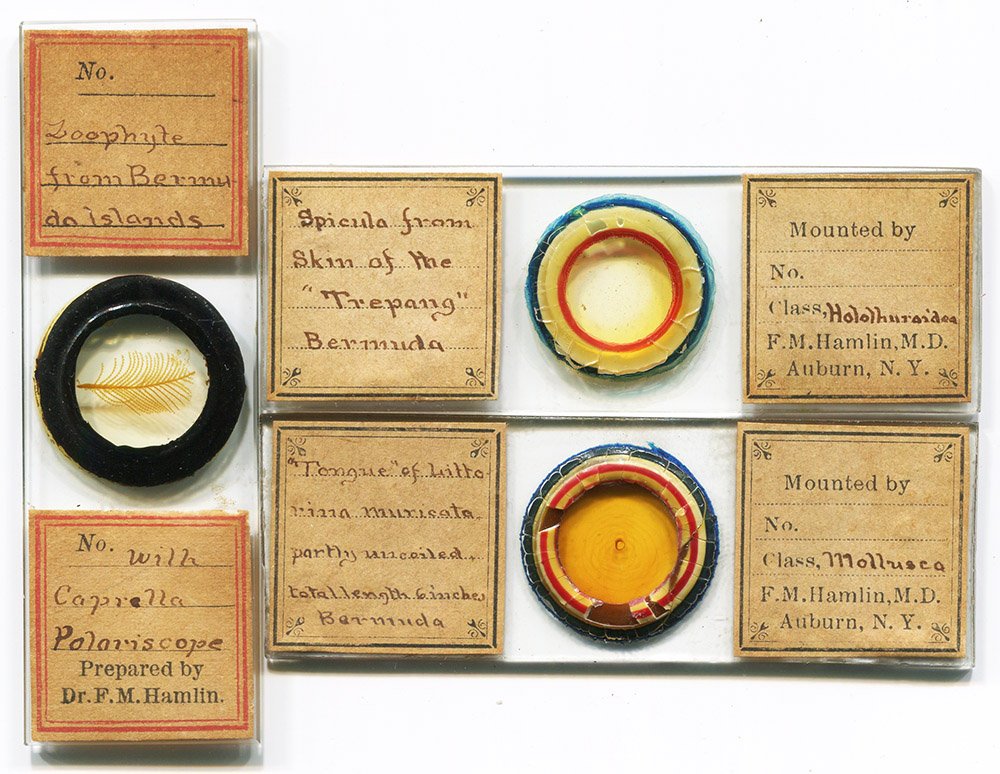
Figure 1. Figure 1. Microscope slides by Francis Hamlin, ca. 1870s-80s. All of specimens are aquatic animals from Bermuda.
Francis Marion Hamlin, 1841 - 1900
by Brian Stevenson
last updated January, 2026
F.M. Hamlin was a physician and skilled microscopist who lived in the Finger Lakes region of western New York. He suffered from tuberculosis for many decades, to the extent that he sought relief by spending several winters in Bermuda during the 1870s-80s. He became highly knowledgeable about the sea-life of Bermuda, wrote several articles on such topics, and prepared a substantial number of microscope slides with specimens from Bermuda (Figures 1 and 2). He appears to have ceased involvement with microscopy during the late 1880s, coinciding with a period of significant addiction to morphine and cocaine.
Figure 1.
Figure 1. Microscope slides by Francis Hamlin, ca. 1870s-80s. All of specimens are aquatic animals from Bermuda.
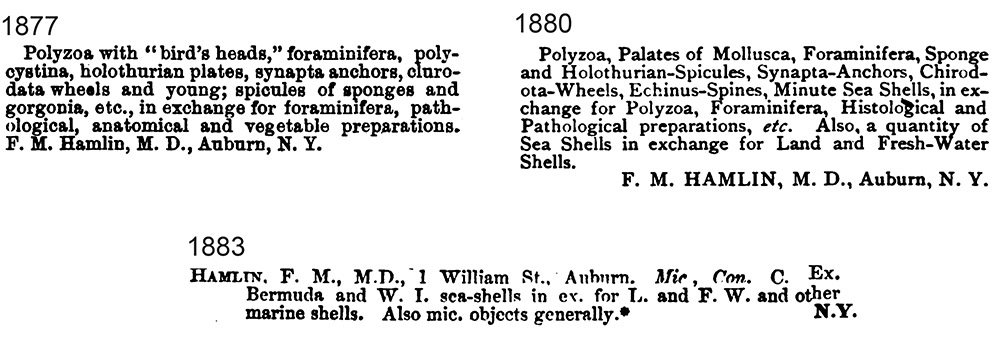
Figure 2.
Exchange offers that Hamlin published in microscopy magazines in 1877 and 1880, and his 1883 entry in “The Naturalists’ Directory”. All of these would put Hamlin in touch with other science enthusiasts throughout the world. The slides shown in Figure 1 were acquired as part of the collection of an early California microscopist, who probably received them from Hamlin in response to such advertisements.
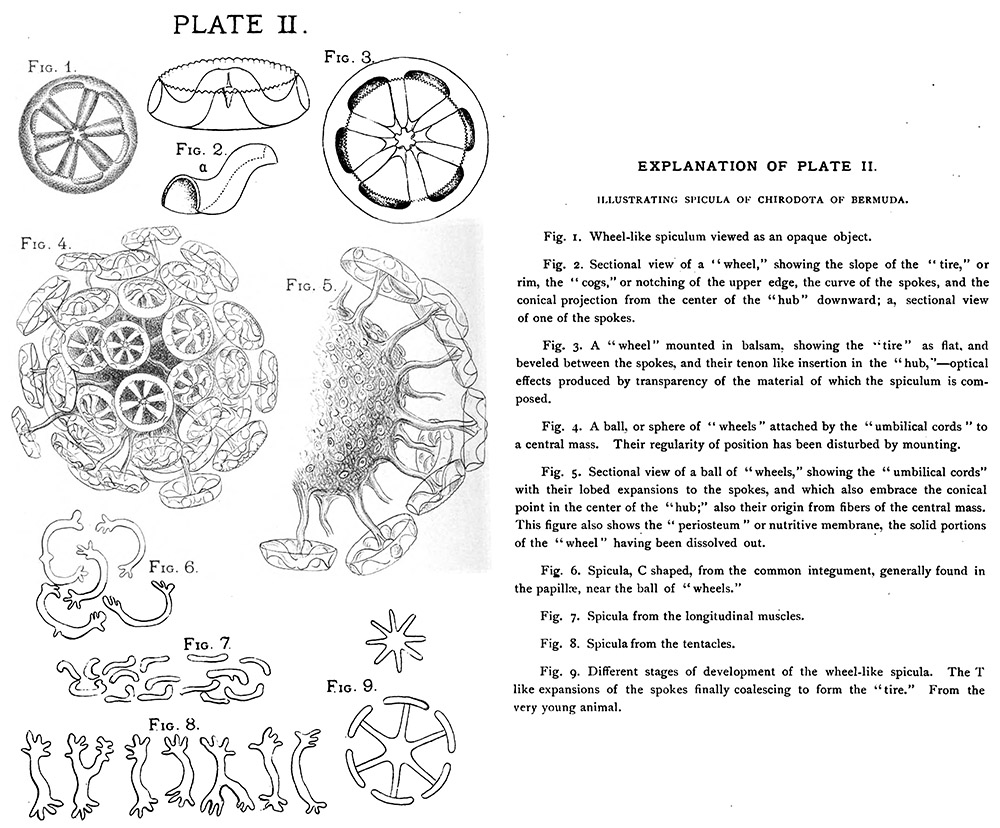
Figure 3.
Drawings by Francis Hamlin that accompanied his 1882 paper, “The wheel-like and other spicula of the Chirodota of Bermuda”, which described the calcareous structures in the skins of sea cucumbers (holothurians).
Francis Marion Hamlin was born on January 11, 1841 in Owasco, New York. He was the ninth of nine children of Seth and Ruth (nee McCoy) Hamlin. Father Seth was described as a farmer and a carpenter.
According to a memorial, Francis “attended the district school near his home, and soon mastered all that was taught there, and was sent to the academy at Red Creek, N.Y. After completing the course he taught in the school. In September, 1863, he entered the Fort Edward Institute, and graduated with honors in July, 1865.” (Fort Edward was a college preparatory school).
In the autumn of 1866, he began medical studies at Columbia College of Physicians and Surgeons, in New York City. However, “he applied himself with such diligence that his health failed before the close of the year and he returned home. He was never robust, and all his life suffered after mental over-exertion.” It is probable that this weakness was due to the tuberculosis that would eventually kill Francis.
He was able to continue studying with a physician near his home, and graduated from Albany Medical College in 1868.
From a memorial, “He did not confine himself to medical research only: he was an expert microscopist, naturalist and botanist.”
After graduating, Hamlin set up a medical practice in Union Springs, New York. He remained in that town until 1872. He presented a paper to the Central New York Medical Association in 1872 on “The thermometer in disease”, explaining the value of knowing a patient’s temperature. This was published in several medical journals.
Hamlin became very interested in mental and nervous diseases, and so took a position on the medical staff of the Government Hospital for the Insane, in Washington, D.C.
In 1877, Hamlin wrote a letter to
Hamlin encountered another American microscopist, C.C. Merriman, during this stay in Bermuda. Merriman later wrote, “In rambling about the island I happened one day to meet my friend, Dr. F.M. Hamlin, of Auburn, N.Y. He was in the outlet of Harrington Sound, in his high rubber boots, searching for the rare little bird's-head Polyzoa, the Avicularia. On the sides or the exposed under surfaces of rocks where some strong tide current runs almost continually, will sometimes be found these little animal clusters attached and growing like a tiny bunch of sea-weed. Later at his room we had some of these objects under the microscope while still living and disporting in their native element. I do not think I have ever seen a more interesting sight than they presented when magnified by a low power objective. Every branch of the shining white tuft was swaying and instinct with animal life. One above another on all sides of the stems were perched the little sea-anemones, with their vases of bright colored tentacles searching about in the water. Over the side of each polyp cup and about half-way down, was loosely attached a miniature condor's head, slowly nodding and at the same time snapping its enormous jaws with savage spitefulness.”
The ”bird’s-head Polyzoa” and other Bermudan specimens were advertised by Hamlin for exchange in 1877, after his return home (Figure 2).
Hamlin left the Washington, D.C. hospital in 1878, then established a medical practice in Auburn, New York. Mental complications, including drug addictions, were among his specialties.
Hamlin joined the American Society of Microscopists, attended and presented at their national meetings, and wrote several articles for the Society’s Proceedings (Figure 3). He also published articles in popular science journals, such as “How to make the new wax-cell” and “How to cut and grind glass slides”. Hamlin was a member of the American Postal Microscopical Club, contributing slides that were described as, “Orbitolites. A very neat mount showing various modifications of orbitolite structure from Bermuda. A good description accompanies the specimen”, and “Wheel-like spicula of Chirodota from Bermuda. A good description and figure accompanies this dry-mounted preparation. There is an unfortunate condensation of minute drops beneath the coverglass, which mars the original excellence of the mount.”
In 1883, Hamlin’s practice expanded to include “The Retreat” at his office/home, focusing on treatment of opiate addiction (Figure 4). This exposure to drug abuse and/or symptoms of tuberculosis led Hamlin to over-use them himself. The Retreat was shuttered in March, 1888, and Hamlin was committed to “the asylum at Utica, a victim to the morphine and cocaine habits” (Figure 5).
Hamlin returned to his practice in Auburn by 1890. A note in the 1895 Naturalists’ Directory indicated that they had not heard from Hamlin for over three years, and would drop him from further volumes. This implies that Francis Hamlin had substantially reduced his interest in microscopy by the late 1880s – early 1890s.
In the late-middle 1890s, Hamlin took charge of the school for patients at The Willard Asylum for the Insane, in Willard, New York.
Francis M. Hamlin died there on March 11, 1890, “of tuberculosis and chronic nephritis”.

Figure 4.
Advertisement for “The Retreat”, from “The Epitome of Medicine”, 1886.
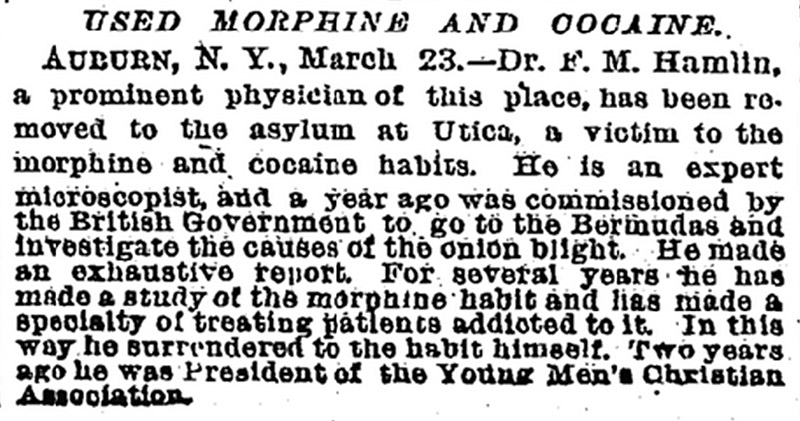
Figure 5.
News of Francis Hamlin’s commitment to “the asylum at Utica”, from “The New York Times”, 1888.
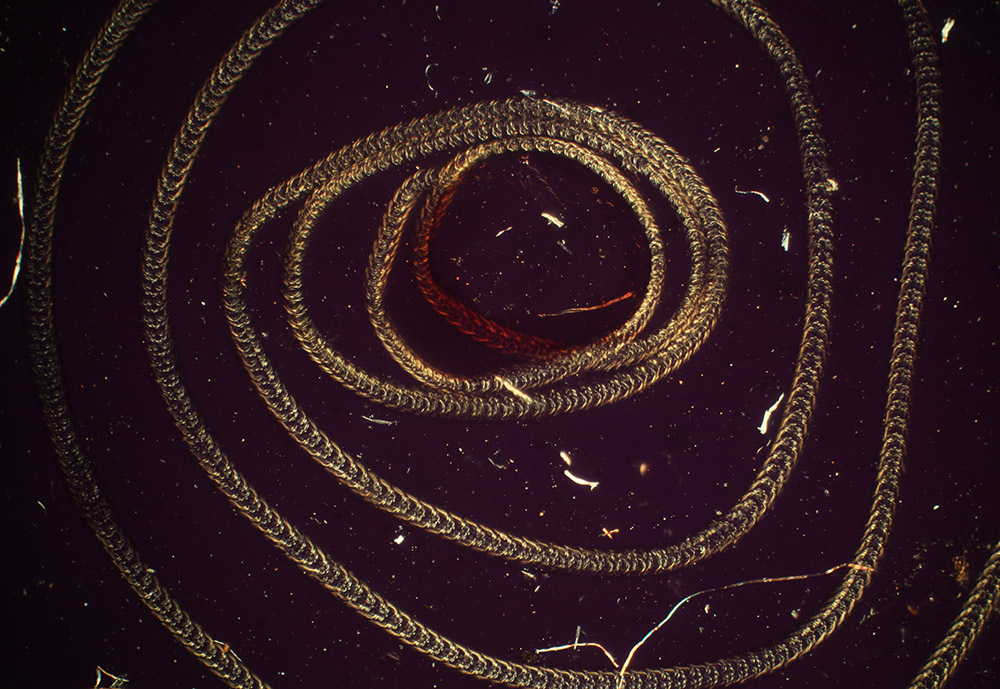
Figure 6.
“ ‘Tongue’ of Littorina muricata, partly uncoiled, total length 6 inches, Bermuda”, prepared ca. 1880 by Francis Hamlin (see Figure 1). Imaged with a 3.5x objective lens and C-mounted digital SLR camera on a Leitz Ortholux II microscope, between crossed polarizing filters.
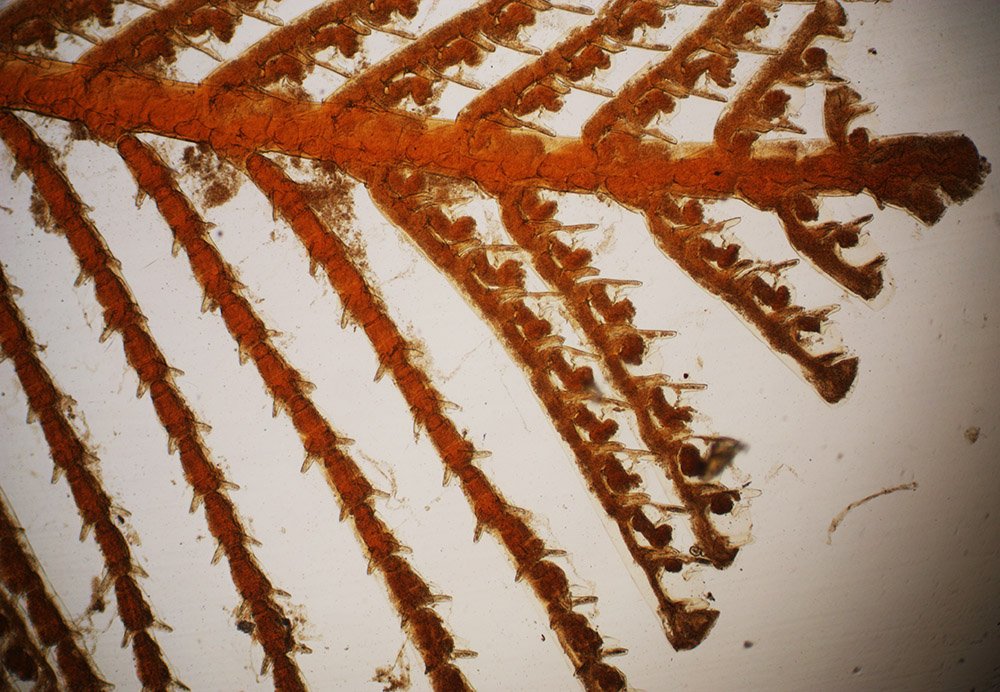
Figure 7.
“Zoophyte from Bermuda Islands”, prepared ca. 1880 by Francis Hamlin (see Figure 1). Imaged with a 3.5x objective lens and C-mounted digital SLR camera on a Leitz Ortholux II microscope, with transmitted and indirect lighting.
Resources
The American Journal of Microscopy (1877) Exchange offers from F.M. Hamlin, page 143 and others
The American Monthly Microscopical Journal (1880) Exchange offers from F.M. Hamlin, page 60 and others
The American Monthly Microscopical Journal (1884) Postal Club boxes, page 96
The American Monthly Microscopical Journal (1886) Postal Club boxes, pages 117-118
Anderson, Kenneth (2022) The Retreat – Auburn NY (1883-1888), Sanitariums, Hospitals, and the Belladonna Cure, Volume Three, The HAMS Harm Reduction Network, Inc, Philadelphia, pages 146-147
The Auburn City Directory (1887) Physicians and Surgeons, “Hamlin Francis M, 9 William”, A.P. Lamey, page 365
The Auburn City Directory (1890) Physicians and Surgeons, “Hamlin Frank M, office 66 North”, A.P. Lamey, page 160
The Bermuda Pocket Almanack, Guide and Directory (1890) “Dr. Hamlin spent also Summer of 1887 in Bermuda, on a visit from the United States”, page 136
Boyd’s Auburn Directory (1871) Union Springs, “Hamlin Francis M., physician, Cayuga opposite Howland School”, page 382
District of Columbia Directory (1875) "Hamlin Francis M. M.D. 2d asst physician Insane Asylum", page 251
The Epitome of Medicine (1886) Advertisement for The Retreat, advertising section
Hamlin, Francis M. (1872) The thermometer in disease, Buffalo Medical and Surgical Journal, Vol. 12, pages 41-49
Hamlin, Francis M. (1877) Bermuda earth, American Journal of Microscopy, pages 141-142
Hamlin, Francis, M. (1878) Balsam mounts, American Journal of Microscopy, pages 187-188
Hamlin, Francis M. (1880) How to make the new wax-cell, American Monthly Microscopical Journal, pages 46-47
Hamlin, Francis M. (1880) How to cut and grind glass slides, American Monthly Microscopical Journal, pages 61-63
Hamlin, Francis M. (1882) The wheel-like and other spicula of the Chirodota of Bermuda, Proceedings of the American Society of Microscopists, pages 139-148
Hamlin, Francis M. (1883) The microscopical examination of seminal stains on cloth, Proceedings of the American Society of Microscopists, pages 21-25
Hamlin, Francis M. (1883) The preparation and mounting of foraminifera, with description of a new slide for opaque objects, Proceedings of the American Society of Microscopists, pages 65-68
Hamlin, Francis M. (1884) The ideal slide, Proceedings of the American Society of Microscopists, pages 179-180
Hamlin, Francis M. (1901) Schools for the Insane, The American Journal of Insanity, Vol. 58, pages 141-150 (includes a memorial to Hamlin)
Lamey’s Auburn Directory (1882) “Hamlin Francis M., physician and surgeon, office and res 1 William, office hours 8 to 9 A.M., 1 to 3 and 6 to 8 P.M.”, page 134
<>Merriman, C.C. (1885) The microscopist in Bermuda, Lectures, Essays and Published Articles on Scientific and Literary Subjects and on Foreign Travel, Merriman, Rochester, N.Y., pages 115-130The Naturalists’ Directory (1878) “Hamlin, F.M., M.D., Auburn, N.Y. Ferns, Diatoms, Micros., Sponges. Coll. Ex.”, Cassino, Boston, page 50
The Naturalists’ Directory (1880) “Hamlin, F.M., M.D., 1 William St., Auburn. Mic., Con. C. Ex. Bermuda and W.I. sea-shells in ex. for L. and F.W. and other marine shells. Also mic. objects generally”, Cassino, Boston, page 72
The Naturalists’ Directory (1888) “Hamlin, F.M., M.D., 9 William St., Auburn, N.Y.. Mic., Con. C. Ex. Bermuda and W.I. sea-shells in ex. for L. and F.W. and other marine shells. Also mic. objects generally”, Cassino, Boston, page 68
The Naturalists’ Directory (1890) “Hamlin, F.M., M.D., 9 William St., Auburn, N.Y.. Mic., Con. C. Ex. Bermuda and W.I. sea-shells in ex. for L. and F.W. and other marine shells. Also mic. objects generally”, Cassino, Boston, page 74
The Naturalists’ Directory (1895) “Hamlin, F.M., M.D., Auburn, N.Y. Con.?”, Cassino, Boston, page 81
The New York Times (1888) Used morphine and cocaine, March 24, page 3
Proceedings of the American Society of Microscopists (1884) Exhibits by F.M. Hamlin: “Mounting opaque objects in Hamlin’s wooden cells… Mounting in liquids, solution of chloral, carbolic acid, etc… Crouch’s Premier Binocular, wheel-like spicules of Chirodota”, pages 200 and 241
Register of Officers and Agents, Civil, Military, and Naval, in the Service of the United States (1873) Interior Department, Government Hospital for the Insane, “Francis M. Hamlin, 2d ass’t physician”, page 335
Register of Officers and Agents, Civil, Military, and Naval, in the Service of the United States (1875) Interior Department, Government Hospital for the Insane, “Francis M. Hamlin, 2d ass’t physician”, page 375
US census and other records, accessed through ancestry.com