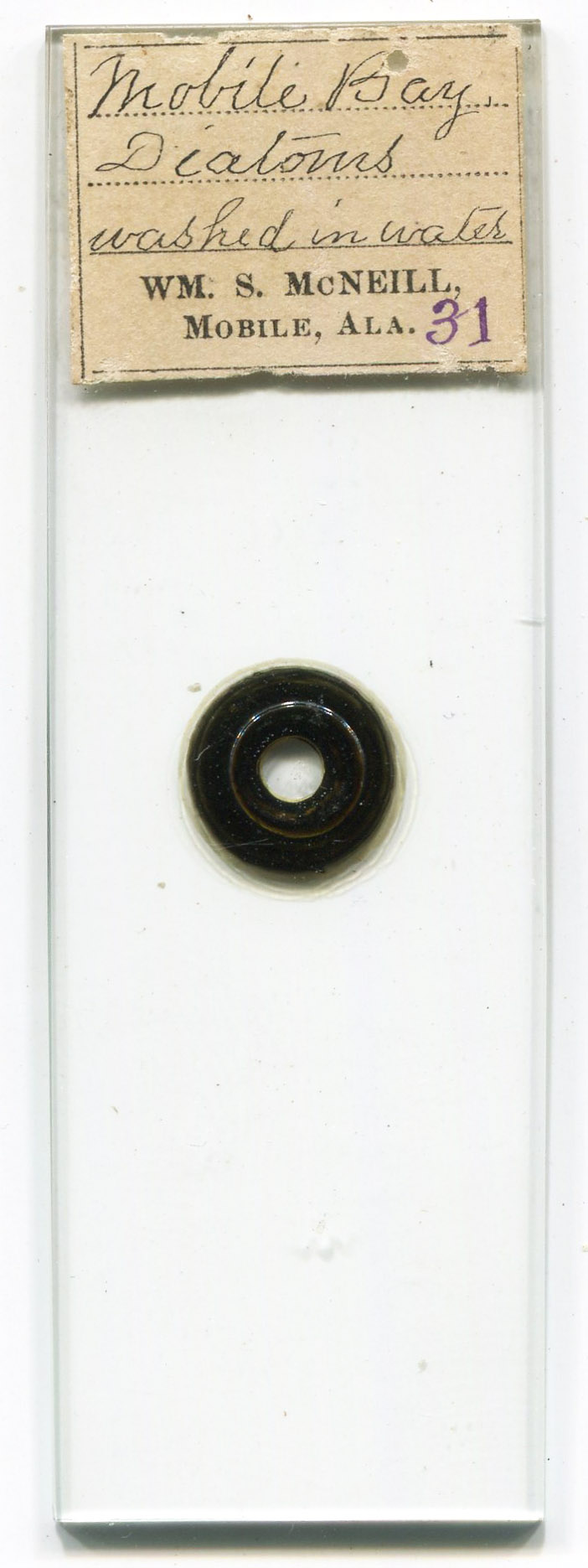
Figure 1. Selected diatoms from Mobile Bay, Alabama, “washed in water” and mounted ca. 1880s by William S. McNeill.
William Stoddard McNeill, 1838 - 1914
by Brian Stevenson
last updated October, 2025
William S. McNeill, of Mobile, Alabama, USA, was an active microscopist during the 1880s. He was particularly interested in the diatoms of Mobile Bay and other locations along the Gulf of Mexico, and shared his gatherings with other amateurs throughout the country. McNeill was also known as an advocate for “water washing” diatoms, in which fresh samples are washed repeatedly with water, but not acid, thereby removing debris without disturbing the organic matter of the diatom.
Figure 1.
Selected diatoms from Mobile Bay, Alabama, “washed in water” and mounted ca. 1880s by William S. McNeill.
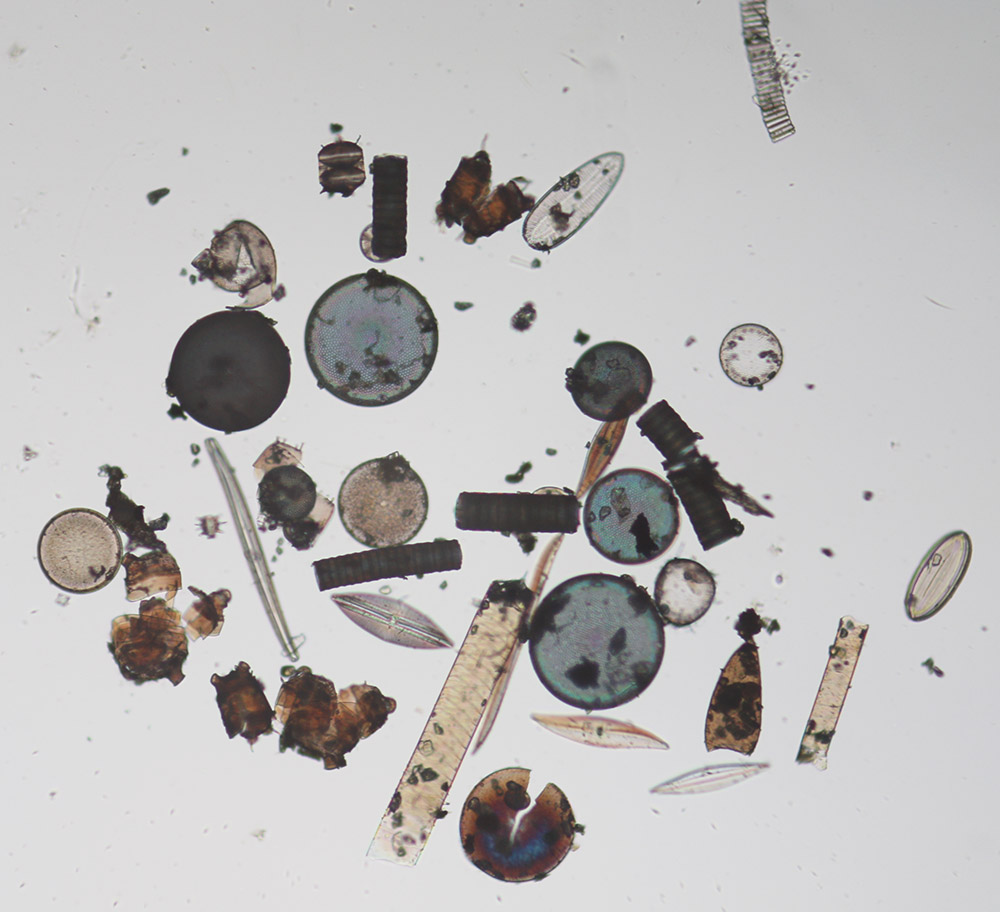
Figure 2.
Loosely-arranged selection of diatom species from Mobile Bay, prepared by W.S. McNeill (see Figure 1). A mud sample was repeatedly washed with fresh water over a period of several days, to remove soil and other debris but leave the diatoms intact. Imaged with a 10x objective lens and C-mounted digital SLR camera on a Leitz Ortholux II microscope.
William Stoddard McNeill was raised in the deep south of the USA, and fought for the Confederacy during the American Civil War (1861-1865). Emotions from the War and Reconstruction probably explain why McNeill’s origins were obscured for many years after the war ended. He claimed to be an Alabama native, although he was actually born in New York, and was therefore a “Yankee”.
How McNeill came to be born in New York is a mystery. His father, Daniel McNeill, was originally from either Scotland or Ireland, and settled in Mobile, Alabama. He became relatively wealthy through retail and insurance businesses. He married his first wife, Juliette Stoddard, in Mobile in 1838. Evidently, Juliette went to New York afterward, and there delivered their only child, William Stoddard McNeill, on January 31, 1839. Juliette died in 1845, and Daniel remarried in 1847. National census records from 1850 and 1860 record William’s birthplace as New York. He was working as a “clerk” in 1860.
Civil War broke out in April, 1861. William McNeill promptly joined the Confederate Army, as a Corporal in the Mobile Cadets, Third Alabama Infantry. Military records state that this position “continued until January 1862 when he was made a 1st Lieutenant, 1st Artillery Battalion at Fort Morgan, Alabama. After the fall of Fort Morgan, he commanded a company in the 21st Alabama Regiment at Spanish Fort, Alabama”. A later report referred to McNeill as “Captain”, suggesting that he received a brevet promotion at some point during the war. He was wounded “slightly in arm” at the Battle of Seven Pines (May 31 to June 1, 1862, in Virginia), and received a concussion from a “shell bursting on log by his head” at the Battle of Spanish Fort (March 27 to April 8, 1865, near Mobile). His widow’s 1917 application for a pension stated that McNeill served “from the very first, to the very last”, and “never left (the Confederacy) till it went down”. For the 1870 and 1880 national censuses, William McNeill claimed to have been born in Alabama. An 1873 history of the Stoddard family also gave his birthplace as Alabama.
William married during the war, to Laura Sibley, on March 8, 1864, in Mobile. They eventually had six children, five of whom lived to adulthood.
After the war, William worked as a clerk with Factor’s Press in Mobile, a business that tightly compressed cotton bales before they were loaded onto ships for export. Through the later 1870s, he worked as a “book keeper” for Dobson Brothers. By 1880, he was Secretary to the Mobile City Commissioners.
McNeill apparently became interested in diatoms during the late 1870s, along with two friends, Kevin M. Cunningham (1841-1911) and George H. Taylor (1842-1909). According to a report by Jacob D. Cox, “Scientific students, and especially those who are interested in the investigation of the diatoms, will, we are sure, take pleasure in the narrative of the work done by a trio of enthusiastic students in Mobile... Neither of them is a professional botanist, all have other employments to which their ordinary working hours must be given, yet they have laid the students of the diatoms under such obligation to them that a recognition of the value of labors such as theirs is no more than their just due. The last named of these gentlemen is a surgeon dentist; Captain McNeill, formerly of the Confederate army, is the recent commissioner of Alabama to the New Orleans Exposition, and Mr. Cunningham is engaged in railway business. In the summer of 1878 Mr. Cunningham accidentally became acquainted with Prof. Bailey's papers upon the Atlantic and Gulf diatoms in the Smithsonian Contributions, and a zeal for research was thus awakened. He began a somewhat systematic examination of the region about Mobile for crude diatomaceous material, both fossil and recent, and by exchanges collected a largely extended variety of material for work. He also made some investigation of the mud of Mobile harbor, but his first gatherings were not promising. After a time, however, his patience was rewarded by the arrival of a vessel from Tampa bay, and upon its chain cables a considerable quantity of the Tampa bay mud was found. Joined at this time by Captain McNeill, both supplied themselves with the material, and Captain McNeill especially applied himself to the task of cleaning it and of studying the best methods of treating it. To this he devoted great patience and labor, with ultimate complete success”.
By 1885, “These Mobile investigators have pushed their examinations east and west along the Gulf coast. Their Pensacola material was communicated to Mr. Peticolas, of Richmond, and is put by him within the reach of students generally. They early shared their treasures with numerous naturalists of the country, among others with Mr. Mallory, of Utica, and Mr. Van Brunt, of New York… During the present season (Taylor) has cleaned a considerable quantity of new material, and has generously arranged to put it in the hands of Mr. Vorce to add to the interest of the 'working session' of the American Society of Microscopists at the Cleveland meeting, and to supply members with samples.”
The trio, and Taylor especially, cleaned many of their diatom gatherings with water only, rather than the acids that are more commonly used to clean diatom frustules. Cox noted that “No real student of the Diatomaceæ will fail to see that in this condition it is material of the greatest use and most profitable examination. Frustules are whole, filaments are complete, the tissues soluble in or destroyed by acids are left intact.” Figure 2 (above) shows a group of diatoms that were “water washed” by McNeill.
In 1883, McNeill and colleagues organized a microscope exhibition in Mobile, described in The Microscopical Bulletin and Optician's Circular: “One of our correspondents informs us that on the 15th of January an exhibition was given (at the Mobile Library Rooms) to the patrons of the Library, at which thirty microscopes were xhibited and the display conducteed by Mr. K.M. Cunningham, Mr. W.S. McNeill, and Dr. A.P. Hall. The attendance was very large and the rooms crowded with the best people of the city, the entertainment being the first of the kind ever given there. We hope soon to hear of the establishment of a live microscopical society in Mobile.”
Also in 1883, Charles Stodder wrote about gatherings of diatoms that he had received from William McNeill, “A few weeks ago, I received a small quantity of diatoms (from Tampa Bay) from Mr. W.S. McNeil, of Mobile, from a depth of eight fathoms… Since commencing this investigation I have received from Mr. McNeil, specimens of diatoms from Pensacola and Mobile Bays, and expected to add the investigation of them to this paper; but I find the Pensacola, while containing most of the Tampa Bay species, has also many others that I need more authorities for consultation, and more time for their study.”
In an 1885 paper on the diatoms of Mobile Bay, J.D. Cox listed Actinoptychus trifoliatus, which he described as a “new species described by Mr. W.S. McNeill of Mobile, I have found in the Richmond and Petersburg fossil deposits, and have been informed by Mr. C.L. Peticolas, of Richmond, that he has found and noted it in the same earth. Mr. McNeill describes and figures it as follows: Disc considerably convex, with three depressions, broadly heart-shaped, shallow, like a broad trefoil; opposite each of the narrower ridges separating the trefoil leaves is a spine within the rim of the disc. Aerolation sub-hexagonal or irregularly reticulate with finer system of regular punctæ, similar to that of the more finely marked Actinoptychus areolatus, Ehr. Hoop hyalinethe trefoil leaves not bounded by sharp depression, but passing into the intervening ridges by very gradual curve.” The species name does not appear to have been retained.
In that time, an excellent way for amateur scientists to become acquainted with each other and to share ideas and resources was to be included in The Naturalists’ Directory (also known as The International Scientist’s Directory and other variations). The 1884, 1886, and 1888 editions included “McNeill, Wm. S., Mobile, Ala. Mic., Diatoms, especially cleaning and mounting marine soundings. C. Ex.”. The final abbreviations indicate that McNeill was interested in collecting and exchanging materials. McNeill did not appear in the 1890 or later editions, suggesting that he had lost interest in that level of microscopical studies.
McNeill began working for the U.S. Department of Interior engineering division. He was listed as a “clerk” in 1889, and “draftsman” in later records. Those government records reported William McNeill’s birthplace as New York. He reclaimed his birth state in the 1900 and 1910 national censuses.
William McNeill died on March 14, 1914, in Mobile.
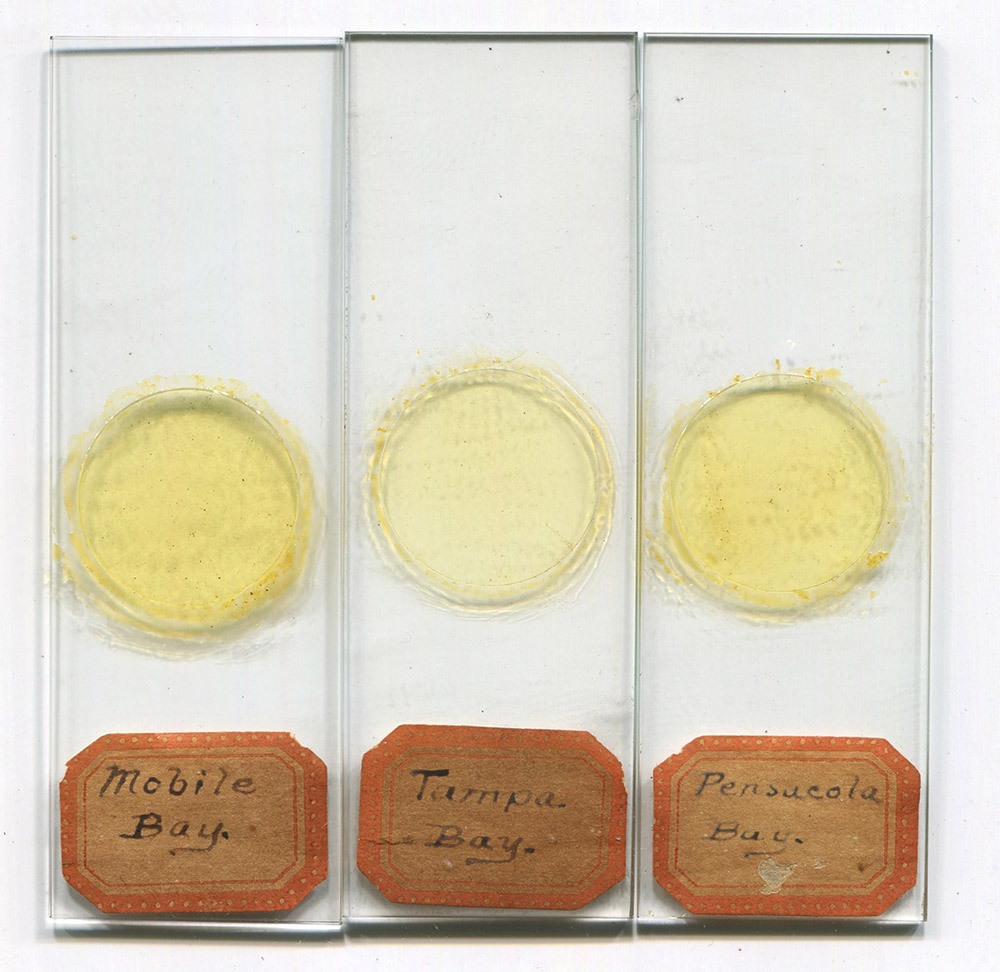
Figure 3.
Three microscope slides by an unknown mounter of diatoms from Mobile Bay, Tampa, Bay, and Pensacola Bay. The sites of collection, and construction consistent with the late 1800s, suggests that the specimens were collected by William McNeill and/or his colleagues George Taylor and Kevin Cunningham. They distributed their gatherings to microscopists throughout the US. For additional insights on these slides, please see: https://diatomimaging.com/pensacola-bay-strew-unknown-maker/.
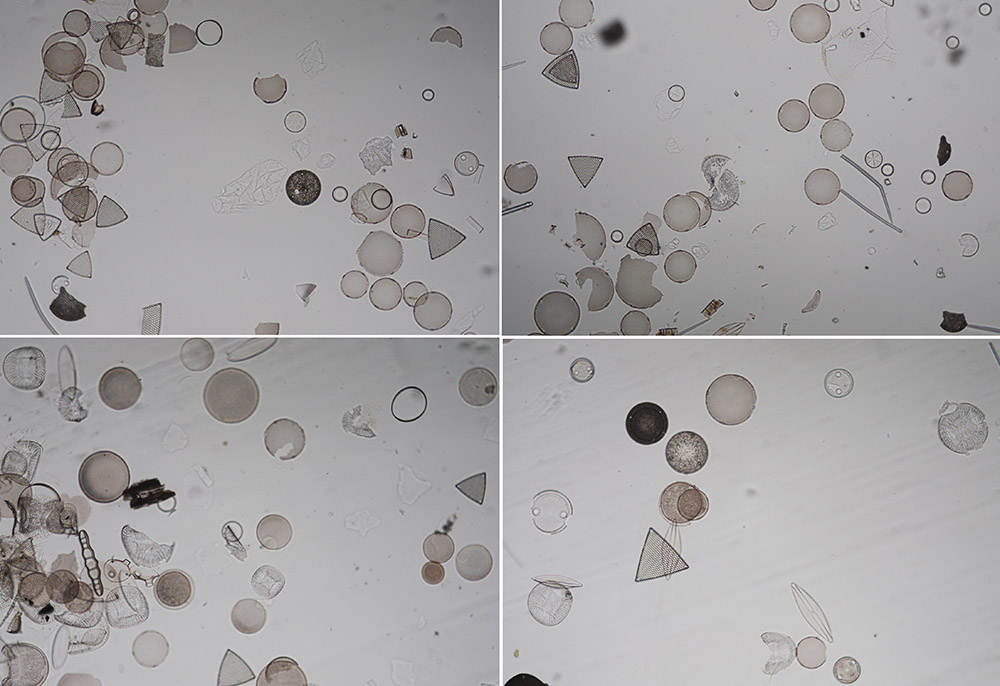
Figure 4.
Images of diatoms from Mobile Bay, Tampa, Bay, and Pensacola Bay (see Figure 3). Images with a 10x objective lens and C-mounted digital SLR camera on a Leitz Ortholux II microscope.
Acknowledgement
Thank you to Jonathan Crowther for helpful discussions.
Resources
Burnett, Lonnie A. (2008) Henry Hotze, Confederate Propagandist, University of Alabama Press, Tuscaloosa, page 221
Christian, Thomas (1891) Water-washed diatoms, The American Monthly Microscopical Journal, Vol. 12, page 58
Cox, J.D. (1885) Diatoms of the Gulf, The American Monthly Microscopical Journal, Vol. 6, pages 145-147
Cox, J.D. (1885) List of Mobile Bay diatoms, Transactions of the American Microscopical Society, pages 210-211
Cunningham, K.M. (1889) The diatoms of Mobile, Alabama, The Microscope, pages 105-108
Gravestone of William S. McNeill (information accessed October, 2025) https://www.findagrave.com/memorial/179892893/william-stoddard-mcneill
Hamilton, Peter J. (1913) Mobile of the Five Flags, Gill, Mobile, page 270
Microscopical Bulletin and Optician's Circular (1883) Microscopy in Mobile, Ala., page 9
Mobile, Alabama City Directory (1870) “McNeill William S. clerk Factors’s press, res se cor Church and Conception”, page 115
Mobile, Alabama City Directory (1872) “McNeill William S. book-keeper, res 53 Church”, page 137
Mobile, Alabama City Directory (1873) “McNeill Daniel, (Daniel McNeill & Co.) and President Gulf City Ins. Co., re se cor Curch and Conception; McNeill Daniel & Co. (Daniel McNeill and Henry Barnewall) commission merchants, 40 St. Michael; … McNeill William S. res nw cor Ann and Spring Hill Sheel road”, page 127
Mobile, Alabama City Directory (1876) “McNeill William S. book-keeper Dobson Bros. res se corner Government and Stocking”, page 130
Mobile, Alabama City Directory (1882) “McNeill William S. secretary Commisioneers city Mobile, res sw cor Dauphin way and Ann”, page 172
Mobile, Alabama City Directory (1885) “McNeill William S. accountant, res se cor Conception and Monroe”, page 185
Mobile, Alabama City Directory (1891) “McNeill William S. draughtsman US Engineer corps, res 261 Monroe”, page 184
Mobile, Alabama City Directory (1899) “McNeill William S. draughtsman US Engr’s office, res 159 Church”, page 242
Mobile, Alabama City Directory (1901) “McNeill William S. chf draughtsman US Engrs Office, res 159 Church”, page 314
The Naturalists’ Directory (1884) “McNeill, Wm. S., Mobile, Ala. Mic., Diatoms, especially cleaning and mounting Marine Soundings. C. Ex.”, page 85
The Naturalists’ Directory (1886) “McNeill, Wm. S., Mobile, Ala. Mic., Diatoms, especially cleaning and mounting marine soundings. C. Ex.”, page 102
The Naturalists’ Directory (1888) “McNeill, Wm. S., Mobile, Ala. Mic., Diatoms, especially cleaning and mounting marine soundings. C. Ex.?”, page 102
Official Register of the United States (1889) Engineer Department at Large, Vol. 1, United States Department of the Interior, page 323
Stoddard, Elijah W. (1873) Anthony Stoddard of Boston, Mass: And His Descendants: 1639-1873, A Genealogy, Stoddard, New York
Stodder, Charles (1883) Notes on Diatomaceae from Tampa Bay, Florida, The American Monthly Microscopical Journal, Vol. 4, pages 30-33
Taylor, George H. (1885) Waterwashed diatoms, Transactions of the American Microscopical Society, pages 207-208
USA census, military, and other records, accessed through ancestry.com