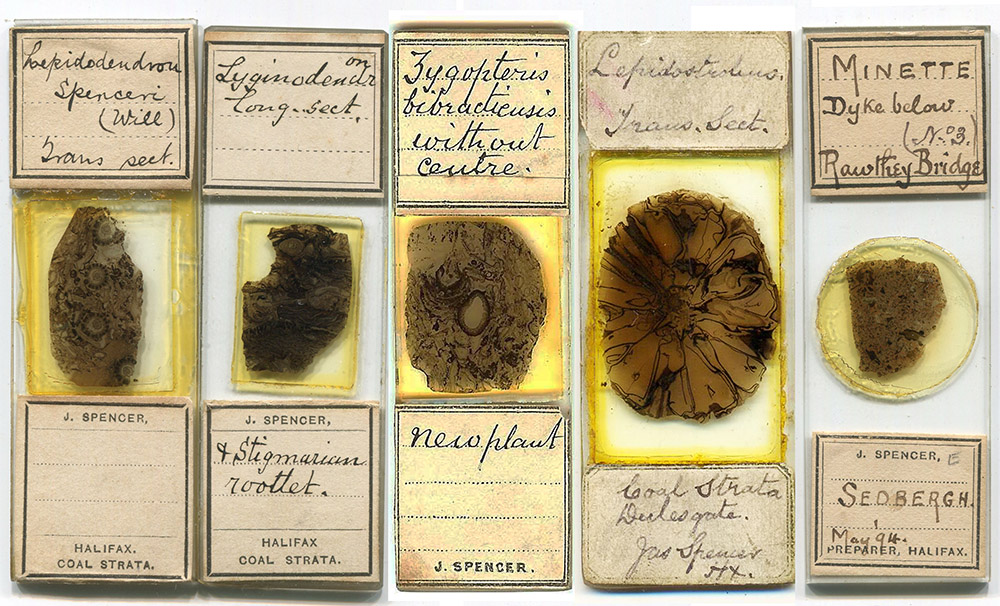
Figure 1. Microscope slides of coal fossils and a mineral, by James Spencer. The slide on the far right is dated May, 1894. From the author’s collection or adapted for nonprofit, educational purposes from an internet sale site.
James Spencer, 1834 - 1898
by Brian Stevenson and Robert Law
last updated July, 2026
An amateur geologist and microscopist, James Spencer prepared numerous slides of thin-sectioned coal fossils and other minerals that he collected from areas around his home of Halifax, Yorkshire. He was of humble origins, and went to work in a brick-making plant as a child, but availed himself of educational opportunities and became a renowned expert in Carboniferous fossils. A family, genus, and species of extinct trees was named after him.
Figure 1.
Microscope slides of coal fossils and a mineral, by James Spencer. The slide on the far right is dated May, 1894. From the author’s collection or adapted for nonprofit, educational purposes from an internet sale site.
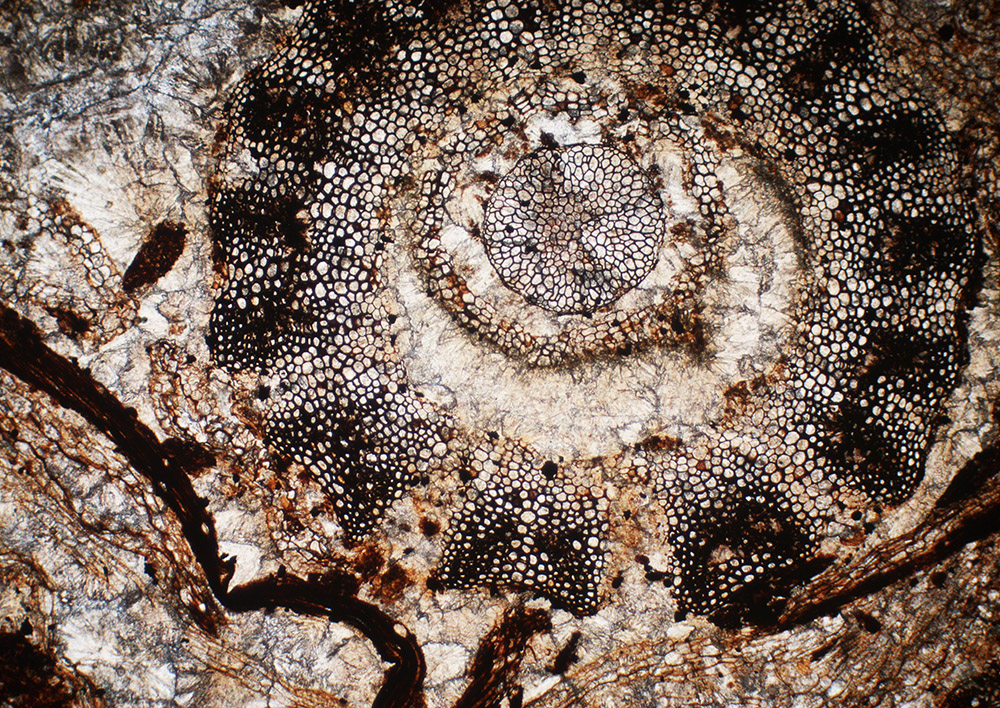
Figure 2.
A microscope slide of a coal fossil with monogram "J.S.". The upper label mentions "Binns", which undoubtedly refers to the Yorkshire quarryman and amateur paleontologist James Binns (1836-1904). The slide is in the collection of the Leeds City Museum Discovery Centre, with a coal mining provenance (the lower label bears recent handwritten notes from 2025). This information suggests that the "J.S." monogram is that of James Spencer, and that it was once in his own collection.
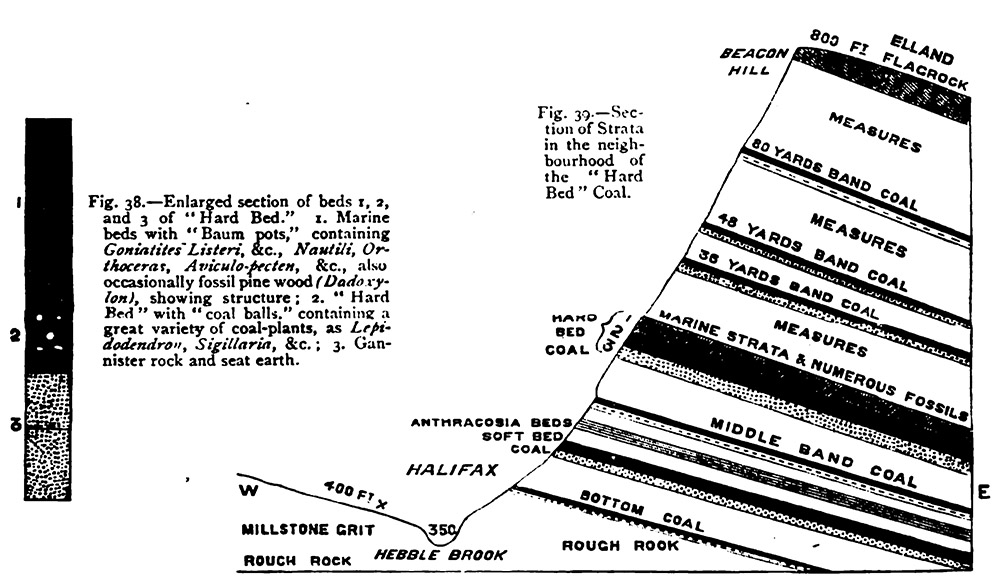
Figure 3.
Magnified view of a transverse section of Lepidodendron spenceri (see Figure 1). This extinct tree was named after James Spencer in 1878. Imaged with a 3.5x objective lens, transmitted light, and a C-mounted digital SLR camera on a Leitz Ortholux II microscope.
Robert Law, a geologist colleague and rockounding friend of Spencer’s, wrote the following memoriam (with minimal editing for clarity, indicated by parentheses). Law sums up James Spencer’s life far better than I could.
Of the many amateur geologist whom Yorkshire has produced, few have done more good work and contributed more to the sum of geological knowledge than Mr. James Spencer, of Halifax. He was born of humble parents at Luddenden in 1834, and soon after came to reside in Halifax.
Being poor, his parents were obliged to send him to work in Charlestown Brick Works at an early age, and his education became much neglected. His facilities for obtaining knowledge were at a discount until he joined the Working Men’s College at Haley Hill, Halifax, which about this time had been founded by the late Colonel Akroyd. Here he met Mr. J.W. David, Mr. Halliday, and others, and was soon after induced to join the evening classes and go in for most of the subjects taught at the college. After some years of diligent study, and by his indomitable perseverance, he not only succeeded in obtaining a general education, but successfully passed examinations in geology, chemistry, history, geography, and languages. His rapid progress in learning was noticed by Colonel Akroyd, who subsequently employed him in the warehouse of his mill, and some years after appointed him cashier at the works at Haley Hill. This post he held up to about ten years ago, when he retired (i.e. ca. 1889).
When a mere boy, and employed at the brickyard, he noticed the curious markings on the shale which the workmen dug from the pit, and on learning that these were called fossils, and that they were relics of extinct living things, young Spencer commenced to take an interest in them. As he grew up into manhood his love for geology became so great that he bought what books he could afford bearing on the subject and carefully studied them. He thus succeeded in obtaining a good, sound, theoretical knowledge of science. Not content with mere book-learning, he at the same time studied assiduously the rocks and fossils in the Carboniferous strata around Halifax.
By the year 1851 (17 years old) he had accumulated sufficient information to enable him to begin an independent and systematic investigation of the Millstone Grits and Coal Measures of his native district, and to make sections of the various exposures of the rocks. When his work in the mill was over, Mr. Spencer might be seen at his favourite pursuit either indoors or in the field, the weather seeming to have no effect in dampening his ardent spirit.
Wet or fine, with hammer and bag, he would start on his rambles each Saturday afternoon and trudge for miles over hill and dale, studying the rocks and collecting fossils along his way, and would often come home late at night cold, hungry, and wet, carrying a heavy load of stones as the results of his toilsome journey. His winter nights were mostly spent at home, labelling and classifying his specimens of rocks and fossils. His holidays were mostly spent in excursions to other districts in order to study the various geological formations.
Besides all this, he seems to have found ample time to write papers and read them before local and other societies, most of them being descriptions of his own work. He also contributed articles on geological subjects to monthly magazines and other periodicals, notably a twopenny monthly paper entitled the Circulator, which was commenced in 1866 by the Haley Hill Literary and Scientific Society. The Circulator, though short-lived, contained several interesting and valuable articles of geology by Mr. Jas. Spencer. The first two numbers contain an introduction to “Popular Geology”. After this came two papers on the strata of Halifax. Other articles are on the coal pits at Low Moor and the geology of Ingleborough. We next find Mr. Spencer contributing papers to the Manchester Geological Society and the Yorkshire Naturalist on the stratigraphical geology of the Millstone Grits and Coal Measures in and around Halifax.
Mr. Spencer was an active member of the Halifax Scientific Society from its commencement until his death, and served as Vice-President. He was also for many years a member of the Ovenden Naturalists’ Society and the Yorkshire Naturalists’ Union. At the latter society he was on the General Committee, also on the Boulder Committee, and in 1896 was elected Chairman of the Yorkshire Fossil Flora Committee.
The favourite haunts of his study of geology were the coal pits at Low Moor and at Clifton, near Brighouse, also at Beacon Hill and in the valley of Shibden. High Green Wood and Horse Bridge Clough, above Hebden Bridge, were often visited by Mr. Spencer when investigating and collecting fossils from the Yoredale rocks. The number of happy hours he spent here in company with Mr. Ashworth, of Hebden Bridge, the late Captain Aitkin, of Bacup, and the Author, might be attested, if need be, by the collection of fossils from this locality, of which he was always proud.
About 1871 Mr. Spencer became especially interested in the study of the structure of fossil plants which occur in nodules derived from the Halifax Hard Bed Coal. At first he found this kind of work very difficult to perform, as he had to break the petrified stems of plants out of the hard nodules, then chip thin pieces off with a chisel, then rub them down on the sink-stone until they were so thin that light would shine through them. Then they had to be polished and mounted on glass with Canada balsam before the structure could be seen to advantage with a microscope. By this primitive and laborious method of preparing microscopic slides of fossil wood, Mr. Spencer worked disadvantageously for some time.
At length he fortunately met with Mr. John Butterworth, of Shaw, near Oldham, who was an adept at this kind of work, having been for several years engaged in preparing and studying microscopic slides from the coal-balls of Lancashire. This gentleman kindly and unhesitatingly agreed to show him a more scientific and quicker method of preparing his slides, and he helped him to set up a machine for cutting and grinding. He also gave him instructions in the art of polishing, mounting, and preparing specimens for scientific use. (note: an essay on the life and works of John Butterworth, 1831-1900, can be seen elsewhere on this site)
Thus equipped, Mr. Spencer set to work with a determination to do something in the comparatively new field of research, and the success he achieved in that particular branch of science may easily be gleaned from the many hundreds of beautiful slides of Calamites, Lepidodendron, Sigillaria, Stigmaria, Fern Spores, Astromyelon, Dadoxylon, and other Coal Measure plants to be seen in his own cabinet, while a greater number have found their way into both private and public collections.
Mr. Spencer did not consider himself sufficiently versed in structural botany to be able to scientifically describe anything at first-hand, so that when he discovered any character in a fossil plant at all uncommon, however, insignificant, he sent it to Professor Williamson, F.R.S., of Owens College, Manchester, who described it in his memoirs and always gave ample credit to the finder (William Crawford Williamson, 1816-1895).
There can be no doubt that Mr. Spencer did good work and was the means whereby much was added to our knowledge of the Carboniferous Flora. The greatest find made by Mr. Spencer was at Bradshaw Pit, near Halifax, about eight years ago, where he came across a new species of club moss. This was described by Professor Williamson, who named it Lepidodendron spenceri, in honour of the discoverer. (note: L. spenceri was later determined to be the same plant as L. insignis, so named by Williamson some 10 years earlier, thereby invalidating the species name “spenceri”. However, H.D. Scott combined L. insignis/spenceri and another species, L. majusculus, into a new genus, Spencerites, in 1897-98. As far as I can tell, that genus name is still valid, and is within the family Spenceritaceae).
Mr. Spencer contributed a series of articles to Hardwicke’s Science-Gossip, which appeared from March, 1881, to July, 1883, entitled “Recreations in fossil botany.” They were based on his general work on the Carboniferous Flora, and were well illustrated. (see Figures 4 and 5, as examples of Spencer’s artwork).
At the York meeting of the British Association, in 1881, he read two papers. He has also read several papers before the Yorkshire Geological and Polytechnic Society. Mr. Spencer studied the “Glacial Drift” in the Calder Valley and read papers on this important work. He was for some time curator of the Halifax Museum.
He was continually adding to his collection of microscopic slides, and his love for geology was so deep-rooted that he pursued it to the end. His work was, however, unfortunately cut short just at a time when he had contemplated making a great improvement in cutting and grinding by adding a gas engine to his lathe. Contracting English cholera, he died at his residence, No. 8, Salisbury Place, Akroydon, after an illness of only three days, on July 9th, 1898, in the sixty-fifth year of his age. He was interred in the cemetery of All Souls, Akroydon.
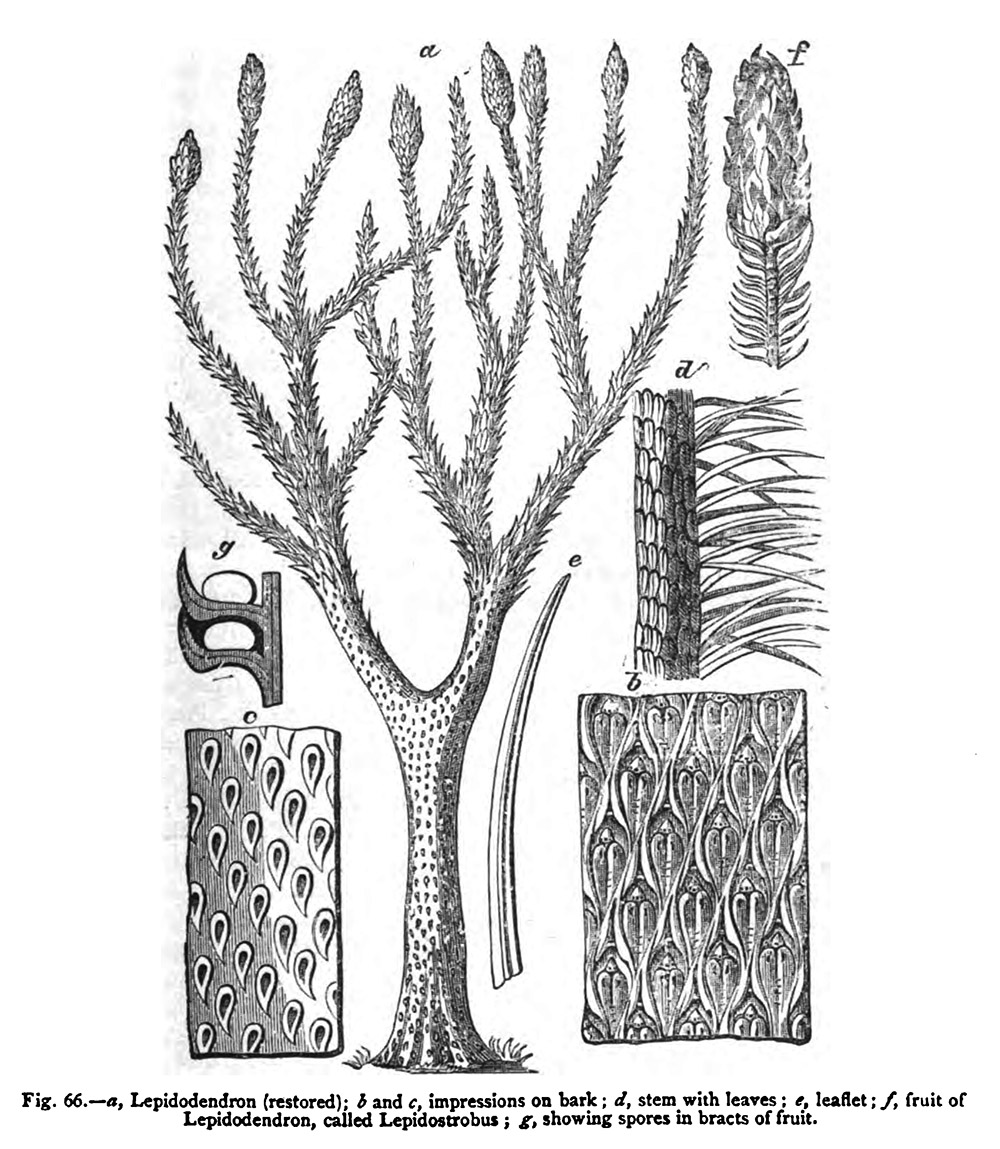
Figure 4.
Geological strata near Halifax, Yorkshire, as diagrammed by James Spencer in his 1881 publication “Recreations in fossil botany: The fossil flora of the Halifax hard-bed coal, no. 1” (from “Hardwicke’s Science-Gossip.”
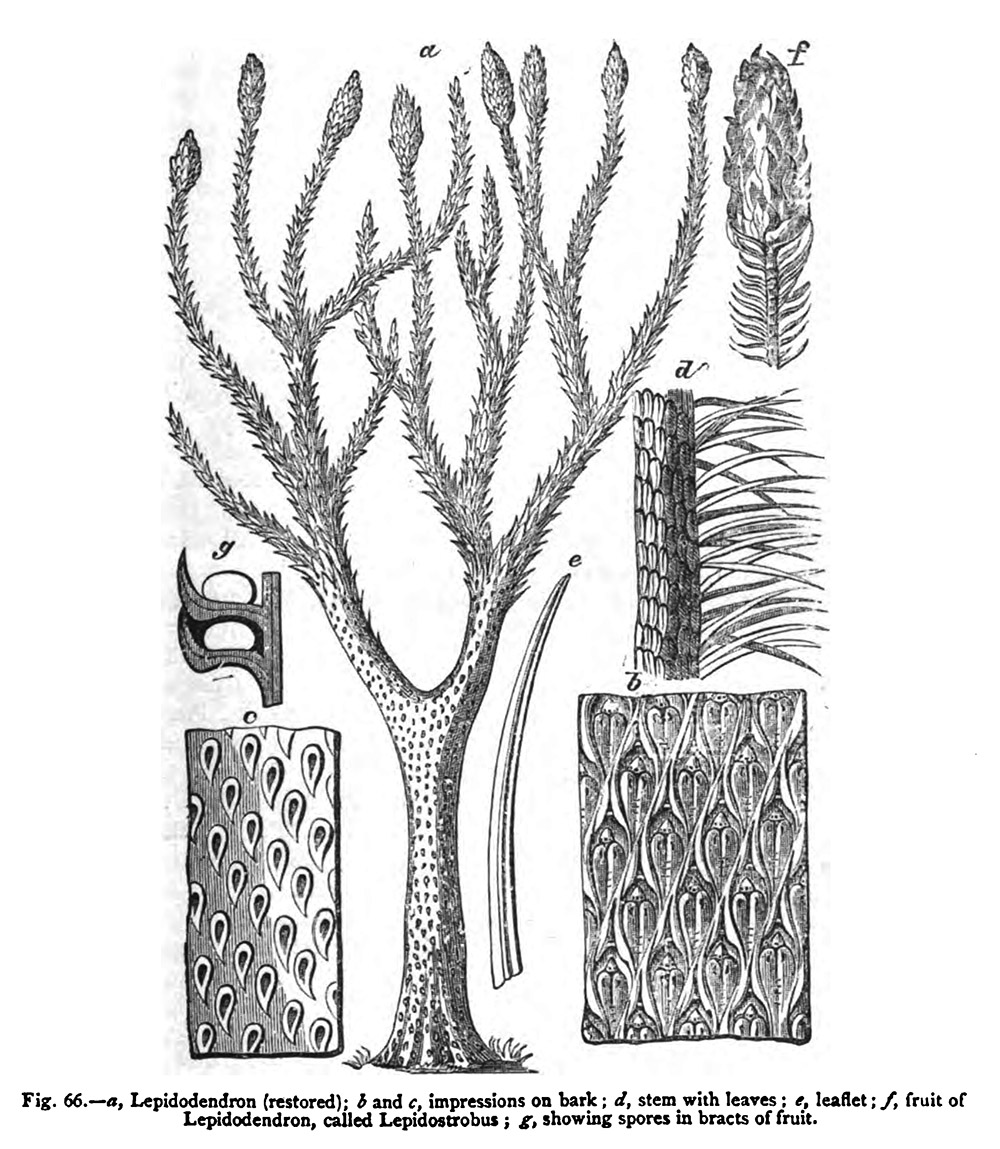
Figure 5.
Illustrations of Lepidodendron spp. trees and tissues, by James Spencer. From his 1882 publication “Recreations in fossil botany: Lepidodendron, no. 3” (from “Hardwicke’s Science-Gossip.”
Acknowledgement
Thank you to Chris Wallage for sharing the picture of the "J.S." monogrammed slide and information on its provenance.
Resources
Baker, R.A. & Gill, D.S. (2018). Fossil hunting and grinding in the Coal Measures: William Cash (1843?1914), his associates, and their work on the fossil plants of the Carboniferous period, Journal of Natural Science Collections, Vol, 5, pages 89-97, https://www.natsca.org/sites/default/files/publications/JoNSC-Vol5-BakerGill2018.pdf
Bracegirdle, Brian (1898) Microscopical Mounts and Mounters, Quekett Microscopical Club, London, pages 87 and 170, Plate 33-Q
Law, Robert (1899) In memoriam: James Spencer, Proceedings of the Yorkshire Geological and Polytechnical Society, pages 473-476
Scott, Henry D. (1897) On the structure and affinities of fossil plants from the palæozoic rocks.— II. On spencerites, a new genus of lycopodiaceous cones from the coal measures, founded on the lepidodendron spenceri of Williamson, Philosophical Transactions of the Royal Society of London, B, Vol. 189, pages 83-106
Scott, Henry D. (1898) On the structure and affinities of fossil plants from the palæozoic rocks. II. On spencerites, a new genus of lycopodiaceous cones from the coal-measures, founded on the lepidodendron spenceri of Williamson, Proceedings of the Royal Society, Vol. 62, pages 166–168
Spencer, James (1881-1882) Recreations in fossil botany, Hardwicke’s Science-Gossip, Vol. 17, pages 52-54, 79-81, 99-102, 123-124, 179-181, and 228-231
Spencer, James (1882) Recreations in fossil botany: Astromyelon and its affinities, Hardwicke’s Science-Gossip, Vol. 18, pages 203-205 and 241-243
Williamson, William C. (1878) Organization of the fossil plants of the coal-measures, part IX, Philosophical Transactions of the Royal Society, Vol. 169, pages 319-364