James Edward Talmage, 1862 – 1933
by Brian Stevenson
last updated March, 2026
James E. Talmage was a geologist and educator in Utah, USA. Later in life, he became a member of the governing body of the Church of Jesus Christ of Latter Day Saints (“Mormons”).
Talmage was also a skilled microscopist, and was elected as a Fellow of the Royal Microscopical Society in 1891. He made a special trip to England soon after his election, presented a talk to the RMS on the Great Salt Lake and its insect life, and donated slides of brine shrimp (Artemia fertilis) to the Society. He later wrote on methods to mount A. fertilis on microscope slides. He also prepared other types of specimens for the microscope, including items associated with his geological and chemical work.
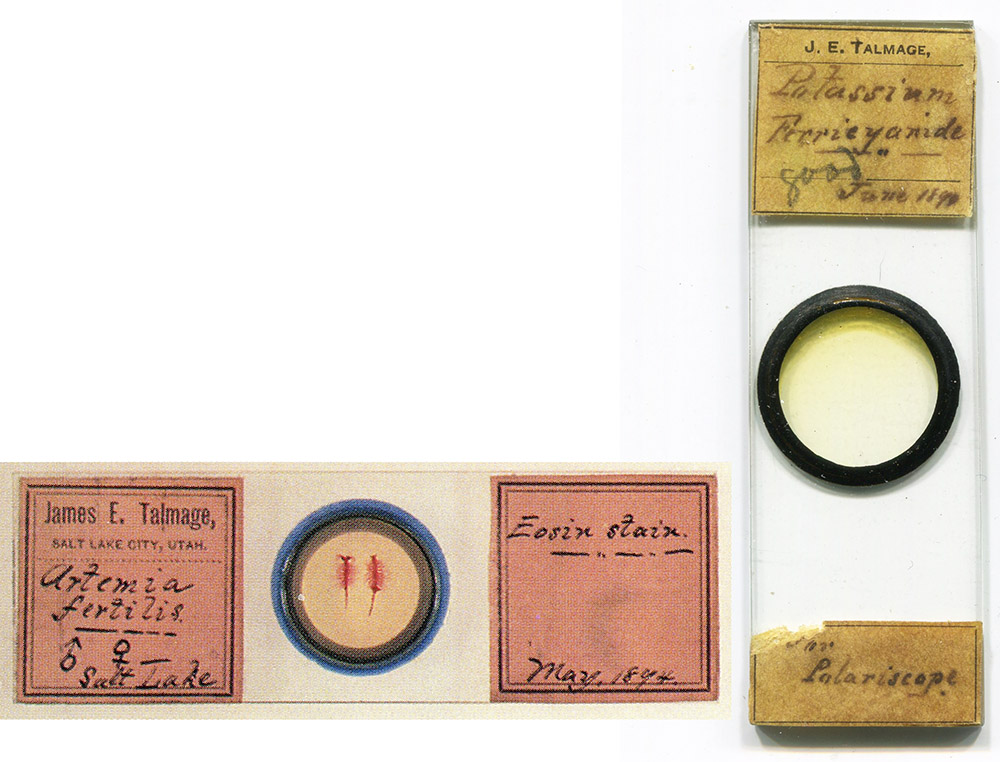
Figure 1.
Two microscope slides by J.E. Talmage. The slide on the left is a mount of a male and a female Artemia fertilis (brine shrimp), stained with eosin and mounted in May, 1894 (adapted for nonprofit, educational purposes from Brian Bracegirdle’s “Microscopical Mounts and Mounters”). The slide on the right contains crystals of potassium ferricyanide and is dated June, 1899 (see Figure 6).
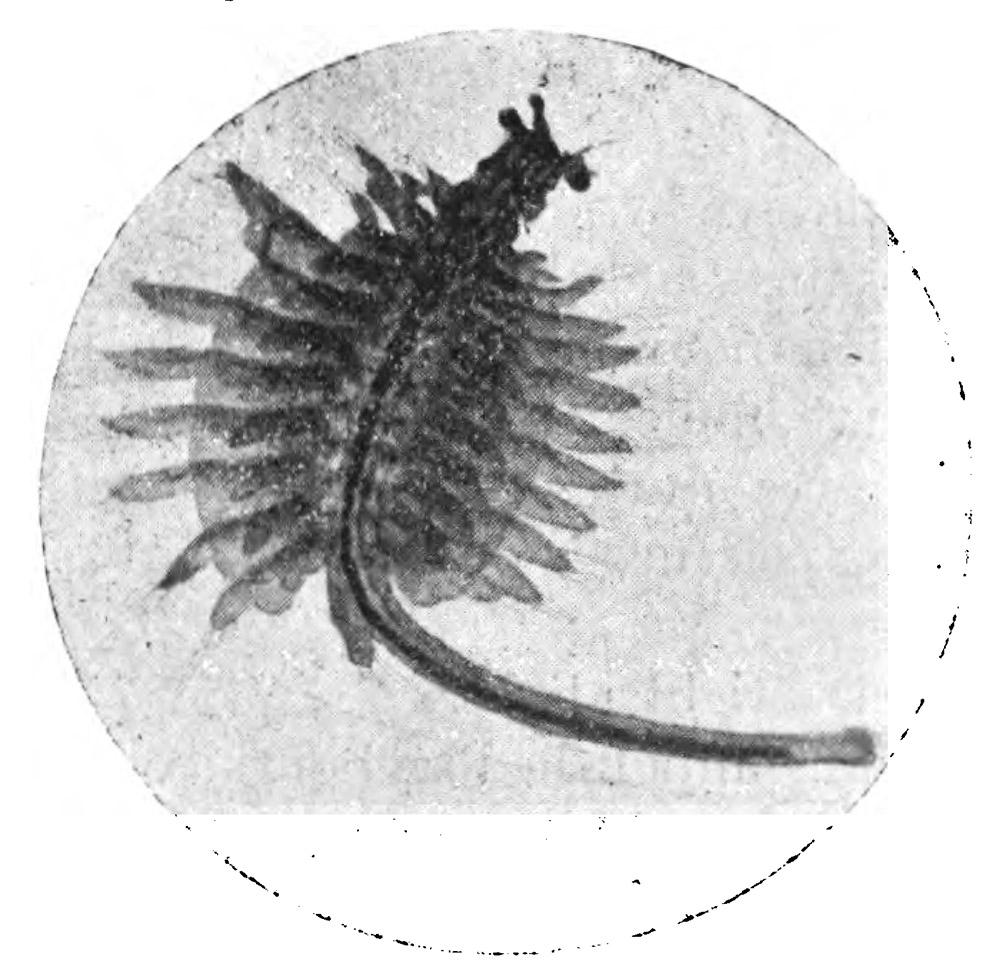
Figure 2.
Photomicrograph of an A. fertilis brine shrimp, produced by J.E. Talmage and published in “The Microscope”, 1893.

Figure 3.
An 1888 exchange request from James Talmage, offering rocks and minerals in exchange for “good mounts”. From “The Microscope”.
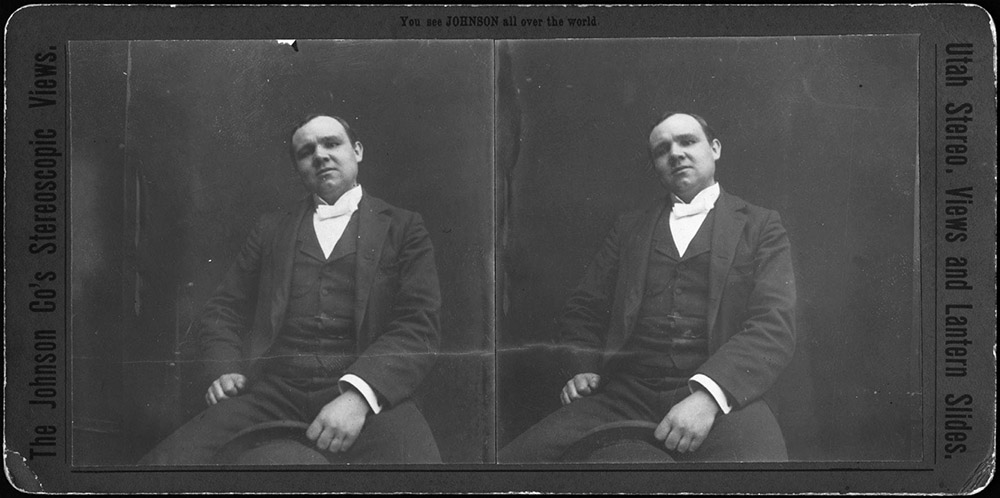
Figure 4.
Stereoview of James Talmage, circa 1895. Adapted for nonprofit, educational purposes from C.S. Smith, “Utah Historical Quarterly”.
James Edward Talmage was the first of eleven children of Gabriel James Joyce and Susannah Preater Talmage, born on September 21, 1862 in Hungerford, Berkshire, England. His father managed the Bell Inn, a pub and hotel. Members of the Mormon Church, the Talmage family moved to Provo, Utah, USA, in 1876 to live in a community of their religious brethren.
James completed his primary education at Brigham Young Academy in Provo. He then performed missionary work in the eastern United States from 1882 until 1884. During that time, he took classes as Lehigh University (Bethlehem, Pennsylvania) and Johns Hopkins University (Baltimore, Maryland). He obtained his Bachelor of Arts from Lehigh in 1891, and his Ph.D. from Illinois Wesleyan University in 1896.
Returning to Utah in 1884, he served as Professor of chemistry at Brigham Young Academy. In the summer of 1888, Talmage was appointed head of the new Salt Lake Stake Academy in Salt Lake City. It was renamed LDS College in 1889. He continued as its head until 1892.
Also in 1888, James married Merry May Booth. The couple had eight children.
It was during this time that we find the first written evidence of Talmage’s interest in microscopes. In 1888, he advertised to exchange “Utah rocks and minerals” and “natural deposits from the mineral lakes and springs of Utah and Idaho” for microscope slides (Figure 3).
In early 1891, “Dr. James E. Talmage, head of the Latter-day Saints' College in Salt Lake City, has been notified by the secretary of the Royal Microscopic Society, of London, that he was, on the 18th of February, 1891, elected a fellow of that scientific institution. This is an exalted honor which has been bestowed upon only a limited number of scientists in the United States. Dr. Talmage has met, at different times, members of the society as they were passing through Salt Lake City on their travels in pursuit of pleasure and knowledge. They have examined some of his personal microscopical work and expressed much satisfaction with it. He also complied with a request to furnish the institution with specimens of Utah insects. These associations evidently led to his being admitted to fellowship, which involves the appending to his name of the letters F.R.M.S.”
Talmage traveled to England that summer to acknowledge his election to the RMS. He presented a talk at the June 17, 1891 meeting, “The President said they were favoured by the presence of Dr. J.E. Talmage, of Salt Lake City, Utah, U.S.A., a recently elected Fellow, who had not only made a special effort to attend the meeting, but had also brought and exhibited some specimens of organic life found in the Great Salt Lake, which he would describe.
Dr. Talmage having expressed his thanks to the President for the kind way in which he had introduced him, and also to the Fellows of the Society for the cordiality of their reception, said that he left Salt Lake City rather hurriedly in order to avail himself of the opportunity of being present at the meeting. On this account he had not brought over as many specimens as he could have desired, but he had placed under some Microscopes in the room several examples of the brine shrimp, Artemia fertilis, from the Great Salt Lake, which he thought might prove of some interest. He found these objects rather difficult to mount for permanent observation. It was, for instance, almost useless to use glycerin, because it rendered the structure indistinct by transparency. He had at present discovered no way better than by putting them into some of the lake water with a 5 per cent. solution of alum. The structure was also so very delicate that it was very difficult to spread them out upon a slide, but by the use of the medium named the creature could be transferred to the slide and it spread itself out as it died. In addition to slides of these shrimps, prepared in the manner described, he also exhibited specimens of the calcareous sand from the lake shore.
Dr. Talmage, speaking of the occurrence of life in the Great Salt Lake, said it would seem to be a difficult task to determine the mean composition of the lake. An examination of the water by Dr. Gale, forty years ago, showed the solid contents to be 22-282 per cent., and the density 1.17. In 1869 Mr. Allen reported the water as containing 14.9934 per cent. solids. He (Dr. Talmage) had analysed the water in December 1885, and found 16.7162 per cent. solid matter, with a density of 1.1225. A later analysis, in August 1889, gave the density as 1.1569, and the total solids in solution as 19.5576 per cent. It is fairly safe to assert that under the conditions now prevailing in the Great Basin, the waters of the lake average from 16 to 18 per cent. solid contents. As would be expected, few species of living things have been found in its waters; yet the assertion that no life exists therein is entirely unwarranted. He vouched for the occurrence of each of the following, most of which were abundant:-(1) Larve of a species of the Tipulidæ, described as Chironomus oceanicus Pack. (2) Larvæ and pupe of Ephydra gracilis Pack. The pupa-cases of this insect accumulate in great numbers upon the shores, where they undergo decomposition, with emanation of very disagreeable odours, recognizable at a distance of miles from the lake. (3) One species of Corixa, probably C. decolor Uhler. (4) But by far the most abundant is Artemia fertilis Verrill, commonly called the brine shrimp. These are often present in such numbers as to tint the water over wide areas. The structure and habits of the Artemiæ would prove a most interesting subject of investi gation. They are capable of adapting themselves to a wide range of conditions as regards the composition of the water. He (Dr. Talmage) had kept them alive for days in the lake water, diluted 25, 50, and even 75 per cent. with fresh water; and for periods varying from 8 to 18 hours in fresh water only”.
Talmage also donated “slides of Artemia fertilis and Calcareous sand” to the Society on that night.
In addition to the RMS, Talmage became a Fellow of the Royal Scottish Geographical Society, the Geological Society (London), the Geological Society of America, the Royal Society of Edinburgh, and the American Association for the Advancement of Science, and was an Associate of the Philosophical Society of Great Britain.
In 1892, Talmage published “The brine shrimp of the Great Salt Lake” in The American Monthly Microscopical Journal. This included a description of his method for preparing microscope slides, “The mounting of the crustaceans for permanent microscopical use is by no means a simple undertaking, most of the ordinary media causing the delicate structure to become distorted, or producing such a transparency as to render the whole object invisible. The method which I now use is to mount them in a preparation of lake water, with corrosive sublimate and an alcoholic solution of carbolic acid. Into this fluid the living artemiæ are transferred directly from the lake brine; they die quickly, but in so doing spread themselves out most perfectly. By this method it is not always possible to get the mount free from foreign particles, but this is but a slight disadvantage. Before mounting I make a very shallow cell of hot paraffin and balsam, and after the cover-glass is in position I ring the edge with a very little of the same material, following this with repeated layers of cement, King's preferred.”
His photomicrograph of a brine shrimp was published by The Microscope in 1893 (Figure 2). That same year, he donated “a photo-micrograph of the female Artemia” and “two microscopic slides of male and female specimens of the brine-shrimp” to the Smithsonian Institute.
Talmage became President of the University of Utah in 1894, with an endowed Chair in Geology. He also worked independently as a mining and scientific consultant, which was successful to the extent that he ceased his academic career in 1907.
He was appointed to the LDS Church’s Quorum of the Twelve Apostles in 1911. He served as President of the Church’s British Mission from 1924 to 1928.
James Talmage died on July 27, 1933 in Salt Lake City, at the age of 70.
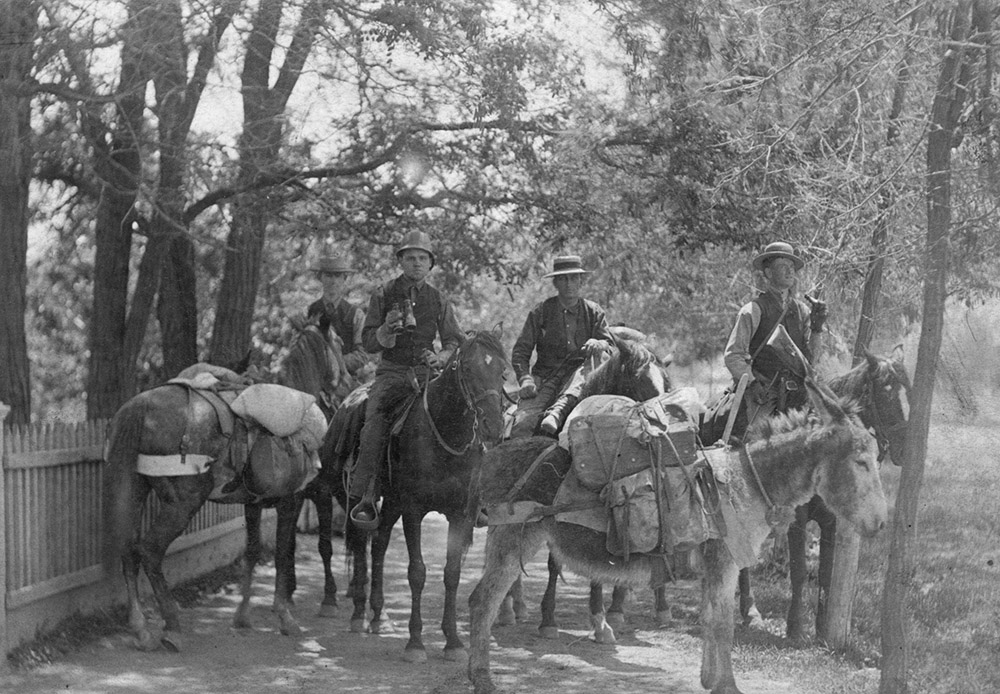
Figure 5.
James Talmage (second from the left, holding binoculars) and colleagues on an 1887 scintific exploration of the Grand Canyon area. Adapted for nonprofit, educational purposes from C.S. Smith, “Utah Historical Quarterly”.
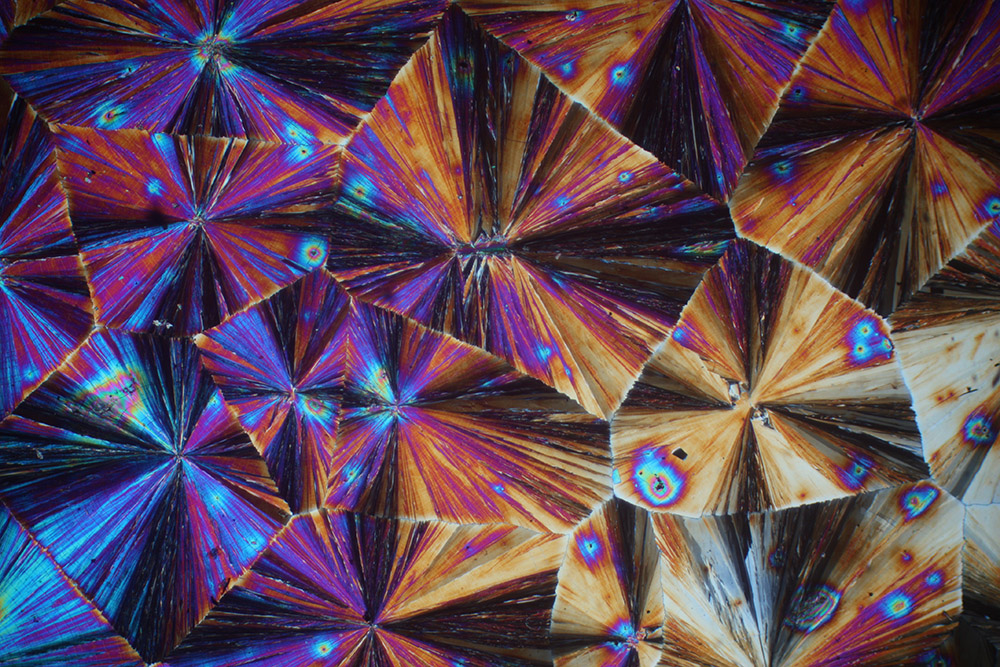
Figure 6.
Crystals of potassium ferricyanide, prepared in 1899 by J.E. Talmage (see Figure 1). Imaged with a C-mounted digital SLR camera, a 3.5x objective lens, and crossed polarizing filters on a Leitz Ortholux II microscope.
Resources
The American Monthly Microscopical Journal (1892) Life in Great Salt Lake, page 18
Annual Report of the Board of Regents of the Smithsonian Institution (1893) Donations, page 257
Bracegirdle, Brian (1998) Microscopical Mounts and Mounters, Quekett Microscopical Club, London, pages 91 and 190, Plate 43-O
The Church Historian’s Press (accessed March, 2026) James Edward Talmage, 21 September 1862 - 27 July 1933, https://www.churchhistorianspress.org/emmeline-b-wells/people/james-edward-talmage-1862
The Journal of Microscopy and Natural Science (1893) Preparing Artemia fertilis, pages 210-211
Journal of the Royal Microscopical Society (1891) Minutes of the meeting of February 18, 1891, pages 293-297
Journal of the Royal Microscopical Society (1891) Minutes of the meeting of June 17, 1891, pages 554-564
The Latter-Day Saints' Millennial Star (1891) Note on J.E. Talmage's election to the Royal Microscopical Society, page 191
The Microscope (1888) Exchange offer from J.E. Talmage, page 160
The Microscope (1893) Objects seen under the microscope: The brine shrimp, pages 129-130
Miller, Benjamin L. (1934) Memorial of James Edward Talmage, Proceedings of the Geological Society of America, pages 259-272
Smith, Craig S. (2016) James E. Talmage and the 1895 Deseret Museum Expedition to Southern Utah, Utah Historical Quarterly, accessed March 2026 from https://issuu.com/utah10/docs/uhq_volume84_2016_number2/s/10121175
Talmage, James E. (1892) The brine shrimp of the Great Salt Lake, The American Monthly Microscopical Journal, pages 284-286