Wallace Stokes White, 1842 - 1921
by Brian Stevenson
last updated July, 2026
W.S. White, of Kalamazoo, Michigan USA, was a professional photographer and, later in life, bandleader and retailer of musical instruments. He acquired a strong interest in microscopy ca. 1880, becoming a member of the American Society of Microscopists and a Fellow of the Royal Microscopical Society.
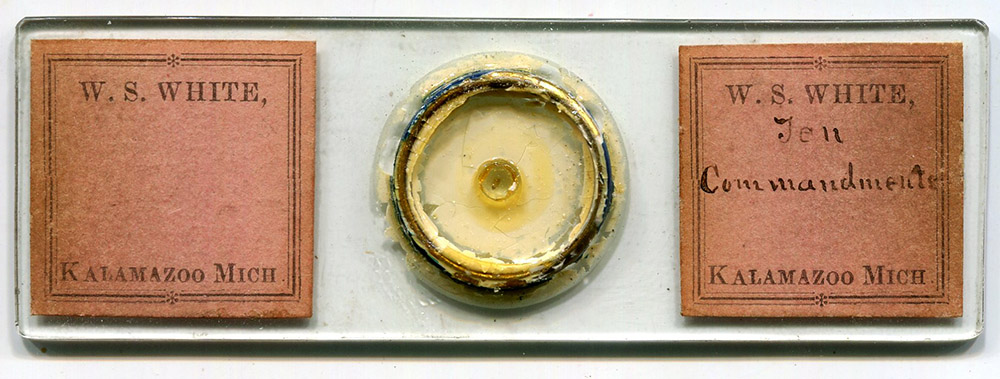
White’s known microscopical interests merged with his photography business (Figures 1 and 2). He gave presentations on preparing microphotographs at the 1883 and 1884 national meetings of the American Society of Microscopists. It is not clear whether White sold his microscope slides, or prepared them only for personal enjoyment.
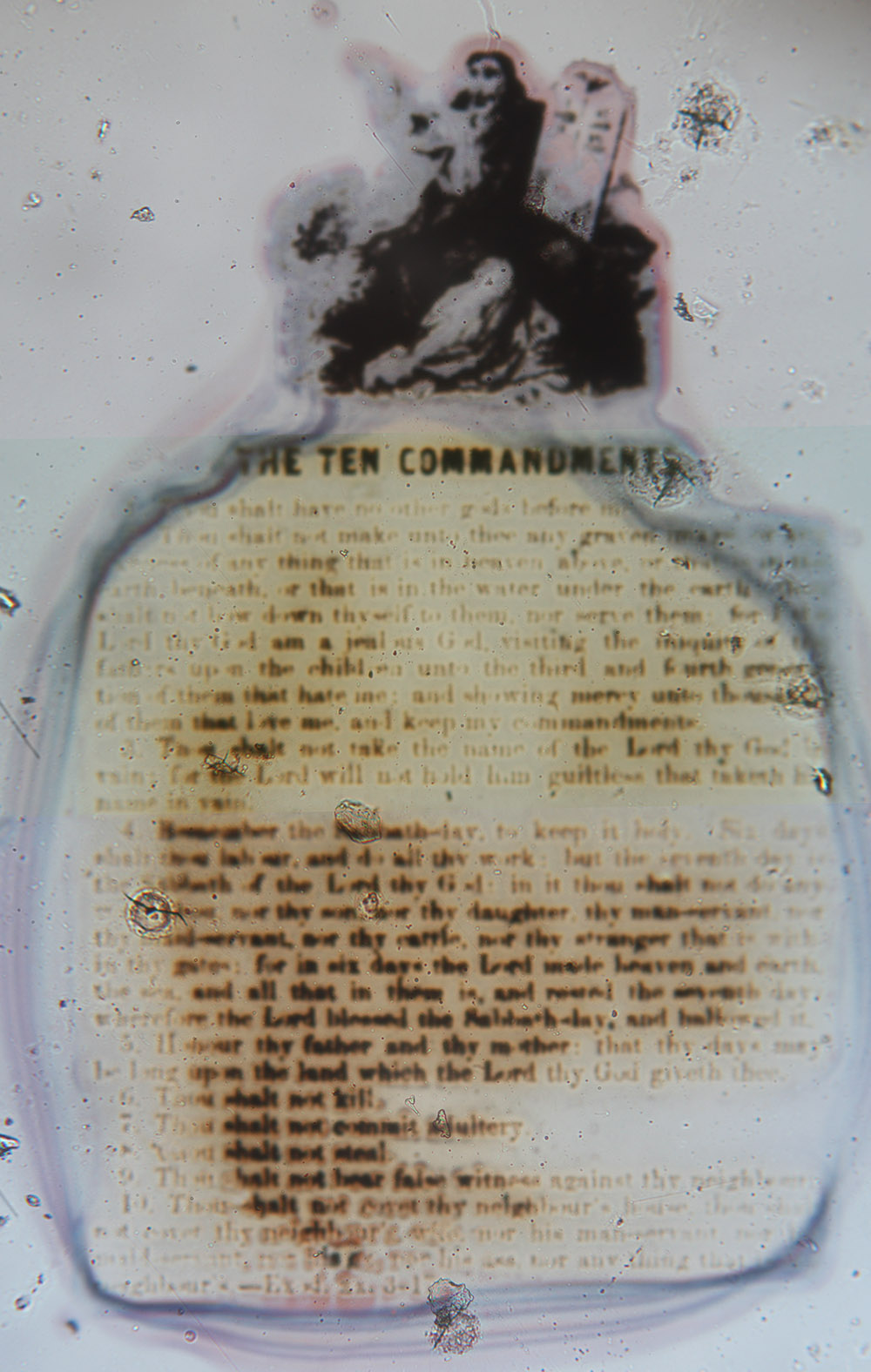
Figure 2.
Image of “The Ten Commandments”, by W.S. White (see Figure 1). The poor quality suggests that White prepared this slide by taking apart an existing stanhope charm, as opposed to making a new microphotograph on a glass disc. Imaged with a 25x objective lens and C-mounted digital SLR camera on a Leitz Ortholux II microscope, stitched from three images.
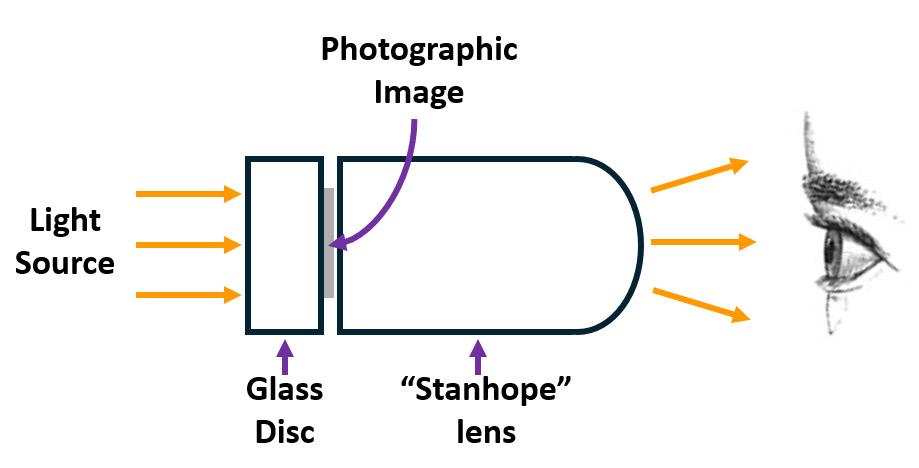
Figure 3.
Schematic of a stanhope microphotograph as it would be in a charm. The microphotograph is made on the surface of a glass disc, which is then sealed to the flat end of a “stanhope” lens. The image is magnified by the convex end of the lens. White produce microscope slides from such stanhope charms, such as that shown in Figures 1 and 2, by separating the glass disc from the lens, then mounting the glass disc image-side down onto a glass slide.

Figure 4.
1884 advertisement from W.S. White, requesting to acquire microscope lenses and other microscopical apparatus in exchange for lantern slides. Being that White was a professional photographer, it is likely that he had prepared those lantern slides. From “The Microscope”.

Figure 5.
1890 exchange request from White, asking to swap microscope-related magazines. From “The Microscope”.
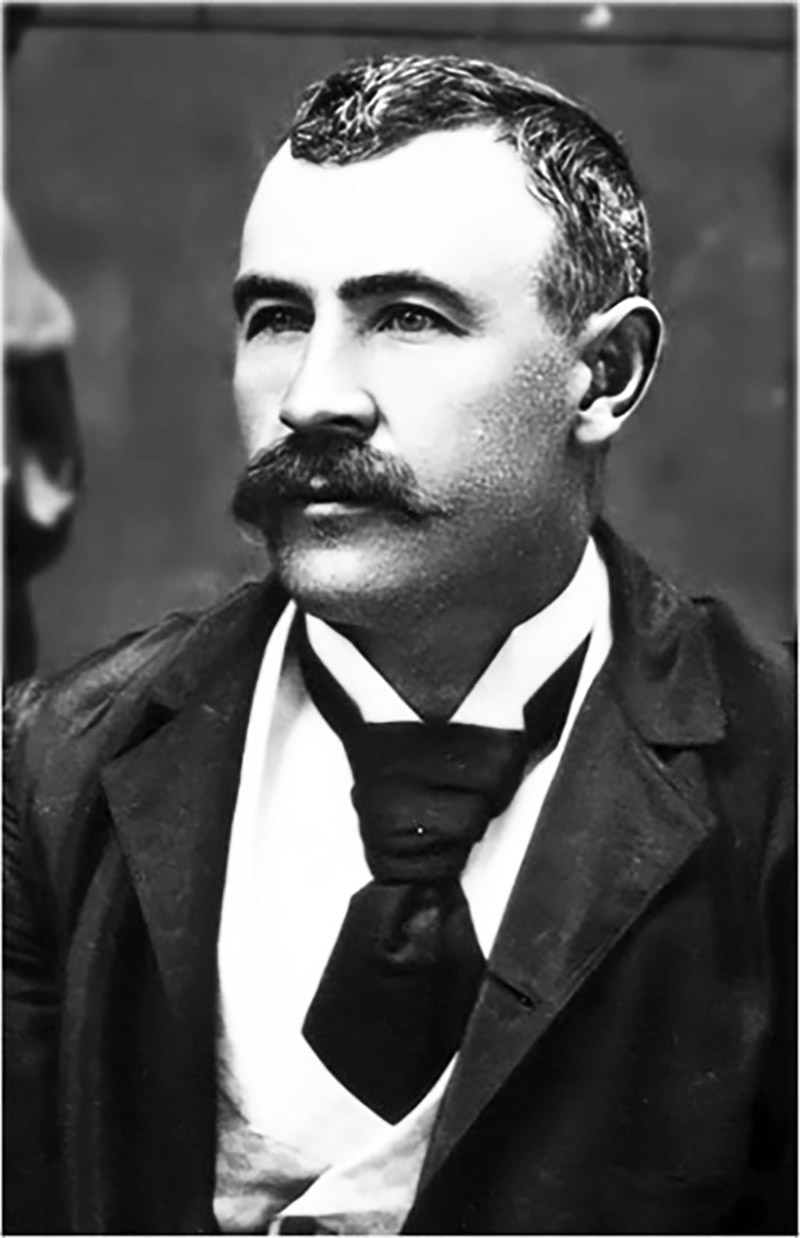
Figure 6.
Wallace S. White, ca. 1880s. Adapted for nonprofit, educational purposes from https://www.kpl.gov/local-history/kalamazoo-history/photographers/white-wallace-s-2 .
Wallace Stokes White was born on April 17, 1842 in Otsego, Michigan. Census records imply that he was the third child of Nathan and Lucy White. The 1850 census listed him as “Stokes W. White”. Father Nathan owned a farm. Wallace’s 1863 military draft registration showed that he was also a farmer. He did not serve in the army during the US Civil War (1861-1865).
Wallace White married Julia Elizabeth Lindsey on April 19, 1866. Records indicate that they did not have any children.
Wallace and Julia White moved to Kalamazoo, Michigan around 1868. Wallace opened a photographic business in partnership with Julia’s brother in 1869. He ended that partnership and opened his own photography shop in 1873, then moved to a larger space in 1878 (Figure 7). This was described as “The rooms are expensively furnished, elegantly carpeted, and the walls are adorned with handsome life size portraits, beautiful engravings and superb specimens of the photographic art. W. S. White, always a favorite artist, has now the finest suite of photographic rooms in Western Michigan, if not unequalled in the state.” An 1880 history of Kalamazoo listed White as one of the city’s principal photographers.
Wallace developed an interest in microscopy during this time He joined the American Society of Microscopists in 1882. He attended the 1883 national conference, where he put on a demonstration on “micro-photographs”.
The following year, he gave two one-hour demonstrations, on “transferring micro-photographs from charms to slides” and “making Griffith cells”. An example of the former is shown above in Figures 1 and 2. “Griffith cells” would have been raised rings for mounting and protecting thick objects on slides. The White slide shown in Figure 1 has a raised ring around the thick microphotograph, which enabled White to apply a coverslip over the glass disc / photograph.
At the 1884 American Society of Microscopists meeting, White also displayed a “micro-photograph – Garfield, the cradle to the grave”. The description noted that White showed that slide on his “J. Swift & Son’s binocular” microscope.
Also that year, White published exchange offers, in hope of acquiring “microscopical apparatus (object-glasses), etc.” (Figure 4).
White’s enthusiasm for microscopy was such that he became a Fellow of the Royal Microscopical Society in 1886. He remained a member through at least 1890.
It is not known whether W.S. White explored other aspects of microscopy, or focused solely on microphotography.
White’s business interests expanded to music during the late 1870s, and he began selling musical instruments and scores (Figure 11). During 1885, he formed a partnership with George Balcom that specialized in this field, offering items “from a violin and cornet down to a harmonica.” That business lasted for less than a year.
He also led and participated in musical groups. By 1878, “White’s Full Quadrille Band” was furnishing music for dancing parties and social occasions”. Military-style bands were popular at that time, and “White’s Military Band” became a popular musical attraction during the 1880s and 1890s (Figure 12). In 1893, the band was inducted into the Michigan National Guard as the official “Second Infantry Band”.
By the late 1890s, music appears to have been White’s primary occupation. The 1900 national census listed him as “music dealer”.
Business evidently took a bad turn during the early 1900s. The 1910 census listed Wallace White as an “assembler” at the Blund Boot Factory. The 1917 Kalamazoo City Directory recorded him as “asmblr Kal Loose Leaf Binder Co.” The 1920 census listed the 76-year old man as a “laborer” in a “binding factory”.
Wallace S. White died in Kalamazoo on April 28, 1921.
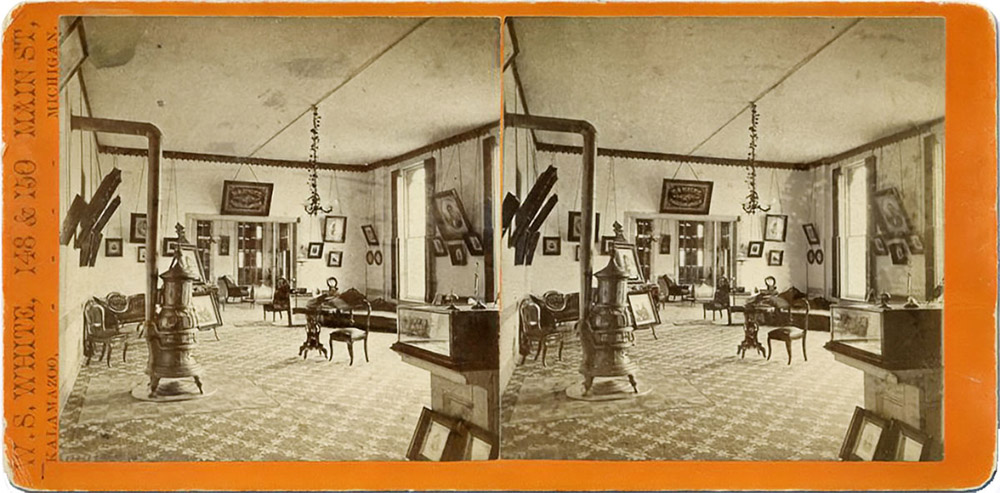
Figure 7.
Stereoview of Wallace S. White’s photography studio, circa 1881. Adapted for nonprofit, educational purposes from https://www.kpl.gov/local-history/kalamazoo-history/photographers/white-wallace-s-2 .

Figure 8.
1878 advertisement from W.S. White. From “The Gazette Directory of Kalamazoo County”.
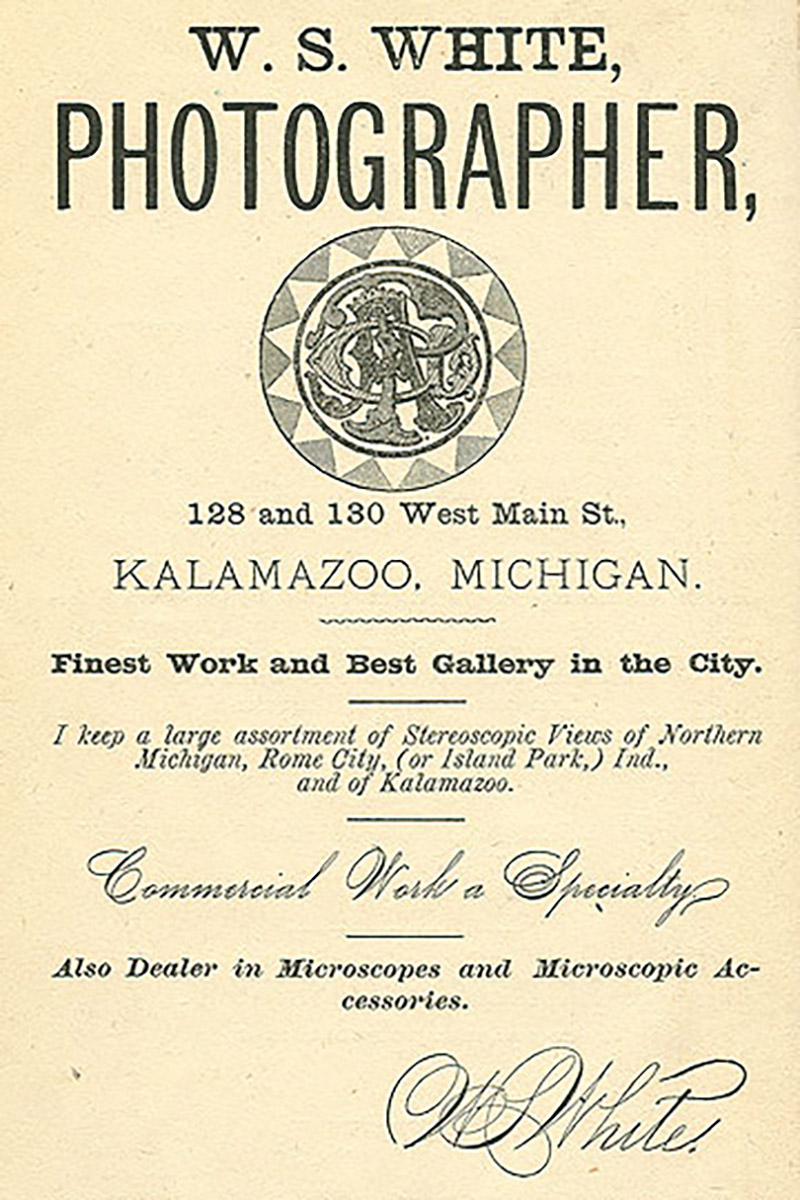
Figure 9.
1883 advertisement from W.S. White. Adapted for nonprofit, educational purposes from https://www.kpl.gov/local-history/kalamazoo-history/photographers/white-wallace-s-2 .
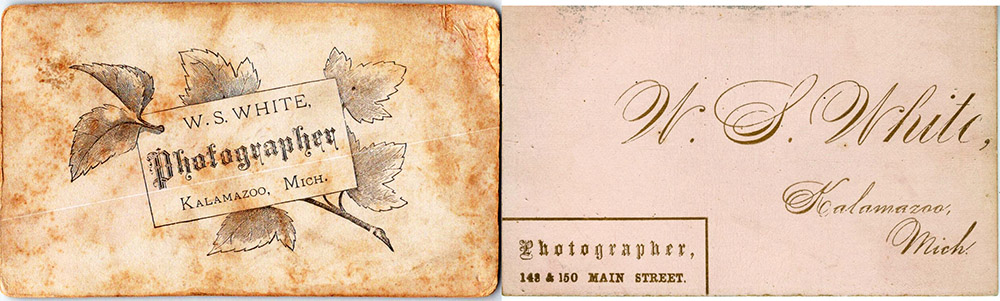
Figure 10.
Reverse sides of two cartes-de-visite (cdv) photographs that were produced by Wallace S. White. Such wallet-sized photographs were very popular during the later 1800s. Adapted for nonprofit, educational purposes from internet auction sites.
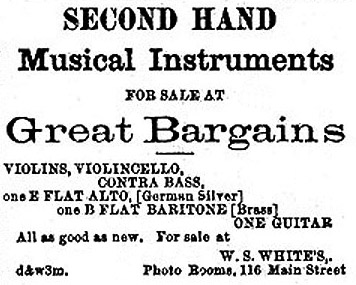
Figure 11.
1893 advertisement for W.S. White’s musical instruments. From “The Kalamazoo Gazette”. Adapted for nonprofit, educational purposes from https://www.kpl.gov/local-history/kalamazoo-history/photographers/white-wallace-s-2 .
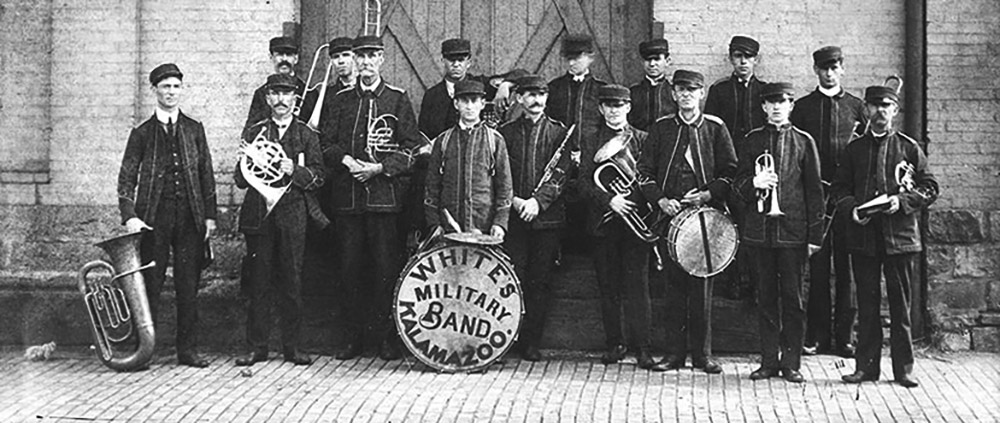
Figure 12.
“White’s Military Band”, circa 1890. Adapted for nonprofit, educational purposes from https://www.kpl.gov/local-history/kalamazoo-history/photographers/white-wallace-s-2 .
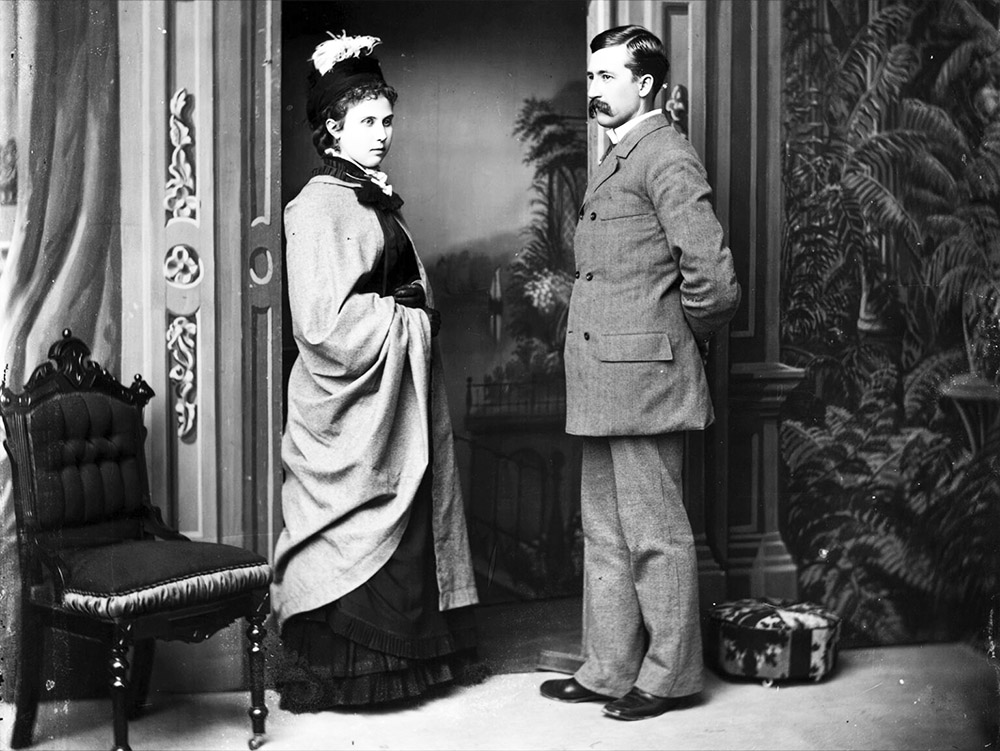
Figure 13.
Julia and Wallace White, circa 1870s. Adapted for nonprofit, educational purposes from https://www.kpl.gov/local-history/kalamazoo-history/photographers/white-wallace-s-2 .
Resources
Durant, Samuel W. (1880) History of Kalamazoo County, Michigan, Everts & Abbott, Philadelphia, page 261
Howard, Keith (accessed July, 2026) Wallace S. White, early Kalamazoo photographer and bandleader, Kalamazoo Public Library, https://www.kpl.gov/local-history/kalamazoo-history/photographers/white-wallace-s-2
Journal of the Royal Microscopical Society (1889) Fellows: “1886, White, Wallace S., 128, W. Main-street, Kalamazoo, Michigan, U.S.A.”
Kalamazoo City Directory (1880) “Photographers … White W.S., 128, 130 W. Main”, page 298
Kalamazoo City Directory (1917) “White Walace S (Julia E), assembler Kal Loose Leaf Binder Co, res 319 Elm”, page 1105
The Microscope (1884) Exchange offer from W.S. White, page 264
The Microscope (1890) Exchange offer from W.S. White, page 64
Proceedings of the American Microscopical Society (1883) “Practical Work, Tables had been arranged in different parts of the rooms at the service of the Society, for the convenience of the worker. The following participated: W.S. White, Micro-photographs”, pages 258-259
Transactions of the American Microscopical Society (1884) “Table No. 27. W.S. White, Esq., photographer, Kalamazoo, Mich., 1st hour – making Griffith cells, 2d hour – transferring micro-photographs from charms to slide”, page 202
Transactions of the American Microscopical Society (1884) “W.S. White, Kalamazoo, Mich., 63.- J. Swift & Son’s binocular. Micro-photograph – Garfield, the cradle to the grave”, page 239
Proceedings of the American Society of Microscopists (1890) Members “White, Wallace S., F.R.M.S., ’82, Kalamazoo, Mich.”
USA census and other records, accessed through ancestry.com