George Bailey, 1844 - 1903
by Brian Stevenson
last updated September, 2026
George Bailey was a Congregationalist / Independent minister. He performed missionary work in Jamaica from 1869-1875, but returned to England due to ill health. For the next 24 years, while serving as a minister in England, Bailey immersed himself deeply into microscopy and other scientific fields. He became a Fellow of the Royal Microscopical Society, and a member of the Quekett Microscopical Club, the Croydon Microscopical & Natural History Club, the Postal Microscopical Society, the Geologists’ Association, and the Conchological Society. Bailey produced a number of high-quality microscope slides between 1875 and 1897 (Figures 1-3). He returned to the mission in Jamaica in 1897, and remained there for the rest of his life.
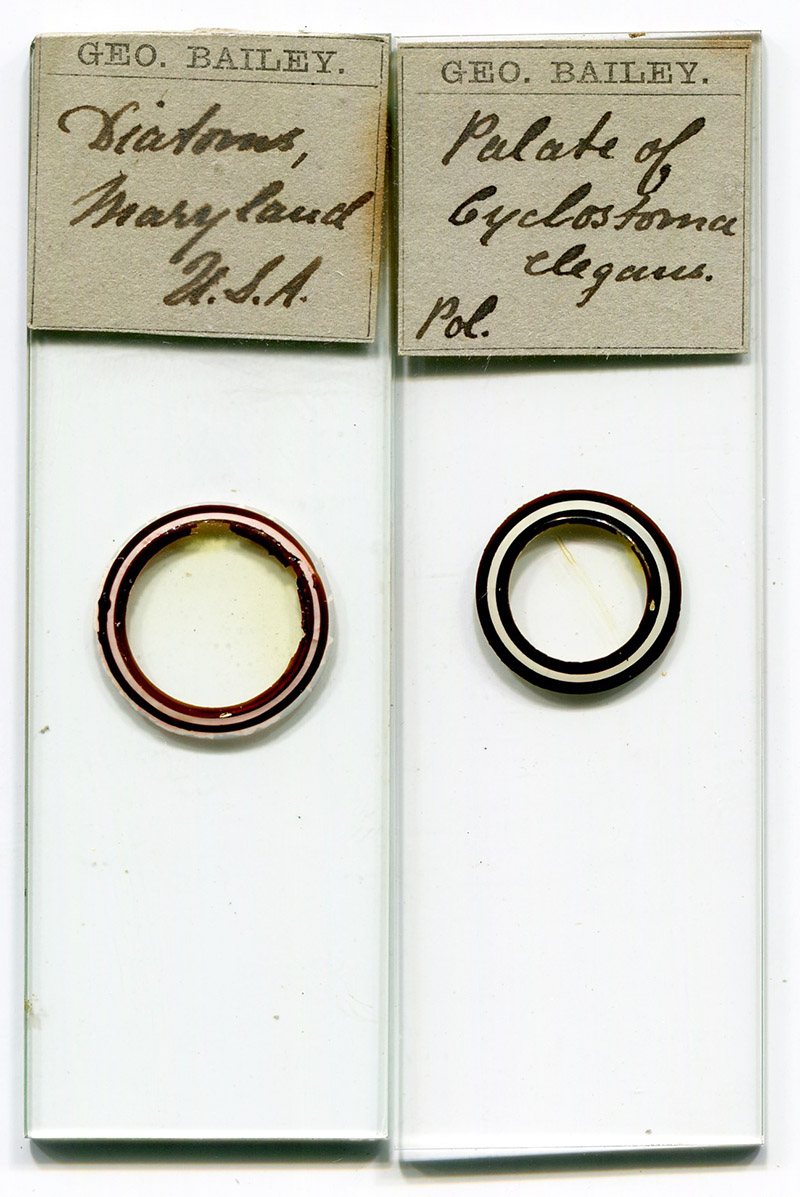
Figure 1.
Microscope slides by George Bailey, ca. 1870s – 1887. He was elected a Fellow of the Royal Microscopical Society in January, 1887, and it was customary for Fellows to append “F.R.M.S.”. The absence of those initials suggest that these slides were produced prior to Bailey becoming a Fellow.
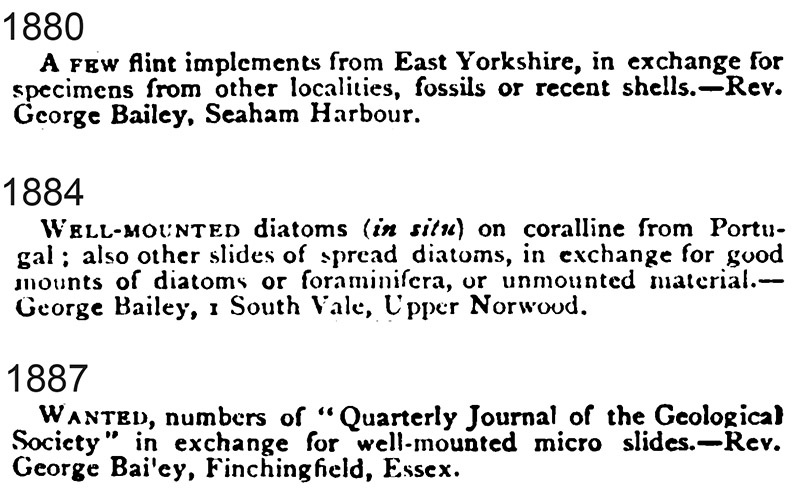
Figure 2.
Exchange offers from George Bailey, published in “Hardwicke’s Science-Gossip”.
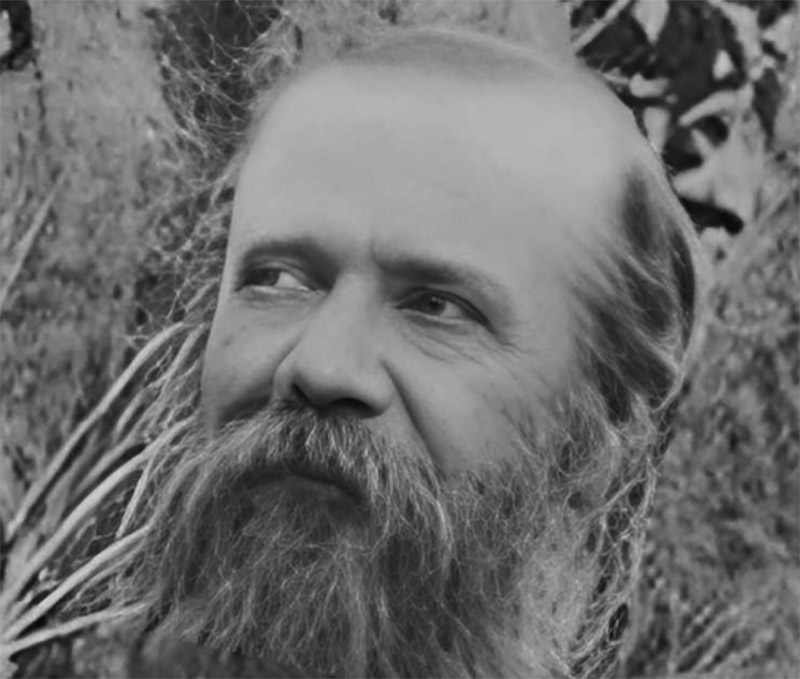
Figure 3.
Undated photograph of George Bailey. Adapted for nonprofit, educational purposes from https://www.ancestry.com/family-tree/person/tree/2439197/person/-1841559405/facts
George Bailey was born on February 21, 1844 in Flamborough, Yorkshire. He was the first child of William and Hannah Bailey. The father worked as a tailor. The family moved to Leeds, Yorkshire, during the later half of the 1840s.
George initially intended to become a shoemaker: the 1861 national census listed the 15 year-old George as “shoemaker apprentice”, working for a master shoemaker in Bridlington, Yorkshire.
Sometime later, his life took a turn toward Christian ministry, and was ordained in the Congregational church. He married Jane Tyndal, who was originally from Bridlington, in the autumn of 1869. As part of the London Missionary Society, the couple left for Jamica on December 20, 1869.
A son and two daughters were born in Jamaica, with the younger daughter dying within a year.
They came back to England in June, 1875. Reports conflict over whether it was George or Jane who suffered an illness that compelled their return.
George then took pastoral positions at several locations in England, including Seaham Harbour, Durham in 1878, Upper Norwood, Croydon ca. 1881, and Finchingfield, Essex ca. 1886.
In 1880, Bailey offered to exchange “flint implements from East Yorkshire”, presumably prehistoric items that he had acquired during his youth in that area (Figure 2). He wrote that request from Durham, and requested “specimens from other localities, fossils, or recent shells”.
By early 1881, the Baileys had moved to Norwood, south of London.
He soon joined the Croydon Microscopical and Natural History Club. In 1882, he became a member of the Zoological Sub-Committee. Also in that year, he joined the Postal Microscopical Society and the Geologists' Association.
Bailey read a paper, “Parasites on some mollusca”, to the Croydon Microscopical and Natural History Club on March 14, 1883.
He joined the Quekett Microscopical Club on December 28, 1883, and became a Fellow of the Royal Microscopical Society on January 12, 1887.
During 1890, Bailey and colleagues H.W. Burrows and C.D. Sherborn wrote two papers on “The Foraminifera of the Red Chalk” for The Journal of the Royal MIcroscopical Society.
George and his family returned to Jamaica in 1897, taking up the pulpit at Ridgmount. “He died, somewhat suddenly, on April 26, (1903) and his funeral testified to the general respect in which he was held by all denominations.”
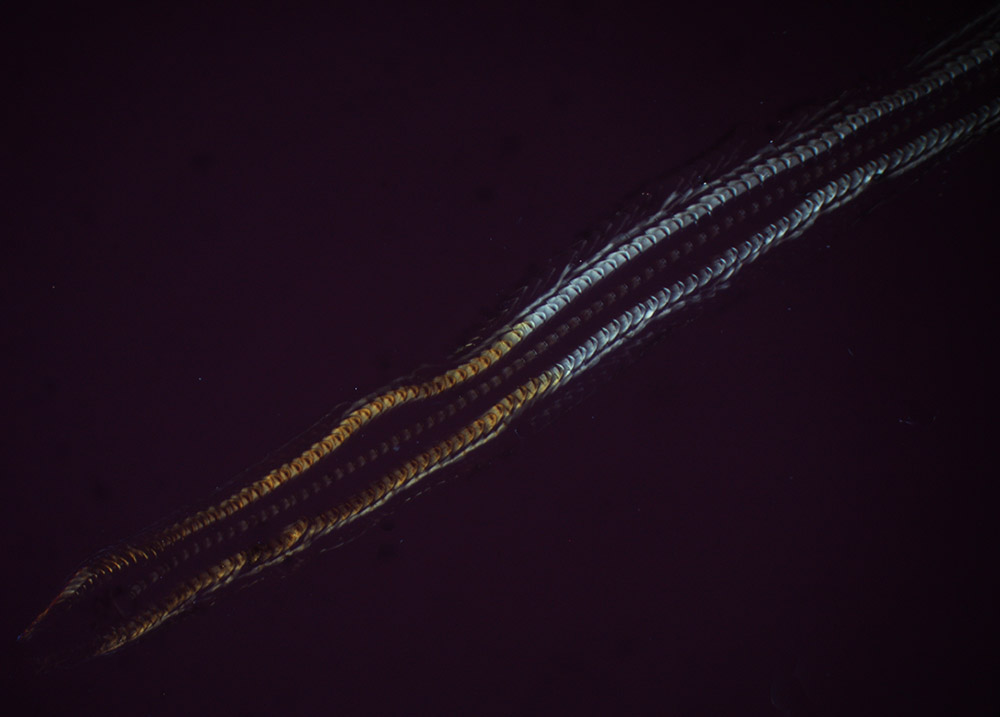
Figure 4.
“Palate of Cyclostoma elegans” (now Pomatias elegans, the round-mouthed snail), prepared by George Bailey (see Figure 1). Often called the “palate” or “tongue” of a mollusk, the radula is covered with serrated “teeth”, and is used by the animal to scrape food from hard surfaces. Imaged with a 3.5x objective lens and crossed polarizing filters with a C-mounted digital SLR camera on a Leitz Ortholux II microscope.
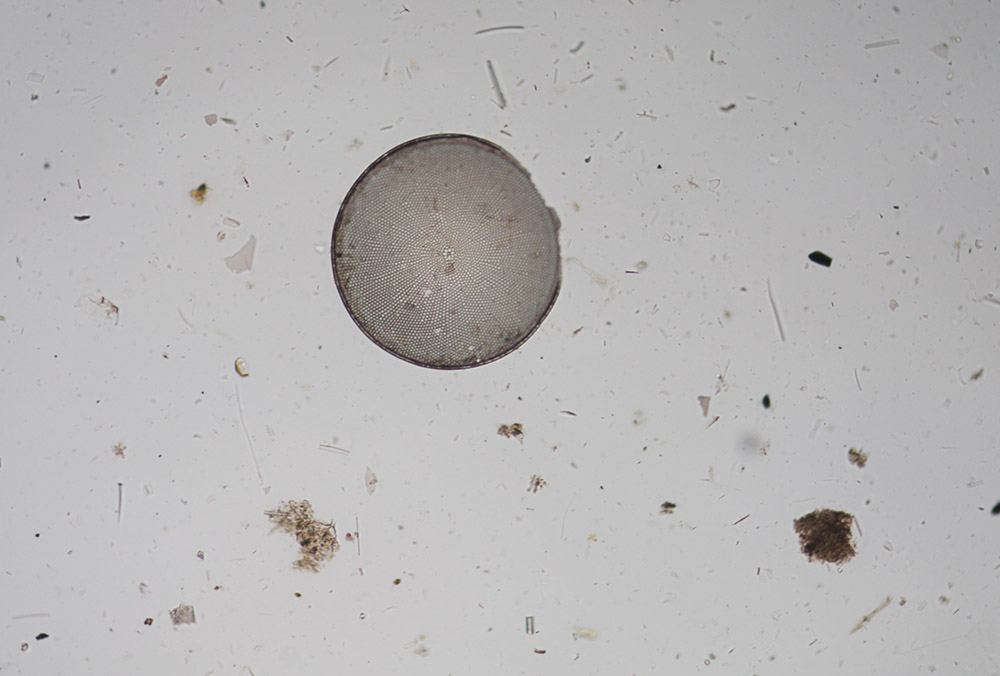
Figure 5.
“Diatoms from Maryland, U.S.A.”, prepared by G. Bailey (see Figure 1). Imaged with a 10x objective lens and C-mounted digital SLR camera on a Leitz Ortholux II microscope.
Resources
Bailey, George (1883) Parasites of some Mollusca, Report and Abstract of Proceedings of the Croydon Microscopical and Natural History Club, page 177
Burrows, H.W., C.D. Sherborn, and G. Bailey (1888) The Foraminifera of the Red Chalk, Journal of the Royal Microscopical Society, pages 383-385
Burrows, H.W., C.D. Sherborn, and G. Bailey (1888) The foraminifera of the Red Chalk of Yorkshire, Norfolk, and Lincolnshire, Journal of the Royal Microscopical Society, pages 549-564
The Chronicle of the London Missionary Society (1870) “Departure of Missionaries - The Rev. George Bailey and Mrs. Bailey, appointed to Jamaica, embarked per ‘Vere’, December 20th”, page 21
England census and other records, accessed through ancestry.com
Evangelical Magazine and Missionary Chronicle (1904) “Jamaica has suffered by the death of the Rev. George Bailey, who first laboured at Davyton in that Colony for the L.M.S. (1870-1875), but returned to England owing to the illness of Mrs. Bailey. In 1897 he went forth a second time, and for six years was minister of the church at Ridgmount. He died, somewhat suddenly, on April 26, and his funeral testified to the general respect in which he was held by all denominations”, page 41
Hardwicke's Science-Gossip (1880) Exchange offer from George Bailey, page 24
Hardwicke's Science-Gossip (1884) Exchange offer from George Bailey, page 284
Hardwicke's Science-Gossip (1887) Exchange offer from George Bailey, page 72
Journal of Conchology (1897) List of Members, “1888. Bailey, Rev. George, F.R.M.S., The Manse, Finchingfield, Essex”
The Journal of Microscopy and Natural Science (1882) Members of the Postal Microscopical Society, “Bailey, Rev. G., 1, South Vale, Central Hill, Upper Norwood, S.E.”, page 10
Journal of the Quekett Microscopical Club (1884) Members, “Dec. 28, 1883, Bailey, Rev. G., 1, South vale, Upper Norwood, S.E.”
Journal of the Royal Microscopical Society (1887) New Fellows, page 184
The Naturalists' Directory (1888) “Bailey, Rev. Geo., F.R.M.S., Member of The Quekett Mic., The Croydon Mic. and Nat. Hist. Clubs. The Manse, Finchingfield, Essex. Mic., Diatoms, Geol., Palaeo., Sponges, Con., Ent., Anth., Foraminifera. C. Ex.”, page 194
Proceedings of the Geologists' Association (1883) Members, “Bailey, Rev. George, 1, South Vale, Upper Norwood”, page 11
Register of Missionaries, Deputations, Etc., from 1796 to 1896 (1896) “Bailey, George. Born, February 21, 1844, at Flamborough. Church Member, Independent Chapel, Bridlington (Dickinson). Studied at Hackney College. Appointed to Jamaica. Ordained, October 21, 1869, at the Independent Chapel, Bridlington. Married Jane Tyndall, Church Member, Bridlington (Dickinson). Sailed, December 20, 1869. Arriving in Jamaica, January 22, 1870, he soon after took charge of the station at Davyton, and, from June 1, 1870, until March, 1872, of Ridgemount also, during Mr. Alloway's absence on a visit to England. His health having failed in 1875, he returned to England, on sick certificate, with Mrs. Bailey, arriving June 28. In 1878, the state of his health not allowing his return to Jamaica, he retired from the foreign work of the Society, and took the Pastorate of the Congregational Church at Seaham Harbour, Durham”, London Missionary Society, London, page 247
Report and Abstract of Proceedings of the Croydon Microscopical and Natural History Club (1882) pages cvi-cvii
Report and Abstract of Proceedings of the Croydon Microscopical and Natural History Club (1883) pages cxxxvi-cxxxvii