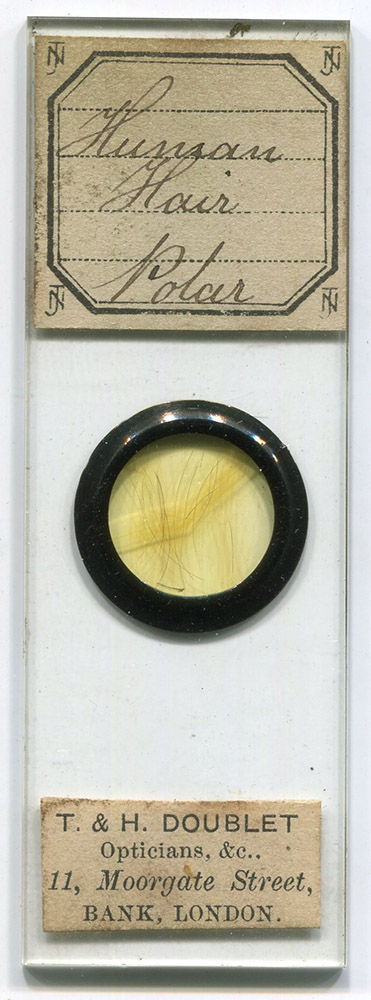
Figure 1. A microscope slide that was made by John T. Norman, with secondary label from T. & H. Doublet. Their address of 11 Moorgate, London, dates its sale between 1878 and 1898. Also see Figure 15, below.
T. & H. Doublet
by Brian Stevenson
last updated April, 2026
T. & H. Doublet (a.k.a. “Thomas & Henry Doublet”) was a family-owned optical business in London through most of the 1800s, then continued under other ownership into the twentieth century. They primarily manufactured and sold corrective eyeglasses, sunglasses, and other vision aids. In addition, Doublet retailed microscopes, microscope slides, telescopes, barometers, engineering tools, and other optical/scientific apparatus, as was the custom with “opticians” of the period. Without a doubt, they did not manufacture any of the microscopes or slides that they sold, but acquired them from wholesale producers. Doublet often engraved their name on instruments.
The firm got its start in the early 1820s when Thomas Doublet 1, a maker of watch cases, died at a relatively young age. His widow, Hannah, maintained herself and family by running a shop that sold “spectacles and glasses”. By the 1830s, she was joined in business by her son, Thomas 2, forming “T. & H. Doublet”. The name continued even after Hannah died in 1863. Thomas 3, the only son of Thomas 2, became a partner around 1870. He evidently lost the business around the turn of the twentieth century, as the 1901 census listed him as “out of employment”. The firm lasted until at least the 1930s, still known as “T. & H. Doublet” / “Thomas & Henry Doublet”. A detailed history of the Doublet family follows Figure 6, below.
Who was Henry Doublet? Extensive searches of records failed to uncover such a person, leading me to conclude that “Henry” never existed. Instead, the name evolved from Hannah’s partnership in T. & H. Doublet. In a time when women were not expected to be business people, it appears that customer’s queries about the identity of “H. Doublet” were eventually answered with the fictitious name!
Figure 1.
A microscope slide that was made by John T. Norman, with secondary label from T. & H. Doublet. Their address of 11 Moorgate, London, dates its sale between 1878 and 1898. Also see Figure 15, below.
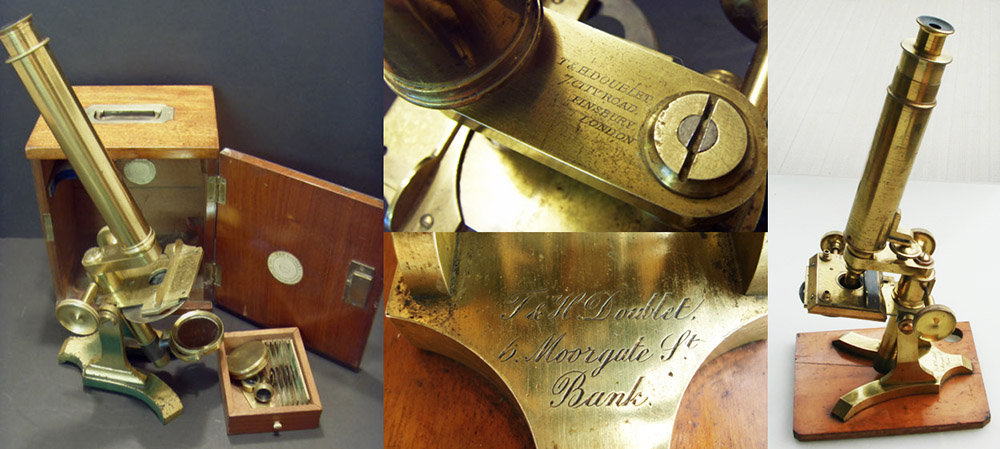
Figure 2.
Two bar-limb microscopes that were retailed by T. & H. Doublet. The business is not known to have had the facilities to manufacture microscopes, telescopes, or other scientific/engineering apparatus, but most likely acquired such equipment through wholesale producers. The microscope on the left / center top bears the address of 7 City Road, Finsbury, dating its sale to between ca. 1859 and ca. 1878. The microscope on the right / center lower bears the address 6 Moorgate Street, indicating sale between ca. 1864 and ca. 1878. Images adapted for nonprofit, educational purposes from internet auction sites.
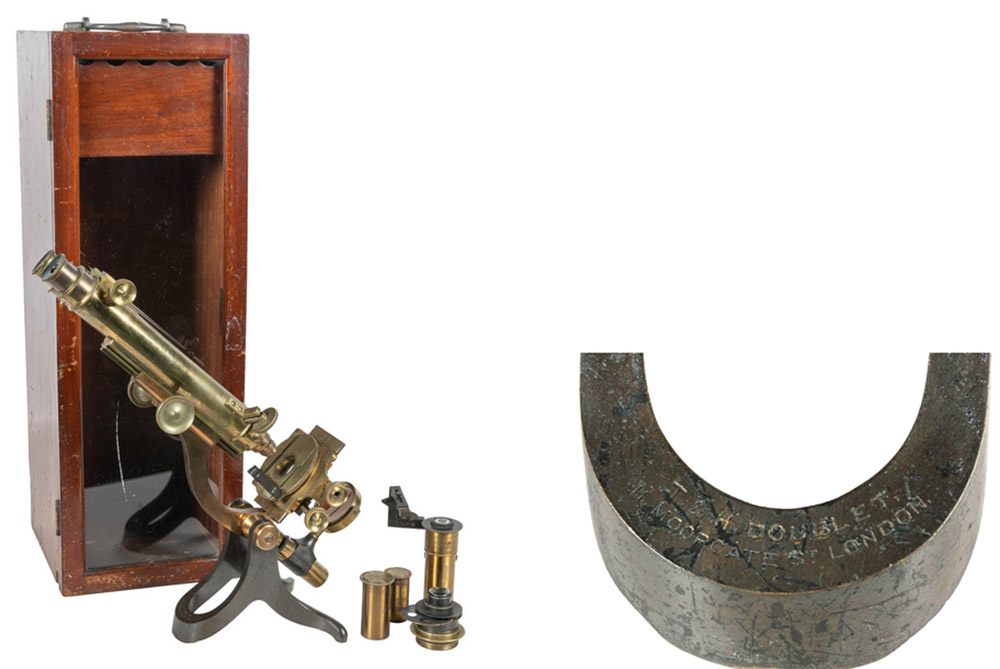
Figure 3.
A T. & H. Doublet compound microscope with a “Crouch” foot, likely manufactured by Henry Crouch. The foot is engraved with the address 11 Moorgate Street, the site of Doublet’s business between ca. 1878 and 1898.
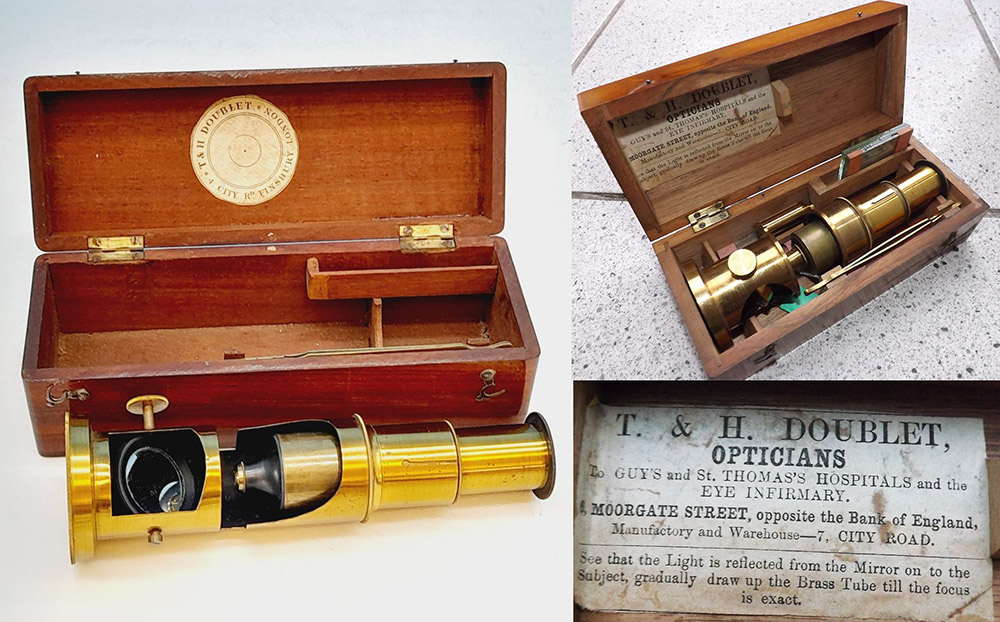
Figure 4.
Two inexpensive drum-type compound microscopes that were sold by T. & H. Doublet, produced by unknown French manufacturers. The case of the left microscope has a label from 4 City Road, Doublet’s location during the 1850s (see Figure 5). The case of the instrument on the right has a label from 6 Moorgate Street, their location between ca. 1864 and ca. 1878.
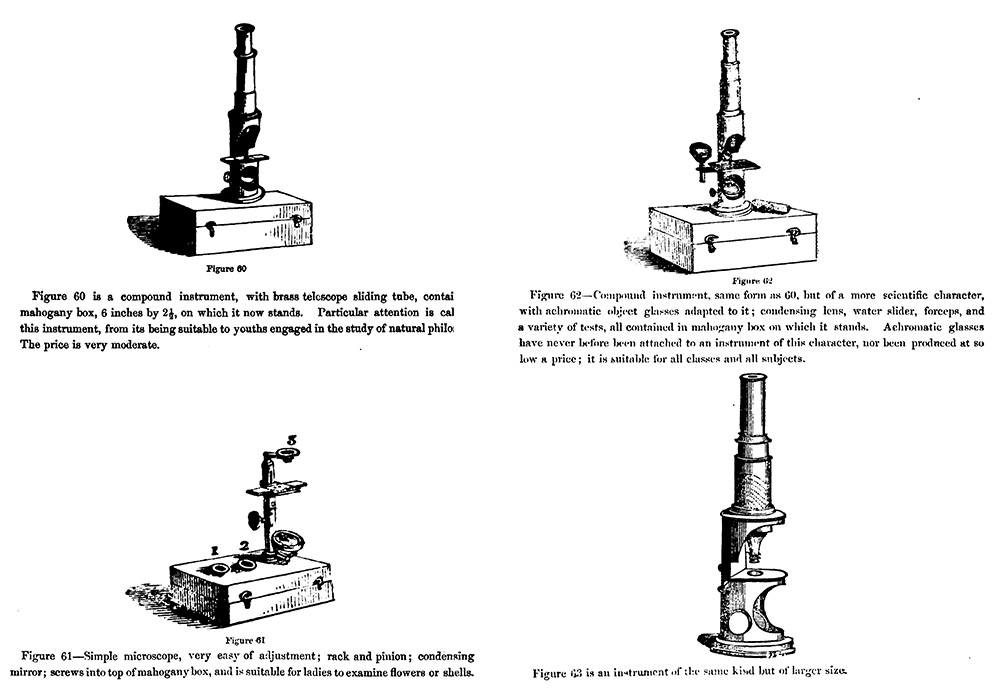
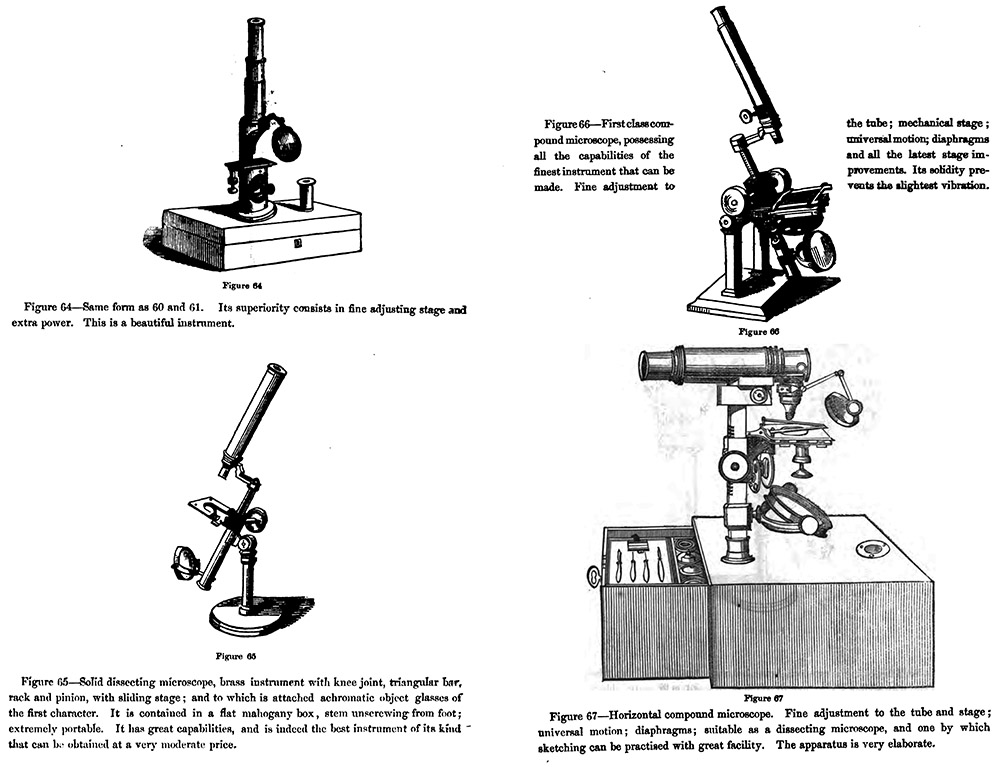
Figure 5.
Microscopes that were offered for sale by T. & H. Doublet in 1850, from the illustrated catalogue that appeared in the back of Thomas Doublet 2’s book, “A Manual of Optical Instruments”. The drum-type microscope illustrated in the upper left (“Fig. 60”) probably represents the surviving instrument shown above in Figure 4. Most, if not all, of these microscopes were manufactured in France by retailers such as Nöel Buron.
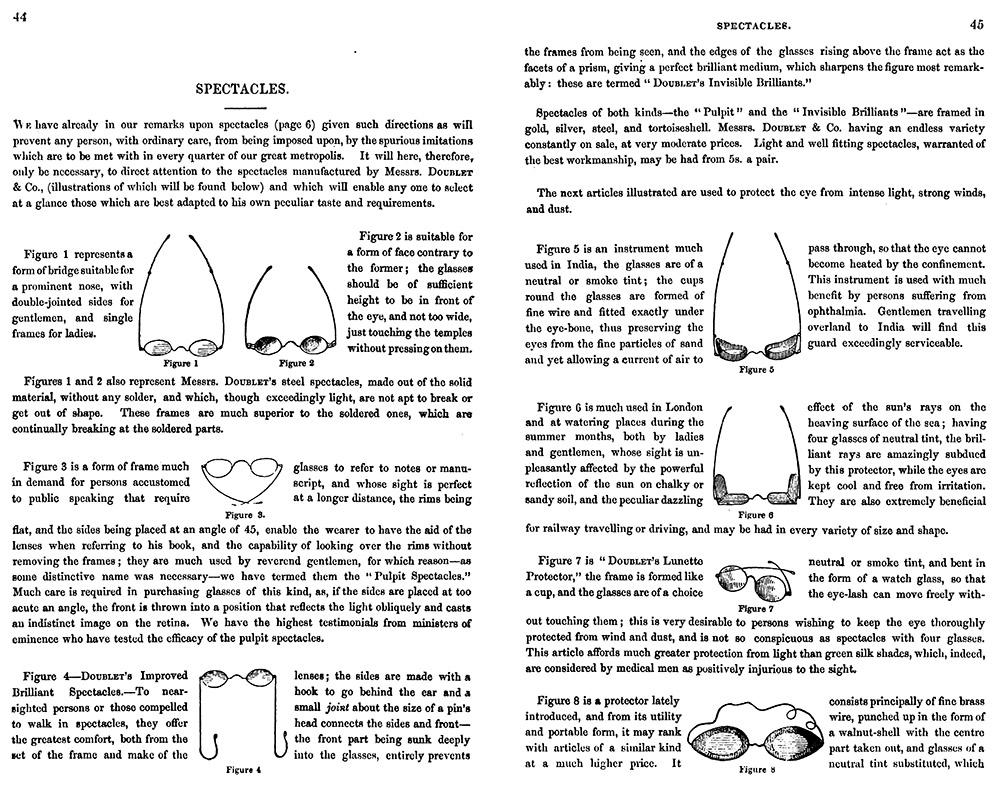
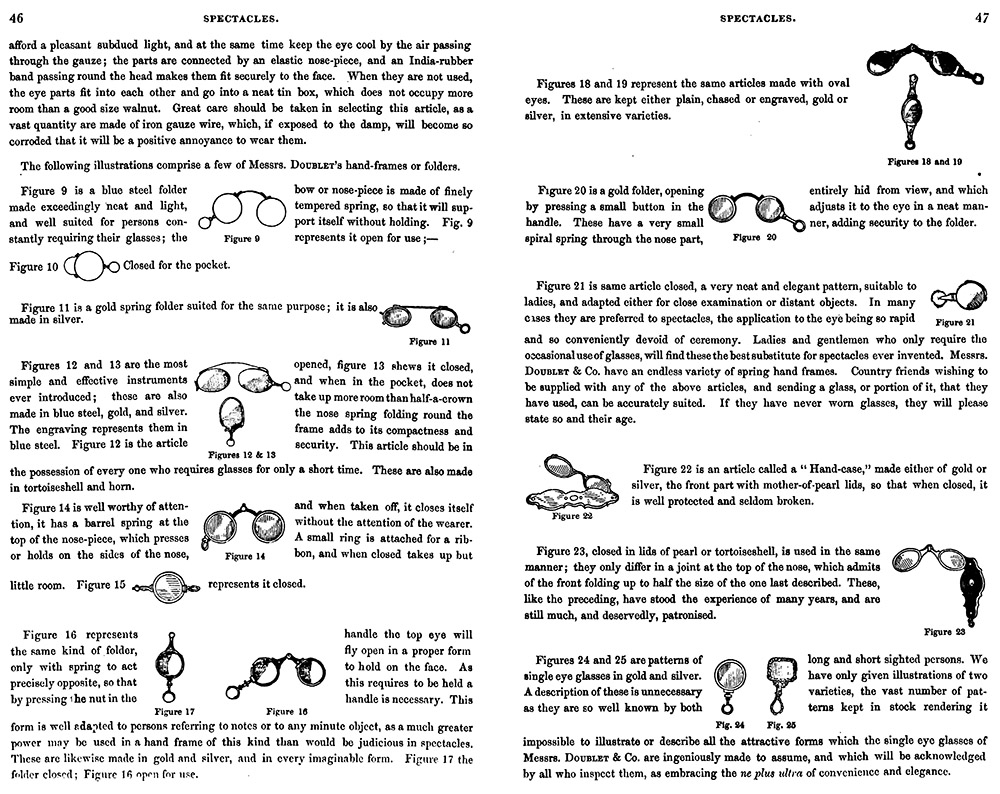
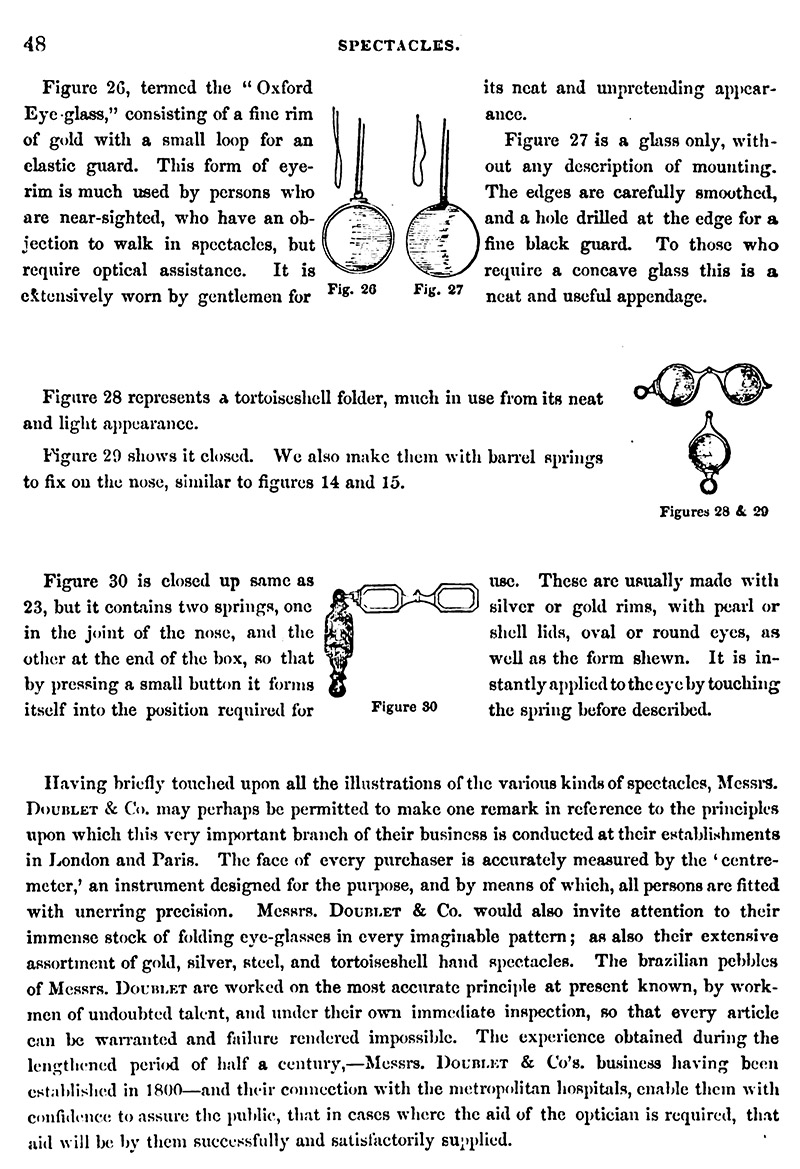
Figure 6.
Spectacles/eyeglasses were the main products of T. & H. Doublet throughout its 100+ years of business. These five pages of illustrations and descriptions were included in the back of Thomas Doublet 2’s 1850 book, “A Manual of Optical Instruments”.
The first of his name, Thomas Doublet 1, was born on February 4, 1780, in Islington, Middlesex, son of James and Susanna Doublet. Father James was a baker. On July 2, 1794, fourteen year-old Thomas was apprenticed to William Clark to learn how to make cases for pocket watches. The apprenticeship record indicates that father James had died by that time. Clark was a member of the Goldsmith’s guild, which Thomas also joined upon completion of his apprenticeship in 1802. At that time, a guildmember’s occupation did not necessarily directly relate to the guild’s name.
Thomas 1 married Hannah Taylor on July 19, 1814. Their first child, Thomas Doublet 2, was born on March 15, 1815. His baptism record states that the father was a “watch case maker”. Thomas 1 is not listed in any London business directories, suggesting that he was not a retailer but worked “for the trade”, i.e., worked on commission for a watchmaker. This 1815 record also shown that the family lived at 74 Paul Street, which was their business address until the 1850s.
Thomas Doublet 1 died in November, 1823. This was only a few months after the birth of a daughter, Mary Ann. To keep her young family alive, Hannah evidently opted not to remarry but instead managed her own business enterprise as a seller of spectacles and eyeglasses. It is possible that she was already in that business before the death of her husband. The records of an 1825 burglary case show that her shop had a display window in the front, with Hannah stating, “I went to my shop window, which was sound a quarter of an hour before; I found the glass broken in, and property gone”. The thieves took “three pairs of spectacles, value 15 s., and an eye-glass, value 3 s.” The record gives additional insights on the English justice system in 1825: both robbers were sentenced to death, but were “strongly recommended to mercy” because they were 11 and 13 years old.
Gloria Clifton’s Directory of British Instrument Makers gives a ca. 1834 address of Hannah Doublet of 14 Shepperton Place, New North Road, London. However, she was listed in contemporary records as being located at 74 Paul Street in 1825, and again in 1839, so I suspect that the Shepperton Place is incorrect.
The 1839 Robson's London Directory listed “Doublett T. Spectacle maker, 74 Paul st, Finsbury” and “Doublet Thos. Optician, 19 Windmill st, Finsbury”. This suggests that Hannah was operating under her deceased husband’s name at Paul Street, while son Thomas 2 had a separate shop on Windmill Street. Mother and son were evidently working together within a few years, with the 1843 Post Office Directory of London showing “Doublet Thomas and Hen. spectacle makers, 74 Paul st. Finsb”, without mention of the Windmill Street address.
Thomas 2 married Eliza Ann Neale in 1841. Their second child, and only son, Thomas 3, was born on August 22, 1845.
By 1850, Hannah had fully become “Henry” in business directories. She and Thomas 2 also acquired a second business site between 1847 and 1850, at 4 City Road, Finsbury Square. The shop at 74 Paul Street was closed soon after 1850. The City Road address changed to number 7 by 1858.
Thomas Doublet 2 wrote a book in 1850, A Manual of Optical Instruments. A synopsis of apparatus of the time, it also included an illustrated catalogue of T. & H. Doublet’s inventory. This included illustrations and descriptions of microscopes that they offered for sale (Figure 5). Most, and probably all, of those microscopes came from French wholesale manufacturers.
By the early 1850s, T. And H. Doublet had been designated “manufacturing opticians” to Saint Guy’s and Saints Thomas’ Hospitals, and “agents to messes. Lerebours and co., of Paris. An assortment of their instruments always on hand”.
An indication of their financial success, the 1851, ’61, and ‘71 national censuses show that Thomas 2 and his family lived in Ilford, Essex, rather than above the London shop. They employed live-in servants.
Thomas 2 had interests in optics beyond eyeglasses. In 1860, he filed for a patent improved sights for rifles.
Hannah Doublet died during the summer of 1863. The business continued as “T. & H. Doublet”.
The premises of T. & H. Doublet were reorganized during the early 1860s. By 1864, the retail shop had moved to 6 Moorgate Street, while the 7 City Road site was retained as the “manufactory” (Figure 10). Further changes occurred in the 1870s. The 1875 Post Office Directory of London gave the firm’s locations as 6 Moorgate Street and 50 Finsbury Square. By 1878, the shop number had changed to 11 Moorgate Street.
Thomas Doublet 3 was married in 1873, to Clara Haggis. They had five children, none of whom entered the family optical business.
Thomas Doublet 2 died on May 13, 1878. The optical firm and home in Ilford were inherited by his son, Thomas 3. He purchased guild membership in 1883.
Thomas Doublet 3 evidently lost control of the optical business during the 1880s, although I have yet to find details of the situation. The 1891 census listed his occupation as “clerk”. His eldest son, Thomas Wellington Doublet, was also working as a “clerk”. The 1901 census described Thomas 3 as “out of employment”, and his sons as a government employee, salesman, and apprentice. Thomas Doublet 3 died on January 25, 1920.
The T. & H. Doublet optical business continued on under its new owners. The shop moved to 39 Moorgate Street in 1898. Advertisements and other notices indicate that the business had become a manufacturer of cameras (Figure 11). I have not found records of the new owner(s), although the 1920 Post Office Directory of London listed “Doublet T. & H. (J. Carman), opticians, spectacle makers, philosophical, mathematical & scientific instrument makers”. The shop was then at 118 London Wall.
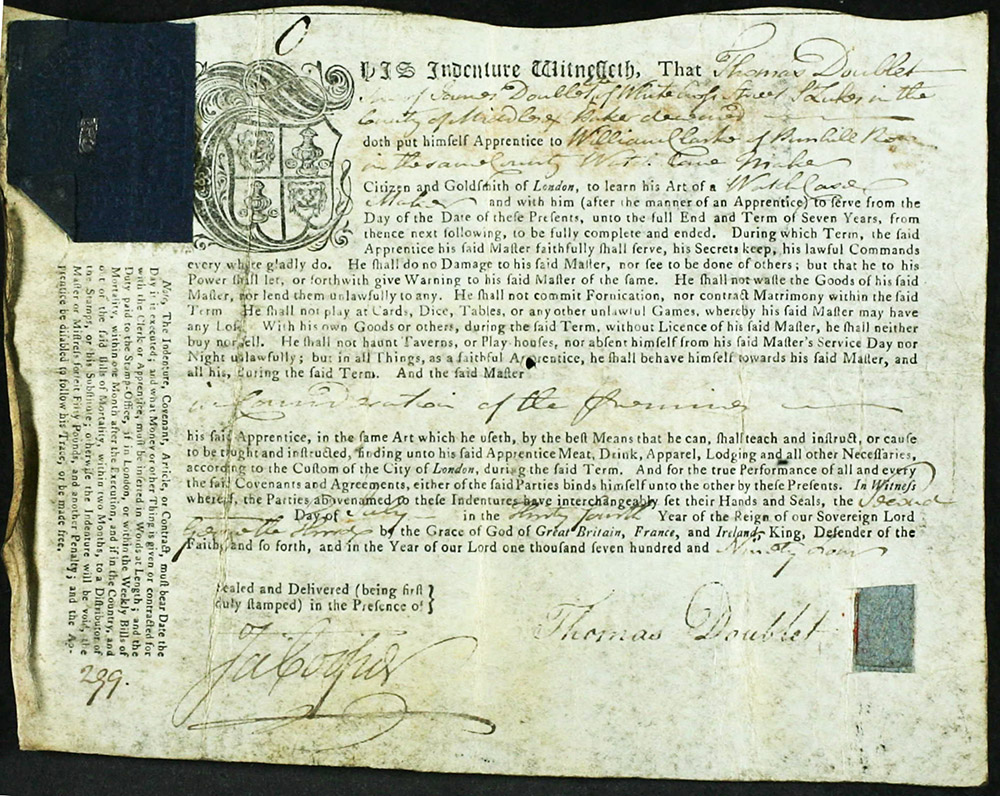
Figure 7.
The 1794 indenture contract that bound Thomas Doublet 1 as an apprentice to William Clark, watch case maker.
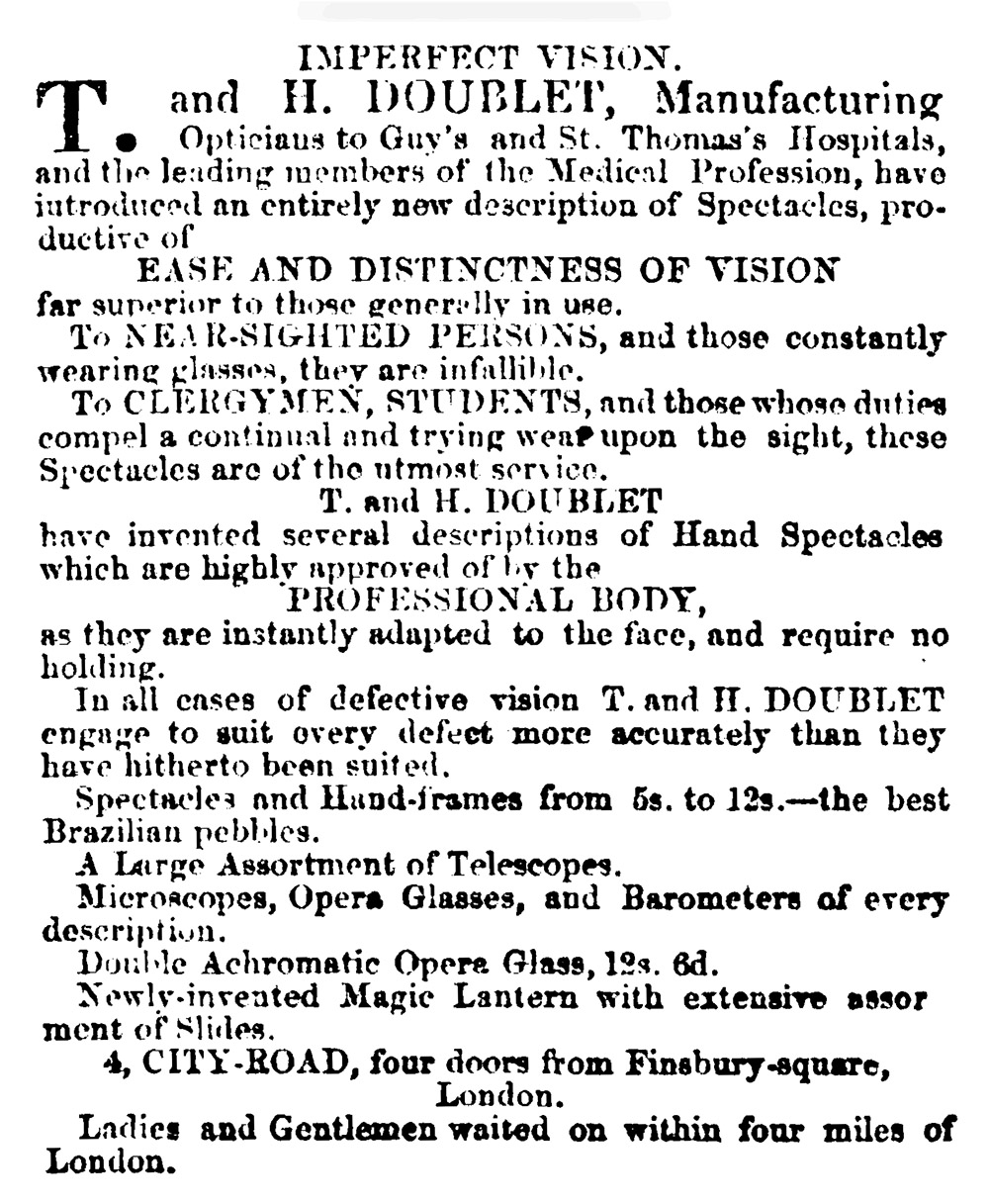
Figure 8.
An 1852 advertisement from T. & H. Doublet. The firm moved to 4 City Road in about 1850. From “The Law Times”.
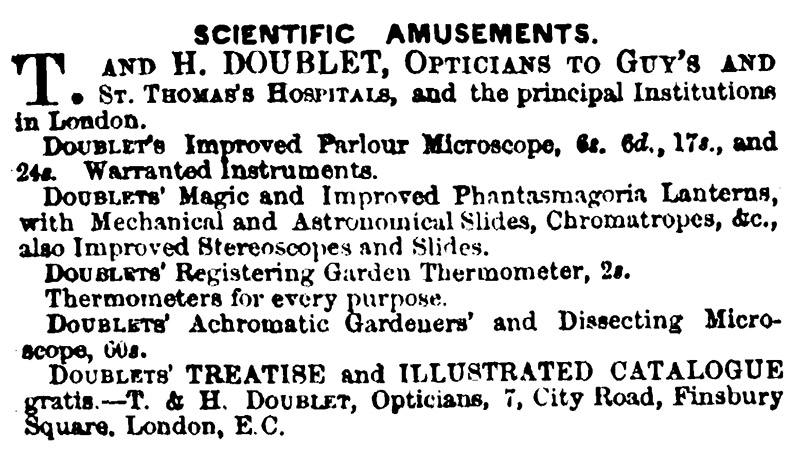
Figure 9.
1859 advertisement. The business address changed from 4 City Road to 7 City Road at a point between 1852 and 1859. From “Gardeners' Chronicle”.
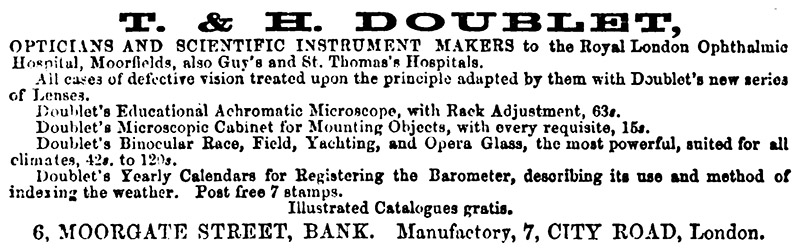
Figure 10.
An 1864 advertisement. The business had rearranged between 1860 and 1864, with the retail shop moving to 6 Moorgate Street and the 7 City Road site being used for eyeglass manufacturing. Fron “The Intellectual Observer”.
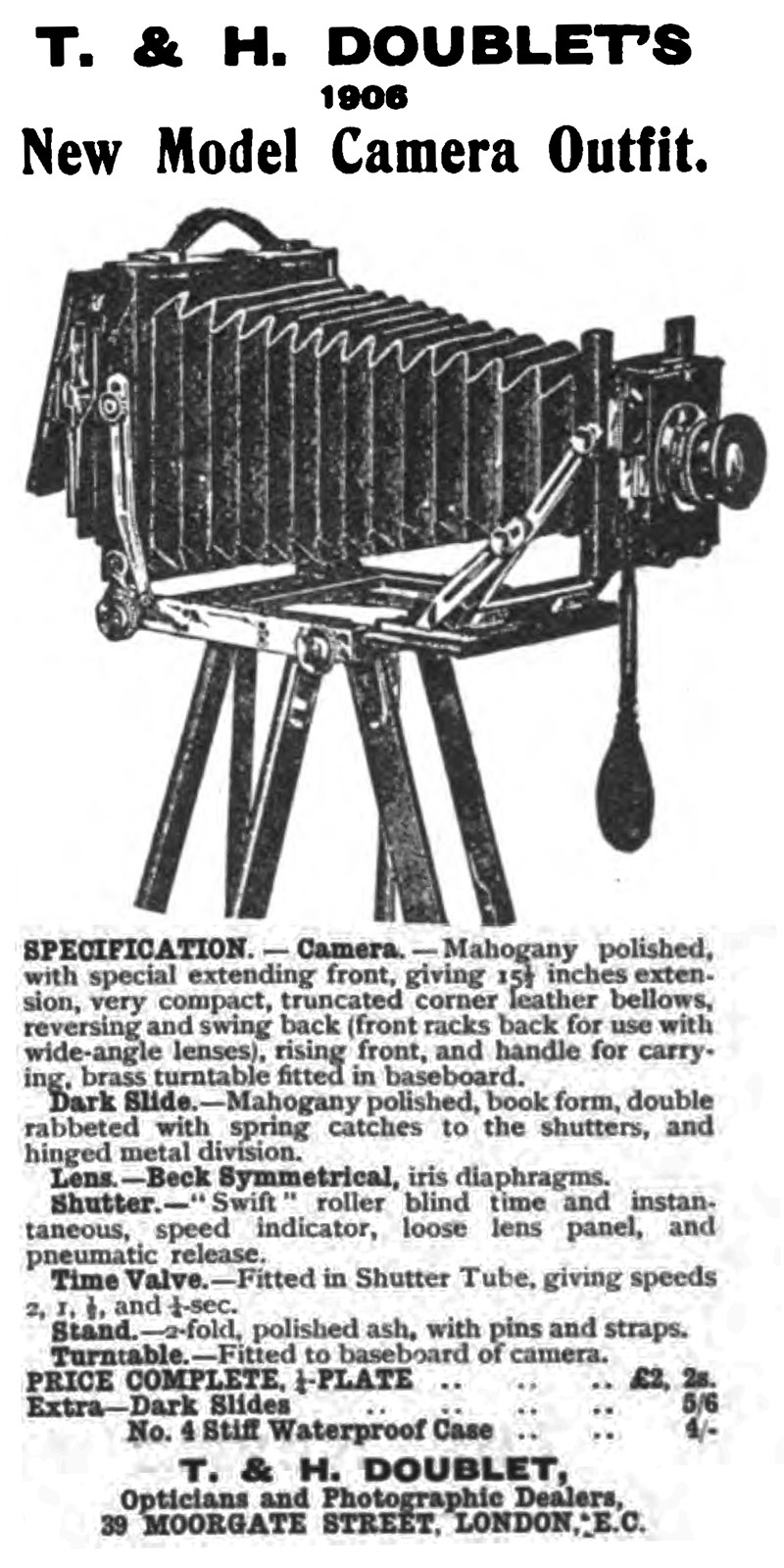
Figure 11.
An advertisement from 1906, when T. & H. Doublet was under new ownership. The business moved to 39 Moorgate Street in 1898. From “Photographic Monthly”.
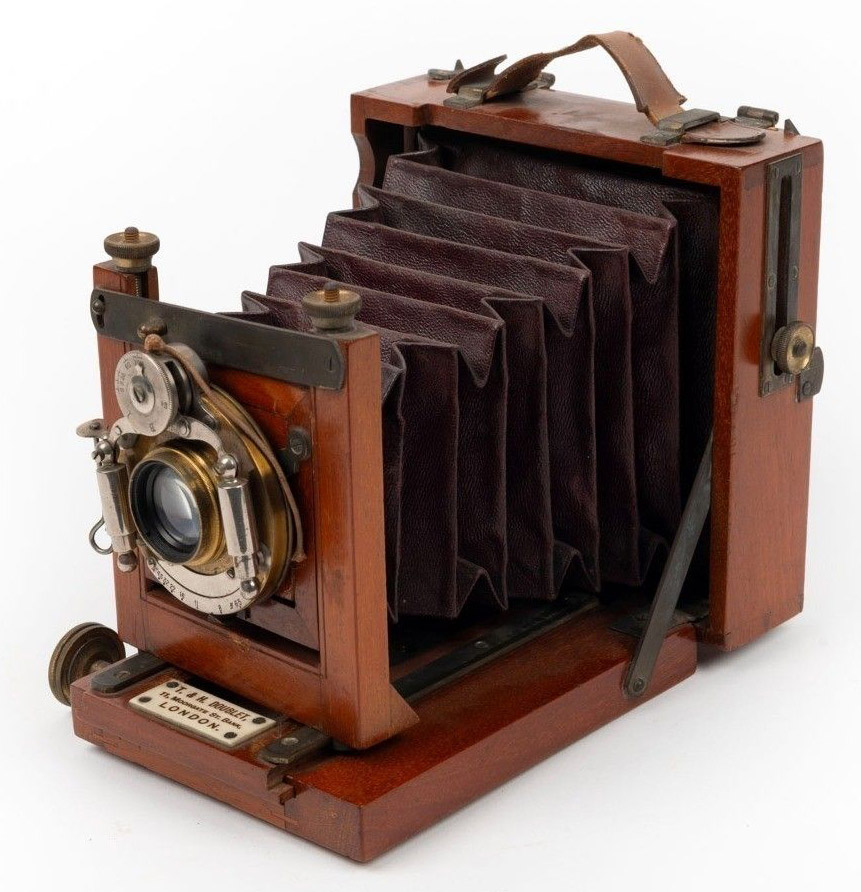
Figure 12.
A Bausch and Lomb camera, labeled for retail by T. & H. Doublet. Adapted for nonprofit, educational purposes from an internet sale site.
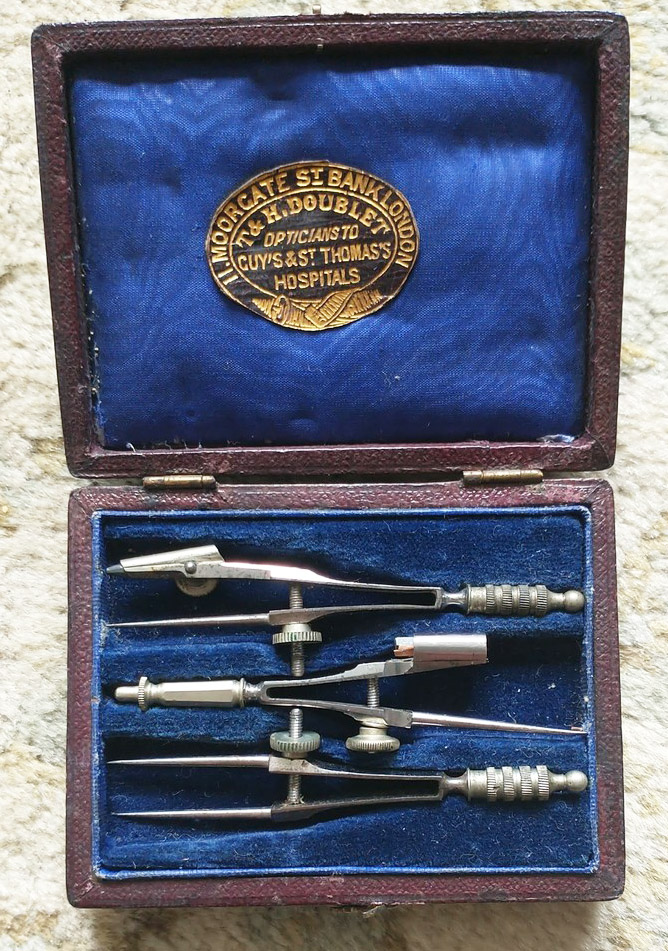
Figure 13.
A small drafting set that was retailed by T. & H. Doublet, but undoubtedly manufactured by a wholesale producer. The address of 11 Moorgate Street dates it to between ca. 1878 and 1898. Adapted for nonprofit, educational purposes from an internet auction site.
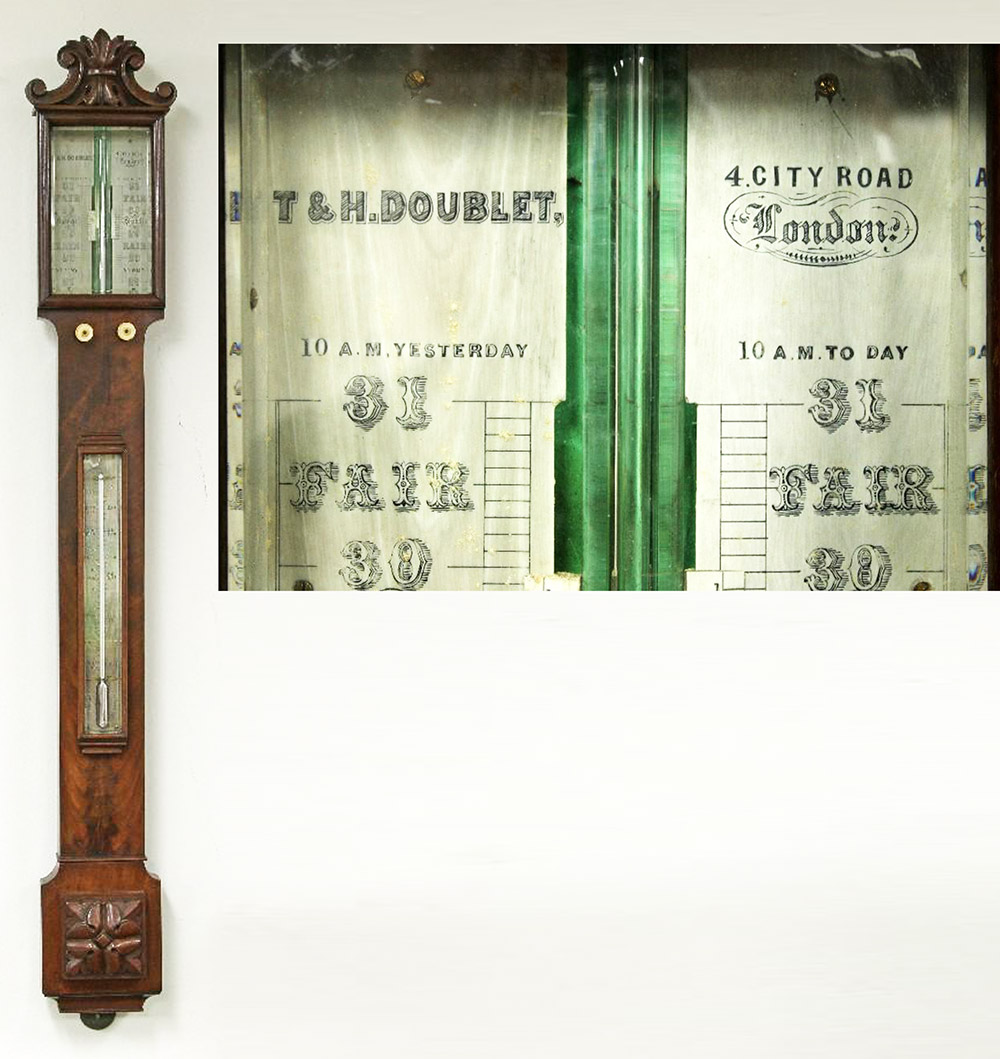
Figure 14.
Barometer that was retailed by T. & H. Doublet. The address of 4 City Road dates it to between ca. 1850 and ca. 1858. Adapted for nonprofit, educational purposes from an internet auction site.
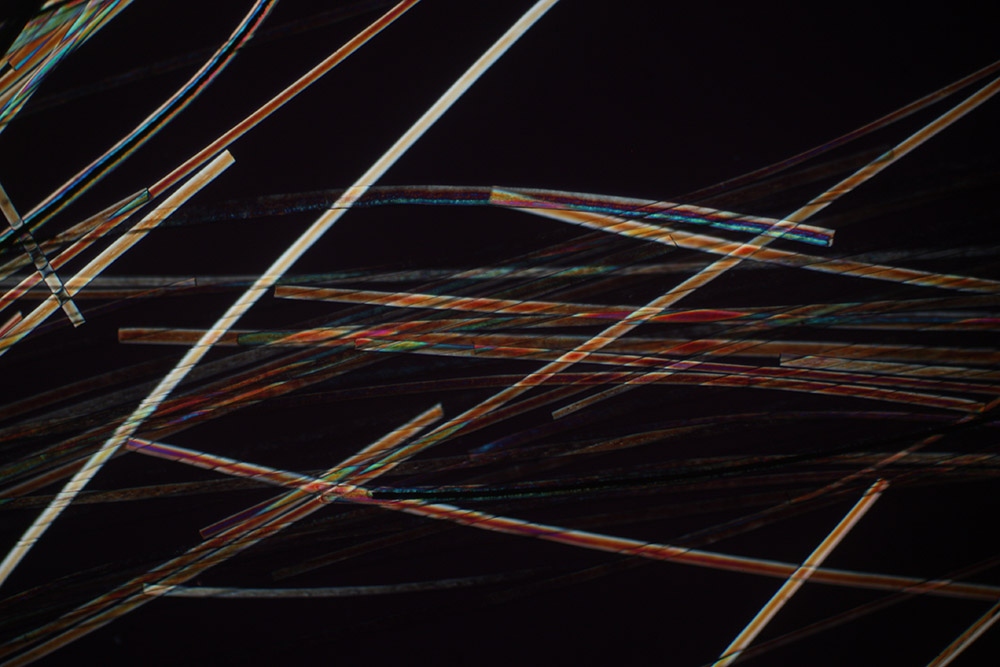
Figure 15.
Clippings of human hair, prepared by J.T. Norman and retailed by T. & H. Doublet between 1878 and 1898 (see Figure 1). Imaged with a 3.5x objective lens, C-mounted digital SLR camera, and crossed polarizing filters on a Leitz Ortholux II microscope.
Resources
Apprentice contract of Thomas Doublet 1 (1794) accessed through ancestry.com
Baptism record of Thomas Doublet 1 (1780) Parish records of St. Luke Finsbury, accessed through ancestry.com
Baptism record of Thomas Doublet 2 (1815) Parish records of St. Leonard Shoreditch, accessed through ancestry.com
Baptism record of Mary Ann Doublet (1823) Parish records of St. Leonard Shoreditch, accessed through ancestry.com
Baptism record of Thomas Doublet 3 (1845) Parish records of St. Leonard Shoreditch, accessed through ancestry.com
Bracegirdle, Brian (1998) Microscopical Mounts and Mounters, Quekett Microscopical Club, London, pages 32 and 130, Plate 13-S
British Banner (1851) “T. And H. Doublet are agents to messes. Lerebours and co., of Paris. An assortment of their instruments always on hand. Importers of object glasses”, May 21, page 16
Burial record of Thomas Doublet 1 (1823) Records of Gibraltar Burying-Ground, Bethnal Green, accessed through ancestry.com
Clifton, Gloria (1993) Directory of British Scientific Instrument Makers 1550-1851, Zwemmer, London, pages 87-88
Doublet, Thomas (1850) A Manual of Optical Instruments, T. & H. Doublet, London
England census and other records, accessed through ancestry.com
English Patents of Inventions, Specifications (1860) "Provisional specification left by Thomas Doublet …”, July 6, number 1639
Freedom of the City record of Thomas Doublet 1 (1802) accessed through ancestry.com
Freedom of the City record of Thomas Doublet 3 (1883) accessed through ancestry.com
Gardner’s Chronicle (1859) Advertisement from T. & H. Doublet, December 10, page 1006
The Intellectual Observer (1864) Advertisement from T. & H. Doublet, multiple issues, Advertiser section
Kelly’s Directory of the Watch & Clock Trades (1880) “Opticians – wholesale … Doublet Thomas, 11 Moorgate st EC”, “Opticians – retail … Doublet Thomas & Henry, 11 Moorgate st EC”, pages 53-54
Kelly's Directory of Merchants, Manufacturers and Shippers (1912) “Doublet Thomas & Henry, 118 London wall EC”, page 2056
The Law Times (1852) Advertisement from T. & H. Doublet, page 68
Marriage record of Thomas Doublet 1 and Hannah Taylor (1814) Parish records of St. James Picadilly, accessed through ancestry.com
Marriage record of Thomas Doublet 3 and Clara Haggis (1873) Parish records of Chesterton, Cambridge, accessed through ancestry.com
The Photographic Dealer (1898) "Messrs. T. & H. Doublet, opticians and photographic dealers, of Moorgate Street, have recently removed to No. 39 Moorgate Street, London, E.C., and their former premises have been pulled down", page 124
Photographic Monthly (1906) Advertisements from T. & H. Doublet, multiple issues
Post Office Directory of London (1843) “Doublet Thomas & Hen. spectacle makers, 74 Paul st, Finsb”, page 162
Post Office Directory of London (1847) “Doublet Thomas & Hen. spectacle makers, 74 Paul st, Finsb”, page 700
Post Office Directory of London (1850) “Opticians … Doublet Thomas & Henry, 4 City road, Finsbury square, & 74 Paul street”, page 1335
Post Office Directory of London (1865) “Opticians … Doublet Thomas & Henry, 6 Moorgate street EC, & 7 City road EC”, page 1824
Post Office Directory of London (1870) “Doublet Thomas & Henry, manfg. opticians & general optical warehouse, 6 Moorgate street EC”, page 816
Post Office Directory of London (1870) “Artificial Eye Makers … Doublet Thomas, 6 Moorgate street EC, ‘professional adapter of artificial eyes’ ”, page 1394
Post Office Directory of London (1875) “Doublet Thomas & Henry, manfg. opticians & general optical warehouse, 6 Moorgate street EC, & 50 Finsbury square EC”, page 861
Post Office Directory of London (1910) “Doublet T. & H., opticians, spectacle makers, philosophical, mathematical & scientific instrument makers, 39 Moorgate st. Bank EC – TN 8945 Central”, page 850
Post Office Directory of London (1915) “Doublet T. & H., opticians, spectacle makers, philosophical, mathematical & scientific instrument makers, 118 London wall EC – TN 8945 Central”, page 867
Post Office Directory of London (1920) “Doublet T. & H. (J. Carman), opticians, spectacle makers, philosophical, mathematical & scientific instrument makers, 118 London wall EC2 – TN 8945 Central”, page 1401
Post Office Directory of London (1925) “Doublet T. & H. (J. Doublet), opticians, spectacle makers, philosophical, mathematical & scientific instrument makers, 109 Finsbury pavement EC2 – TN Clerkenwell 8092”, page 1489
Probate of the will of Thomas Doublet 2 (1878) “The Will of Thomas Doublet formerly of the City-road in the County of Middlesex but late of Sidmouth House South Park Ilford in the County of Essex and 11 Moorgate-street in the City of London Optician who died 13 May 1878 at Sidmouth House was proved at the Principar Registry by Eliza Ann Doublet of Sidmouth House Widow the Relict the sole Executrix. Personal estate under £1000”, accessed through ancestry.com
Probate of the will of Thomas Doublet 3 (1920) “Doublet Thomas of 51 Shelley-avenue East Ham Essex died 6 December 1920 Probate London 25 January to Clara Doublet widow. Effects £778 18s 6d”, accessed through ancestry.com
Robson's London Directory (1839) “Doublett T. Spectacle maker, 74 Paul st, Finsbury” and “Doublet Thos. Optician, 19 Windmill st, Finsbury”, page 463
Trial record of William Field and Thomas Godwin, for theft and housebreaking (1825) accessed through https://www.oldbaileyonline.org/record/t18250630-6