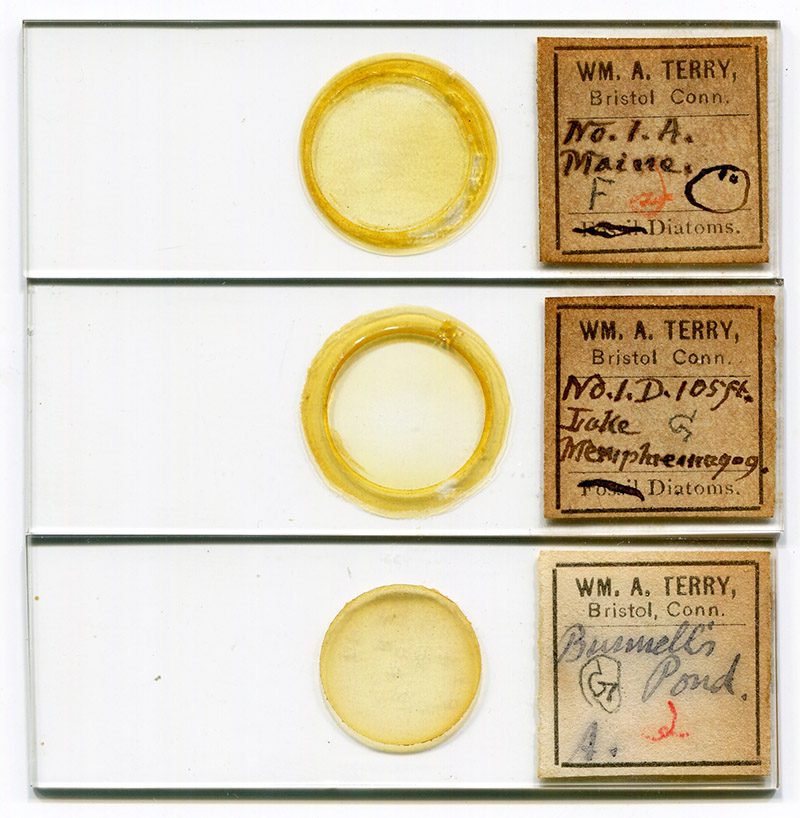
Figure 1. Microscope slides by W.A. Terry. All are strews of diatomaceae that he collected from waterbodies in Connecticut and adjacent states.
William Almerton Terry, 1828 - 1917
by Brian Stevenson
Last updated September, 2026
W.A. Terry took up the study of diatoms in 1887, when he was 58 years old, shortly before he retired from a successful career as a photographer, shopkeeper, florist, and clock-maker. He then became an expert in characterizing diatoms of his native Connecticut, USA, and surrounding areas. He wrote more than two dozen papers on identification and cultivation of diatomaceae. Terry shared his material with other experts around the world. At least four species of diatoms are named after W.A. Terry.
The majority of Terry’s diatom mounts are in museum collections, although they are occasionally encountered in private collections (Figures 1-3).
Figure 1.
Microscope slides by W.A. Terry. All are strews of diatomaceae that he collected from waterbodies in Connecticut and adjacent states.
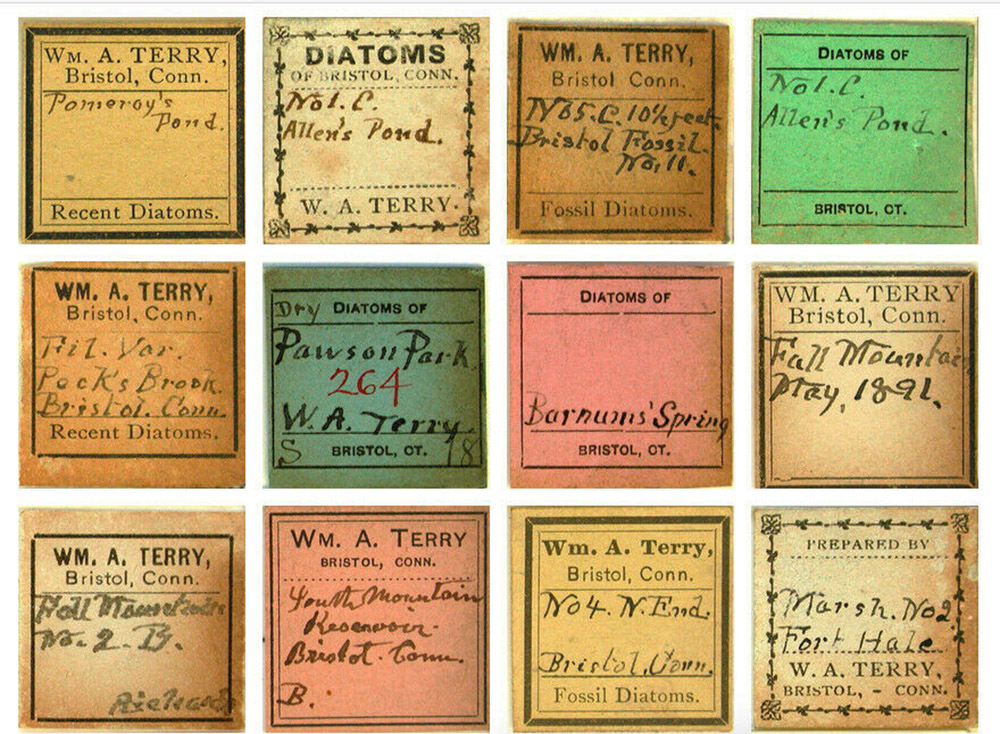
Figure 2.
Examples of customized labels that were used by William Terry on his microscope slides. Adapted for nonprofit, educational purposes from Harvard University’s Terry Collection, https://diatoms.hsites.harvard.edu/terry-labels
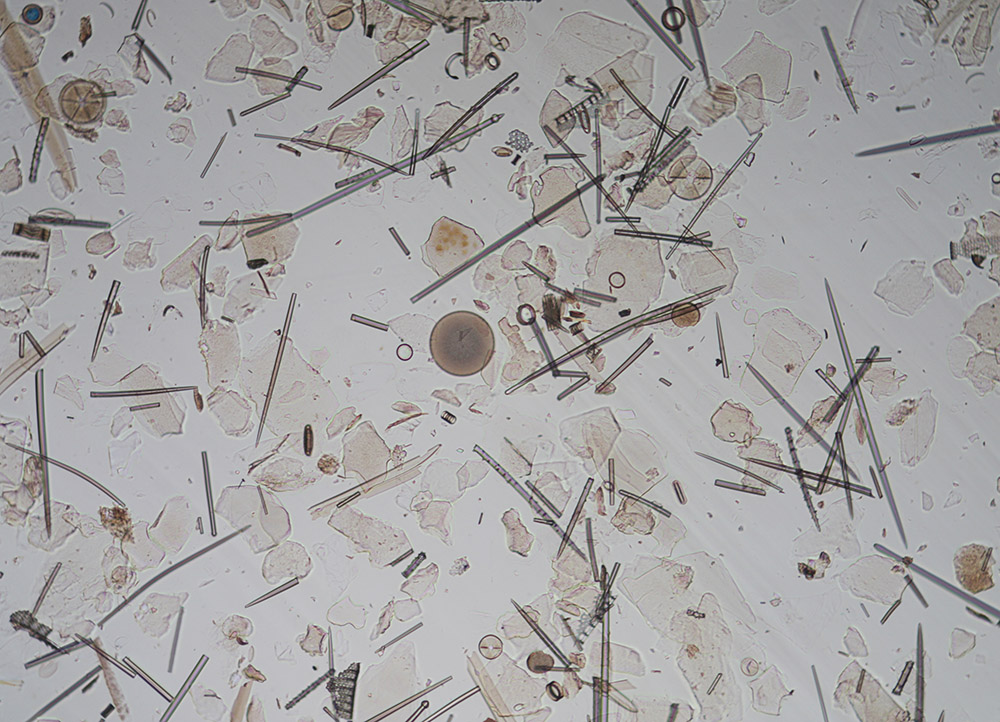
Figure 3.
“No. 1. A. Maine” diatoms, prepared by W.A. Terry (see Figure 1). Imaged with a 3.5x objective lens and C-mounted digital SLR camera on a Leitz Ortholux II microscope.
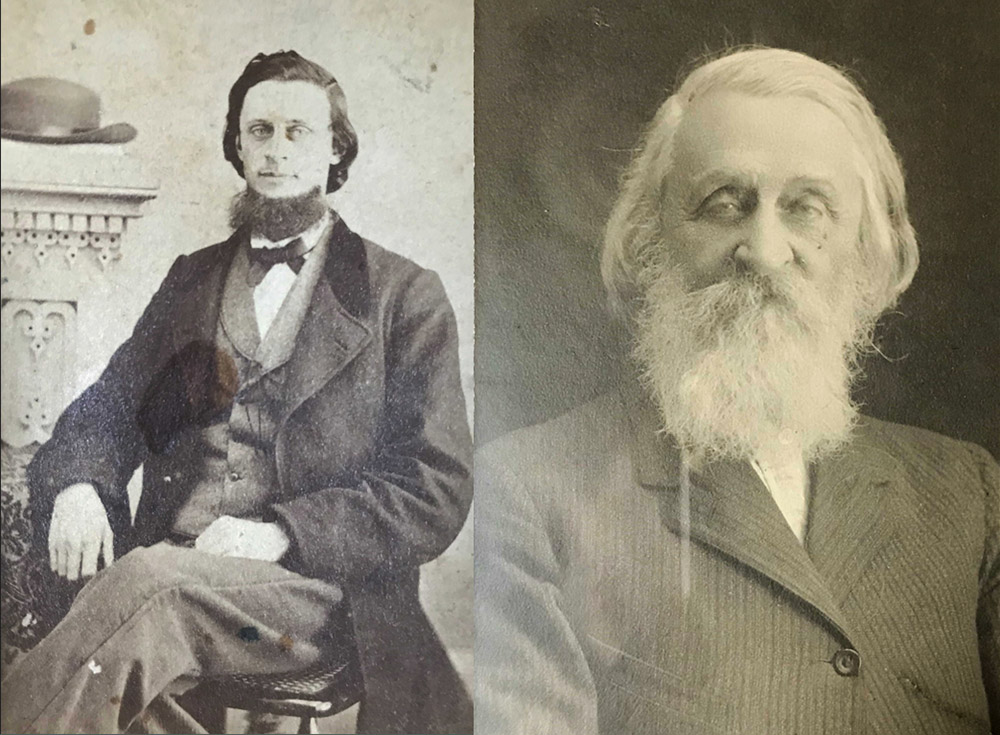
Figure 4.
William A. Terry, in middle- and old-age. Adapted for nonprofit, educational purposes from https://www.ancestry.com/family-tree/person/tree/169702163/person/132201323536/gallery
William Almeron Terry was born on October 14, 1828, in Bristol, Conencticut. He was the first child of Samuel Steel and Mary (nee Stoughton) Terry. Father Samuel was a clockmaker, as were also several of his relatives.
William left school at the age of 15, to work for his father.
He married Esther Amelia Ball on April 8, 1850. The couple had six children. The first two died before reaching their first birthdays, while the other four lived long into adulthood.
Samuel S. Terry moved his clock factory to Ansonia, Connecticut in 1850. William remained in Bristol, working as a clockmaker for about one year with Atkins & Ives, then for about two years with Terry, Downs & Co. (which was owned by his uncle, Ralph E. Terry).
Around 1853, William Terry quit the clockmaking business. He worked for several years as a tuner of melodeons (reed organs).
During the mid-1850s, he took up photography, working as both an “ambrotypist” and melodeon tuner.
Evidently a creative man, William Terry and one H.W. Harkens obtained a patent in 1857 for “apparatus for broiling, roasting, &c.”
By 1860, Terry was a full-time, professional photographer. An 1864 advertisement for “Terry’s Gallery” is shown in Figure 5. A “carte-de-visite” (CDV) photograph by Terry is shown in Figure 6.
Another two patents were issued in 1870: for a “calendar clock” and a “water wheel”. A second patent for a “calendar clock” was issued in 1875. The calendar clock was “set by moving the hands, while others had to be set by moving one day at a time. The model of it in the Patent Office, Washington, D. C., would calculate leap year correctly for more than three thousand years, leaving out leap year at the end of every fourth century”. An example with his clock movement, manufactured by the Ansonia Clock Company, is shown in Figure 7. That clock factory was owned by his father, Samuel S. Terry.
“Terry’s Art Gallery” expanded its offering over the years, to include musical instruments, sewing machines, microscopes, and flowers (Figures 8-9). William retired ca. 1893. The business was continued by his eldest son, William B. Terry, and B.A. Peck as “Terry & Peck”.
W.A. Terry made his first marks as a diatomist in 1887, publishing two multi-page “Notes on diatom studies” in t\The American Monthly Microscopical Journal. Subsequent articles included “Notes on diatoms and other algae of New Haven Harbor and adjacent waters” (1889), “A search for diatoms in Boston Harbor” (1889), and eight articles entitled “Diatoms of the Connecticut shore” (1890-1895). Three papers on culturing diatom species were published in The American Monthly Microscopical Journal in 1898 and 1899.
The web site of the Terry Collection at Harvard University writes, “For two decades commencing in 1887, when he was 58 years old, William Terry began publishing papers on diatoms he had collected from a variety of habitats in Connecticut. He published 25 papers on diatoms covering means of collecting them, their motility, their artificial culture and their spatial and temporal distributions. He focused his work on the freshwater ponds in the vicinity of Bristol, Connecticut, along the Connecticut marine shore from Milford on the west to New Haven Harbor to Branford on the east, and in the freshwater-brackish-marine deposits composing the Quinnipiac marshes north of New Haven. Much of this marine coastal work surveyed diatom distributions in the surficial sediments and down into the peat deposits of salt marshes. Terry sent diatoms samples from many of these localities to major European workers, where they became sources of descriptions of new taxa and contributions to elucidating large-scale geographical distributions. His samples are notable in J.A. Tempère & H. Peragallo's 'Diatomées du Monde Entier' (1888-1995 & 1907-1915), in P.T. Cleve's 'Synopsis of the Naviculoid Diatoms' (1894-1896), in A. Schmidt's 'Atlas der Diatomaceenkunde' (1874-1959), and in J. Brun's articles on new and poorly known diatoms in 'Le Diatomiste' (1890-1896). He exchanged materials extensively with David Boyd Ward, C.L. Peticolas, K.M. Cunningham, William Phipps Blake, John Casper Branner, Arthur Meade Edwards, T. Chalkey Palmer, Lewis Woolman, Robert Hagelstein, W.H. Pratt, Rueben Nevius and other American collectors and experts on diatoms between 1890 and 1910”.
The diatom species Cyclotella terryana, Pleurosigma terryanum, Stauroneis terryi, and Surirella terryi were named after W.A. Terry.
In 1898, The American Monthly Microscopical Journal wrote, “We have received two very interesting slides from W. A. Terry, Bristol, Conn. They represent the artificial culture of diatoms; one a two-year culture and the other a 22-year culture. He says he has nearly succeeded in convincing Prof. H. L. Smith that they are produced from spores”. An obituary for Terry wrote that “He contributed many skillfully made microscopical slides” to another scientific magazine, The Observer. Sharing microscope slides with editors of science magazines was a common means of free advertisement if one wanted to sell or exchange such items.
W.A. Terry published articles on other topics, such as his 1896 “Among water plants”. The American Botanist wrote that Terry “was long a subscriber of, and contributor to, this magazine”.
Following a prolonged period of illness, William A. Terry died on October 31, 1917, at his home in Bristol.
Robert K. Edgar wrote that “By the end of his career as a diatomist, conducted independently of any association with scientific institutions and their resources, Terry had accumulated nearly 5000 slides and 2000 vials of diatoms”.
He further wrote, “Terry had shown little interest inorganizing his collection and left no instructions for its disposition upon his death. In 1918 his diatoms were sold to George A. Fisher of Reading, Massachusetts, an amateur collector who had purchased the personal collections of other American diatomists. He made hundreds of slides from Terry’s samples, cleaned and re-cleaned samples for his personal collection, but put them to no scientific use. In the 1930s, Fisher sold all of his collection to Clarence A. Cheaver of Milton, Massachusetts, another amateur collector. In 1941 Cheaver donated his huge collection, encompassing Terry’s, to the Farlow” (i.e. the Farlow Herbarium of Harvard University).
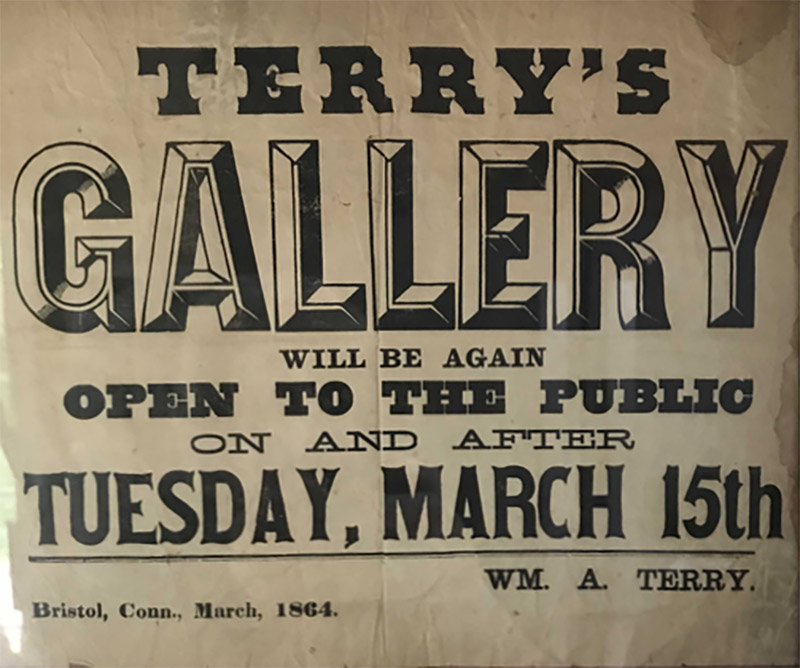
Figure 5.
1864 advertisement for W.A. Terry’s photographic studio. Adapted for nonprofit, educational purposes from https://www.ancestry.com/family-tree/person/tree/169702163/person/132201323536/gallery
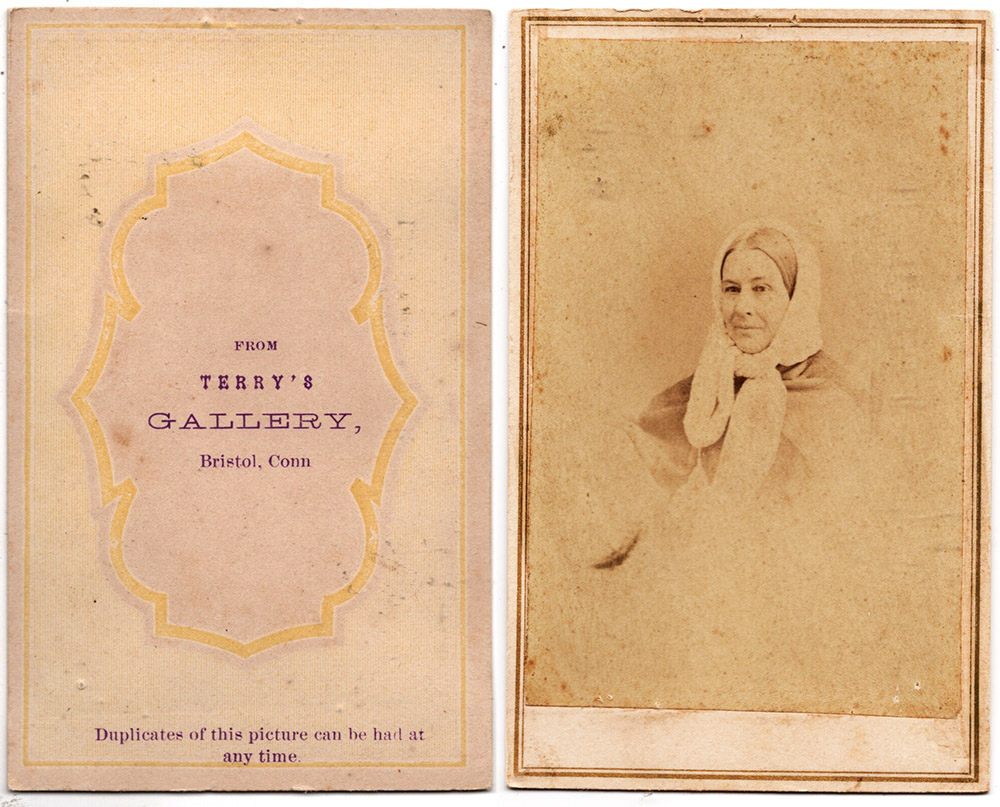
Figure 6.
ca. 1860s carte-de-visite photograph, from Terry’s Gallery. Adapted for nonprofit, educational purposes from an internet auction site.
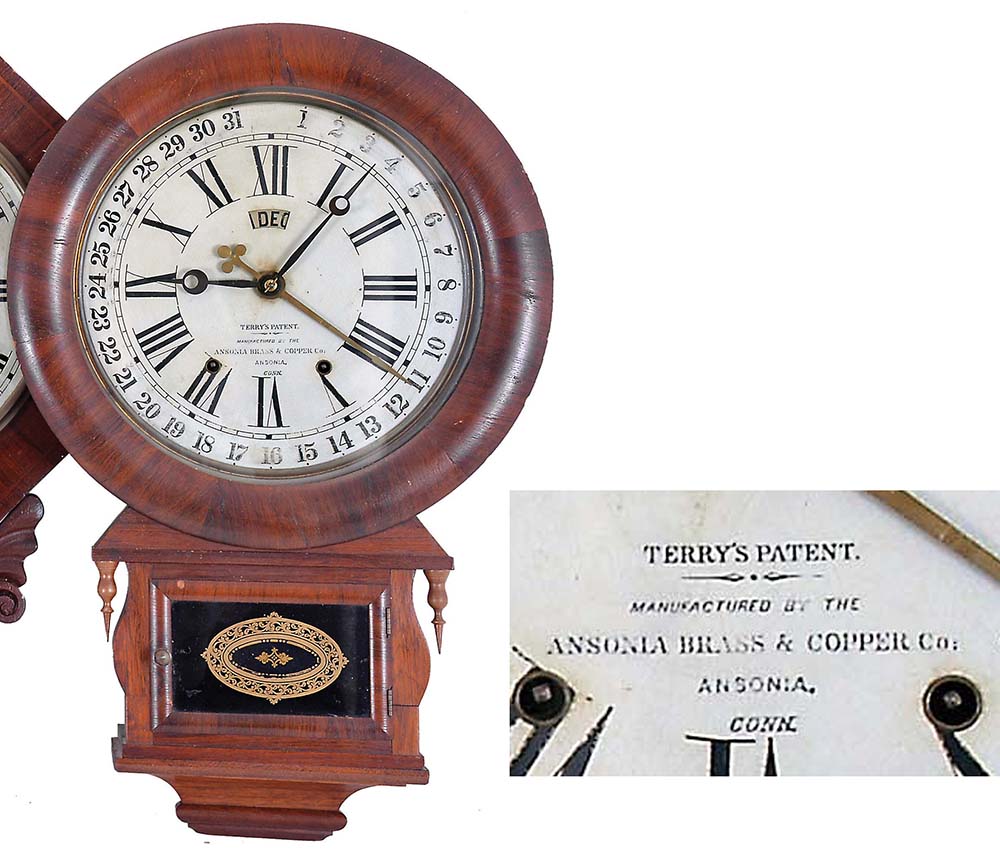
Figure 5.
ca. 1877 clock that was manufactured by the Ansonia Brass & Copper Co., featuring William Terry’s patented calendar clock movement. The Ansonia firm was owned by William’s father, Samuel S. Terry. Images adapted for nonprofit, educational purposes from an internet auction site.
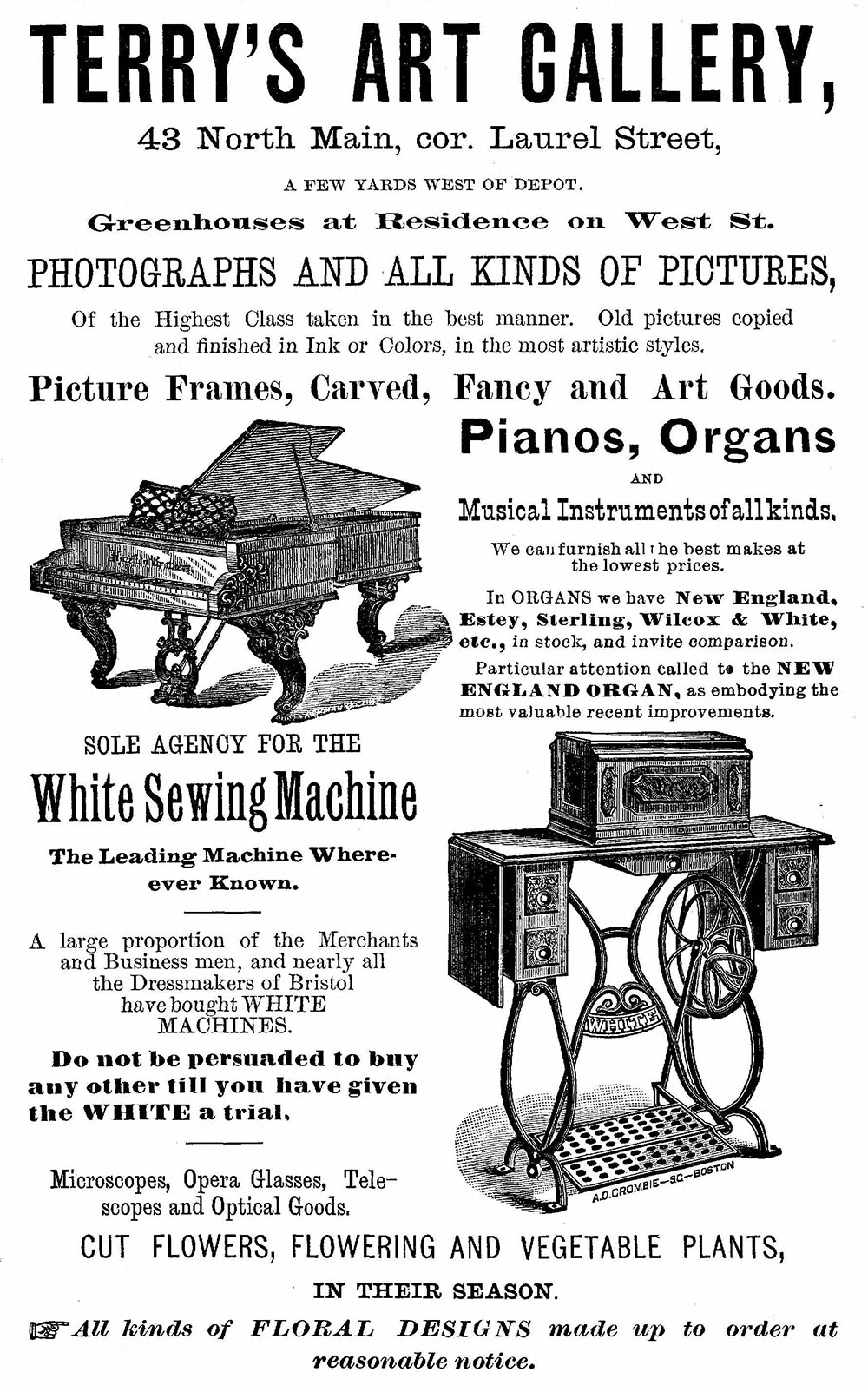
Figure 8.
1886 advertisement for Terry’s Art Gallery, showing the diversity of products that he provided. From “Bristol City Directory”.
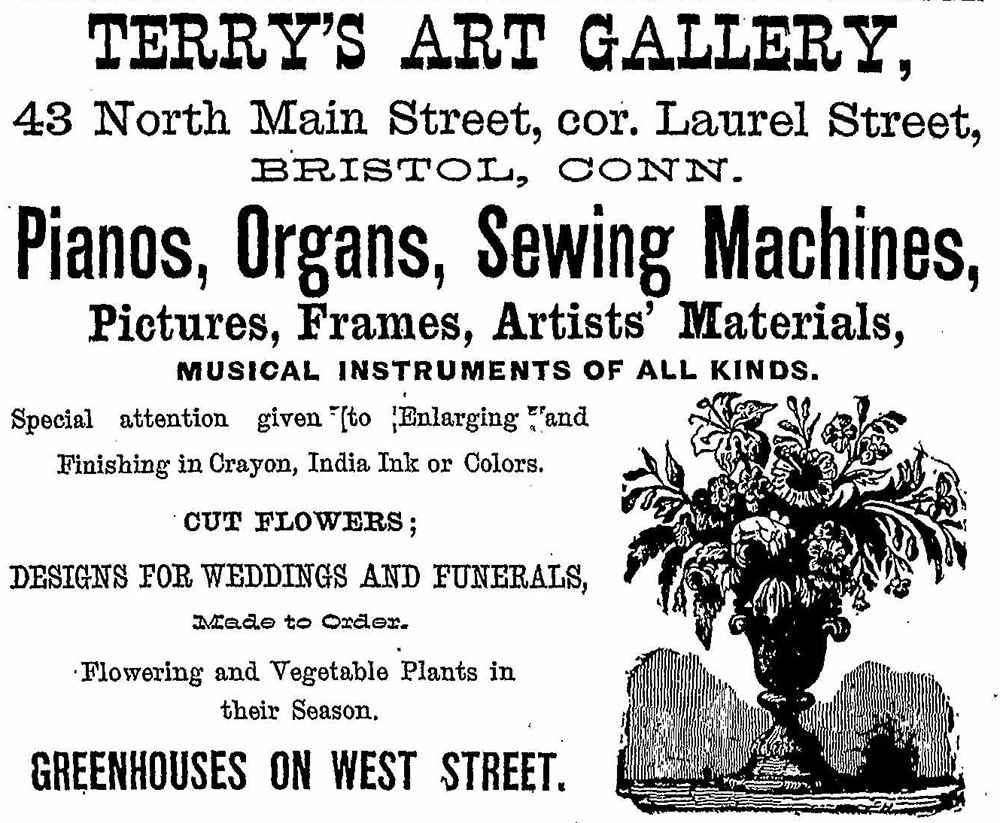
Figure 9.
1893 advertisement for Terry’s Art Gallery. From “Bristol City Directory”.
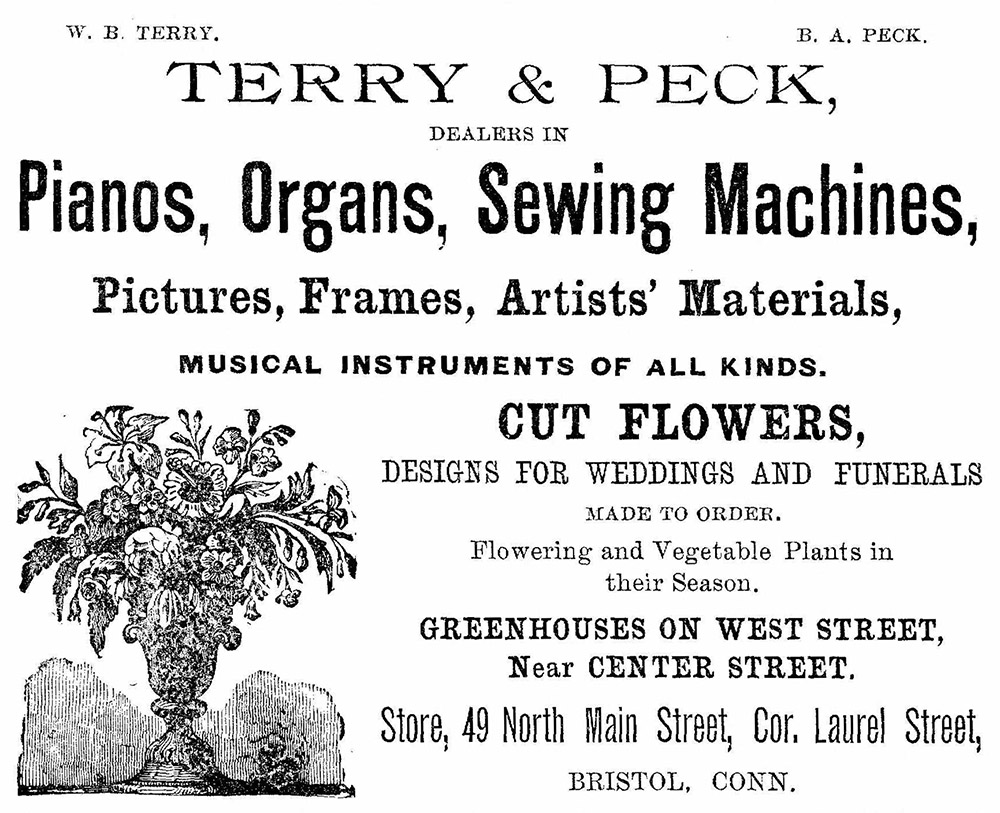
Figure 10.
W.A. Terry retired ca. 1893, and the business was continued by his son, William B. Terry, and B.A. Peck. 1895 advertisement, from “Bristol City Directory”.
Resources
The American Botanist (1917) Death of William A. Terry, page 142
The American Monthly Microscopical Journal (1898) Slides, page 160
Beckwith's Almanac (1857) Patents issued, page 56
Bristol Directory (1882) Advertisement for Terry’s Art Gallery, page 12
Bristol Directory (1886) Advertisement for Terry’s Art Gallery, page 8
Bristol Directory (1893) Advertisement for Terry’s Art Gallery, page 246
Bristol Directory (1895) Advertisement for Terry & Peck, page 249
Bulletin of Photography (1917) William Almeron Terry, page 482
The College Courant (1870) List of patents, pages 345 and 394
Commemorative Biographical Record of Hartford County, Connecticut (1901) William Almeron Terry, J.H. Beers & Co., Chicago, pages 274-277
Edgar, Robert K. (2003) The William A. Terry Diatom Collection, Newsletter of the Friends of the Farlow, number 41
The Guide to Nature (1917) William Almeron Terry, page 220
Palmer, T. Chalkley (1911) Stauroneis terryi D.B. Ward, Proceedings of the Academy of Natural Sciences of Philadelphia, pages 456-459
Specifications and Drawings of Patents Issued from the United States Patent Office (1875) 165432 Calendar-clocks. W.A. Terry, Bristol, Conn., pages 301-303
Terry Collection (accessed September, 2026) https://diatoms.hsites.harvard.edu/terry-collection
Terry, W.A. (1896) Among water plants, The Observerpages 535-537
US census and other records, accessed through ancestry.com
Weekly Florists' Review (1912) “Terry & Peck, who have been in business as florists at the corner of North Main and Laurel streets for more than a quarter of a century, have sold out to John C. Cullem. Judge B.A. Peck, who was a member of the firm, died recently, and the other member, William B. Terry, did not care to continue. The new owner intends to remodel the store and add stationery, confectionery and other side lines.”, page 84