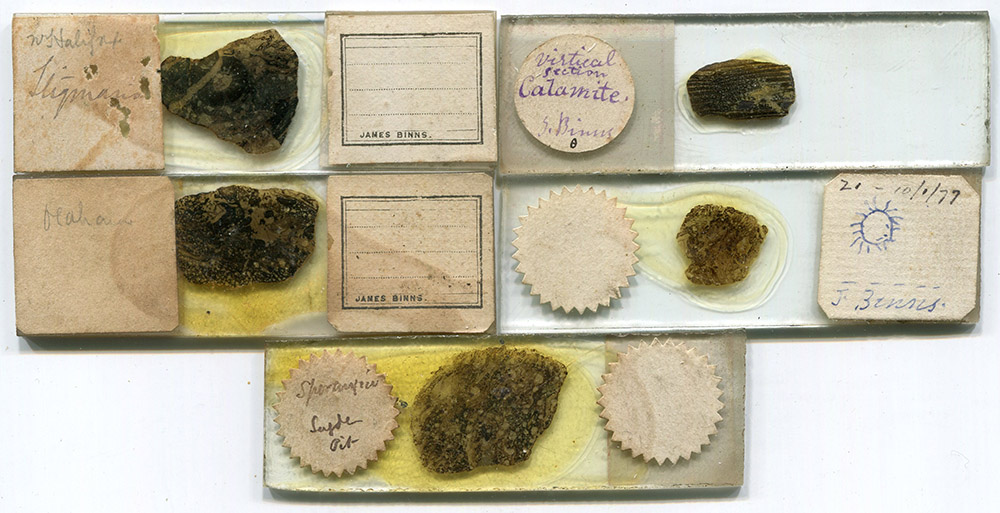
Figure 1. Figure 1. Microscope slides by James Binns, all of fossil plants in coal sections. One is dated October 1, 1877. He applied liberal amounts of balsam over many of the specimens.
James Binns, 1836 - 1904
by Brian Stevenson
last updated June, 2026
James Binns worked as a manual laborer in stone quarries of Halifax, Yorkshire, yet taught himself botany and learned to recognize the plant fossils that he found in coal. Binns discovered many new species among those fossils, which he provided to his academic colleagues for descriptive publications.
Binns also became an expert in preparing thin-sections of coal fossils and mounting them on slides. He advertised to sell them commercially. Many other slides were given or sold to his scientific colleagues, and may be found in museum collections.
Paleontology colleagues William Cash (1843-1914) and Thomas Hick (1840-1896) wrote of, “our friend, Mr. James Binns, of Halifax, who has long worked hard in this field of research, and indeed has discovered most of the novelties which this district has yielded. Though one of those whose only college has been the university of Nature, and who … has matriculated in a stone quarry, yet his fine powers of observation, trained by long and patient practical study of recent plants in the field, have enabled him to detect the analogies between fossil and existing forms; and, joined to this, he has a rare manipulative skill in preparing sections of fossil plants for the microscope (a by no means easy task), which gives promise, we trust, of still further contributions from his hands to the fossil flora of the Halifax district.”
Figure 1.
Figure 1. Microscope slides by James Binns, all of fossil plants in coal sections. One is dated October 1, 1877. He applied liberal amounts of balsam over many of the specimens.
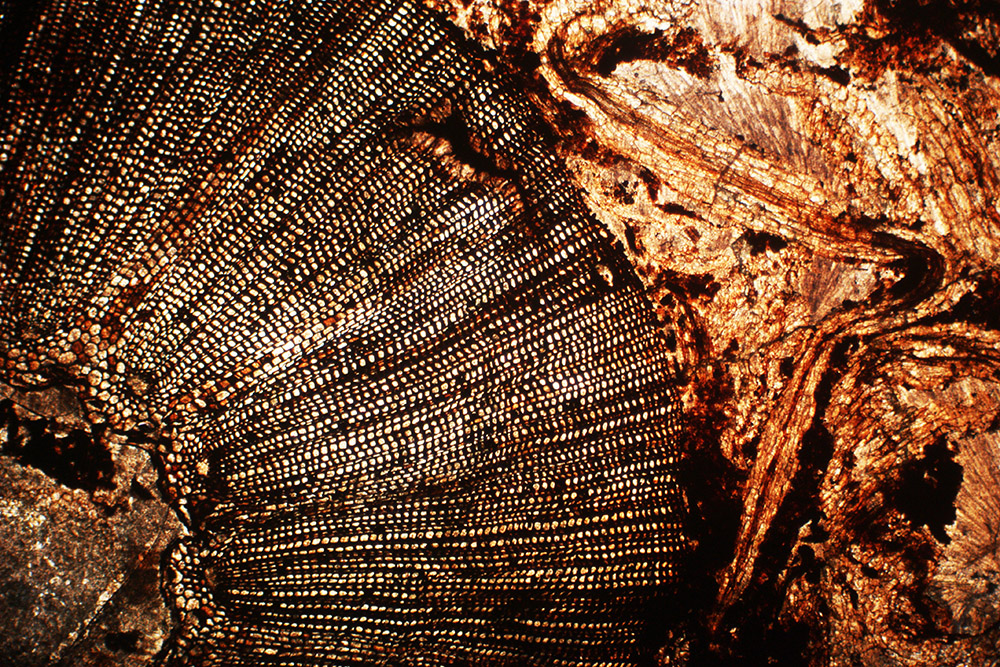
Figure 2.
“Stigmaria” from Halifax coal, prepared ca. 1880s by James Binns (see Figure 1). Imaged with a C-mounted digital SLR camera and 3.5x objective lens on a Leitz Ortholux II microscope.
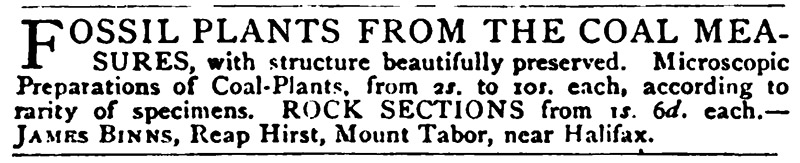
Figure 3.
March, 1880 advertisement by James Binns, from “Hardwicke’s Science-Gossip”.
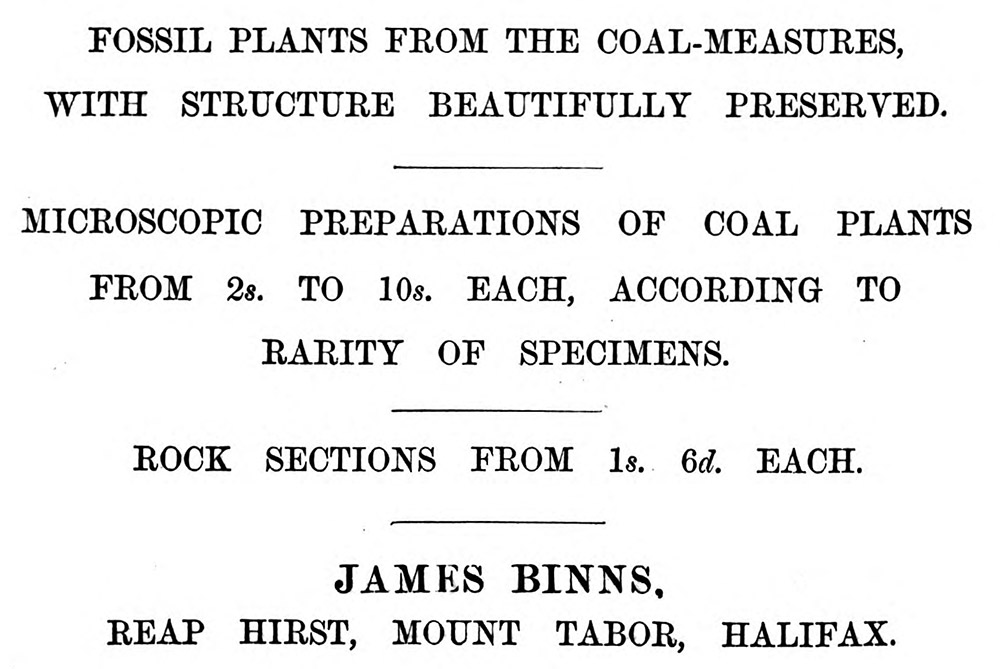
Figure 4.
Another March, 1880 advertisement by James Binns, from “Geological Magazine”.
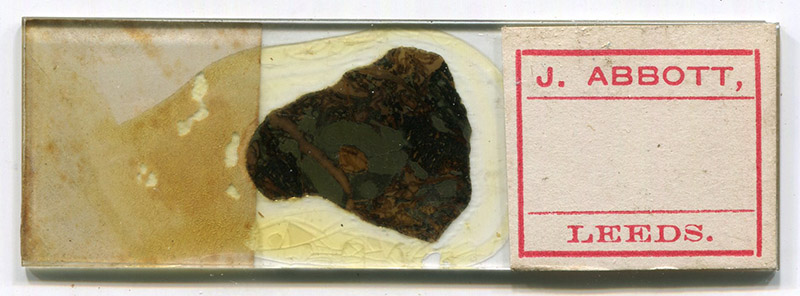
Figure 5.
Each of the slides shown in Figure 1 has a retail label from James Abbott (1832-1889) on the back. Abbott was a pharmaceutical chemist, member and officer of the Leeds Naturalists' Club & Scientific Association, and Demonstrator in the Biology Department of Yorkshire College.
James Binns was born on November 20, 1836 in Ovenden, Yorkshire. He was the fourth of six children, and second son, of William and Mary Binns. The 1841 census described father William as a “stone delver”, meaning that he primarily extracted and moved stones from a quarry. The Binns family was relatively poor, and everyone had to work. The 1841 census lists that the eldest children, Samuel and Sarah, aged around 10, both worked in a fabric mill. James probably entered work around the same age: the 1851 census lists him as a “factory worker”.
Binn's September 7, 1853 marriage record to Grace Wade showed that he had taken up work as a “delver”. The 1861 census listed his occupation as “stone cutter”, suggesting that he had acquired skills to break rocks apart. The 1881 and 1891 censuses described him as a “stone dresser”, implying that he shaped and smoothed stones.
Despite the hard physical labor necessary for quarrying stone, Binns found time to educate himself and to explore the coal piles and spoil heaps of nearby coal mines. Referring to the quote from Cash and Hick that was cited at the beginning of this essay, Binns used his knowledge of modern botany to identify fossil plants that he found in the coal. Binns’ skills were such that he identified fossil fungi on coal bed plants. Binns does not appear to have published any descriptive papers on his discoveries. Instead, he passed his findings along to academics such as Cash and Hick, who published extensively on additions “to our Fossil Flora, (and) we have once more to record our thanks to our indefatigable friend, Mr. James Binns, of Warley, near Halifax, who has already furnished us with several new forms”.
Binns was probably more interested in receiving money for his finds, rather than publication credits. It is reasonable to assume that Cash, Hick, William C. Williamson (1816-1895), and other authorities paid Binns for the samples that he provided to them. He advertised to sell microscope slides of his preparations during 1880, at least (Figures 3 and 4).
He became a member of the Lancashire and Yorkshire Palaeobotanical Society, which was founded in 1893. That group included two other laborers who became expert paleontologists and slide-makers, John Butterworth and James Spencer, as well as Cash, Hick, and other local enthusiasts.
An 1896 survey of quarries in the United Kingdom described James Binns as “owner or company (i.e. occupier)” of the Nab Hill sandstone quarry. This suggest that he was at least site manager by that stage in life.
The 1901 census recorded that 65 year-old James Binns was retired and “living on own means”. He and Grace lived with their unmarried son and daughter, both of whom worked in a fabric mill, and a married daughter, her husband, and their infant son.
James Binns died during the summer of 1904, in Halifax.
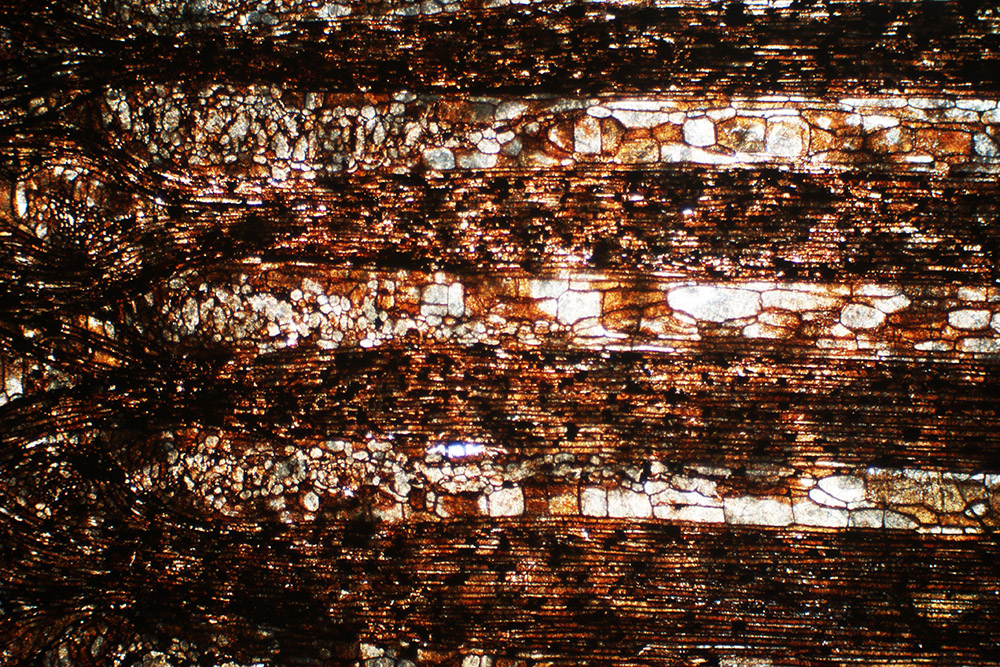
Figure 6.
“Vertical section of Calamite”, prepared by James Binns (see Figure 1). Imaged with a C-mounted digital SLR camera and 3.5x objective lens on a Leitz Ortholux II microscope.
Acknowledgement
Thank you to Michael Bell for generously providing microscope slides by James Binns and for continued support of the microscopist.net project.
Resources
Baker, R. A. and Gill, D. S. (2018) Fossil hunting and grinding in the Coal Measures: William Cash (1843-1914), his associates, and their work on the fossil plants of the Carboniferous period, Journal of Natural Science Collections, Vol. 5, pages 89-97, accessed through https://www.natsca.org/sites/default/files/publications/JoNSC-Vol5-BakerGill2018.pdf
Baptism record of James Binns (1837) accessed through ancestry.com
Cash, William, and Thomas Hick (1878) A contribution to the flora of the lower coal measures of the Parish of Halifax, Yorkshire, Proceedings of the Yorkshire Geological and Polytechnic Society, pages 73-78
Cash, William, and Thomas Hick (1879) On fossil fungi from the lower coal measures of Halifax, Proceedings of the Yorkshire Geological and Polytechnic Society, pages 115-121
Cash, William, and Thomas Hick (1881) A contribution to the flora of the lower coal measures of the Parish of Halifax, pt. III, Proceedings of the Yorkshire Geological and Polytechnic Society, pages 400-405
Crossland, C. (1907) The study of fungi in Yorkshire, (“We must take our thoughts back for a moment to the dim past, when the Halifax Coal Measures were in process of formation on the surface. We have evidence that even at that remote period fungi were at work. In 1878, Messrs. W. Cash and T. Hick discovered traces of their presence in the shape of fossilized spores, mycelium, etc. in these beds. They were described and recorded in the Proceedings of the Yorkshire Geological and Polytechnic Society (1879, pp. 115-122). The two able authors generously inform us that the material and sections showing these traces of fossil fungi were found and cut by the late James Binns, a Halifax quarryman, and a field botanist”), The Naturalist, pages 81-97
England census and other records, accessed through ancestry.com
Geological Magazine (1880) advertisement from James Binns, March advertiser section page xxiii
Hardwicke’s Science Gossip (1880) advertisement from James Binns, March advertiser section
Marriage record of James Binns and Grace Wade (1853) accessed through ancestry.com
Quarries: List of Quarries (under the Quarries Act, 1894) in the United Kingdom of Great Britain and Ireland, and the Isle of Man (1896) Nab Hill quarry, page 113