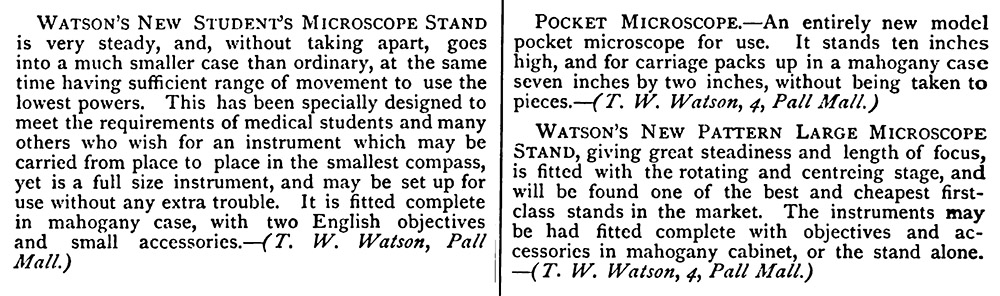
Figure 1. The earliest known information on Thomas Watson’s business, descriptions of three microscopes, published in the September 15, 1877 issue of “The London Medical Record”.
T.W. Watson
Watson Brothers:
Thomas William Watson, 1848 - 1933
Arthur Henry Watson, 1857 - 1937
by Brian Stevenson
last updated September, 2025
The London businesses of T.W. Watson and Watson Brothers were relatively small-scale manufacturers of microscopes and other apparatus, and retailers of used microscopes and other scientific instruments. They also sold new and used guns of a variety of makers, and by the late 1890s turned their focus to almost exclusively manufacturing and selling firearms.
The Watson businesses got a major boost in 1879 when Thomas Watson was engaged by geologist Frank Rutley (1842-1904) to produce a high-quality petrographic microscope that featured state-of-the-art mechanisms and an English-style body. Rutley described Watson’s model in his 1879 book, The Study of Rocks: An Elementary Text-book of Petrology, and also in a letter to the scientific journal Nature (Figure 1).
Thomas and Arthur Watson were brothers. Thomas began T.W. Watson in 1876 or ’77. Arthur joined him in 1884, forming Watson Brothers. Their father was a brother of William Watson, whose variety store grew to focus on firearms and scientific equipment, and eventually became the famous W. Watson & Sons microscope firm. Thomas had worked for his uncle prior to opening his own shop.
A detailed history of Thomas and Arthur Watson, and their businesses, is presented after Figure 15. As I researched these men and their works, I came across numerous recent publications that repeated false statements. These likely started as someone making a guess about something, which was then repeated by another person as if it was a fact. I strive to make these historical essays as accurate as possible, based on documents that were contemporary with the subjects. Information in this essay should help clear up the misinformation about T.W. Watson / Watson Brothers, but I will deal with a few egregious errors here:
T.W. Watson was begun by Thomas W. Watson ca. 1876, and his brother, Arthur, joined ca. 1884 to form Watson Brothers. One frequently encounters descriptions of the business that erroneously claim that T.W. Watson was the father of Thomas and Arthur.
There was only one person named Thomas W. Watson associated with the T.W. Watson/Watson Brothers and W. Watson businesses. The same man appeared in two different locations during the 1871 national census due to a flaw in the counting method, as described in detail below.
Thomas W. Watson was son-in-law to the firearms designer and manufacturer William Tranter, but did not marry Tranter’s daughter, Mary, until 1882. Several recent publications suggested that Tranter may have helped Watson to acquire his business. But, since Watson opened his shop in 1876 or 1877, it is far more likely that his gun-selling business led him to meet Tranter, and, subsequently, Mary. I note also that Watson was 12 years older than Mary, and she was only 15-16 years old when he opened his shop.
It is often repeated that T.W. Watson acquired his shop from a famous London firearms maker named Durs Egg, and that Watson possibly worked with Egg or one of his heirs. The truth is that Durs Egg died in 1831, and so could not have met Watson. Moreover, although Egg and Watson both operated from 4 Pall Mall, their businesses were separated in time by three other, unrelated businesses. Government records indicate that Thomas Watson worked for his uncle William until at least 1871, by which time the Egg family was out of the gun-making business.
Figure 1.
The earliest known information on Thomas Watson’s business, descriptions of three microscopes, published in the September 15, 1877 issue of “The London Medical Record”.
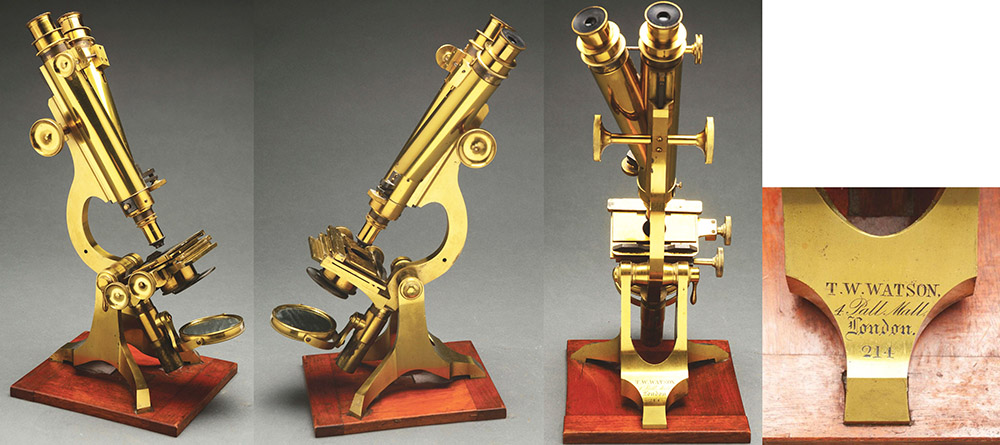
Figure 2.
A binocular microscope, signed by T.W. Watson, serial number 214. This may be an example of his “New Pattern Large Microscope” (see Figure 1). Watson presumably built this microscope, although it is possible that some of the components were acquired from wholesale manufacturers. Only a few microscopes by T.W. Watson / Watson Brothers are known (see also Figures 3-5), but the serial numbers range above 5000. A possible explanation is that they used a single series of serial numbers for all of their products, and that many of the other numbered items were guns and other apparatus. Images adapted for nonprofit, educational purposes from an internet sale site.
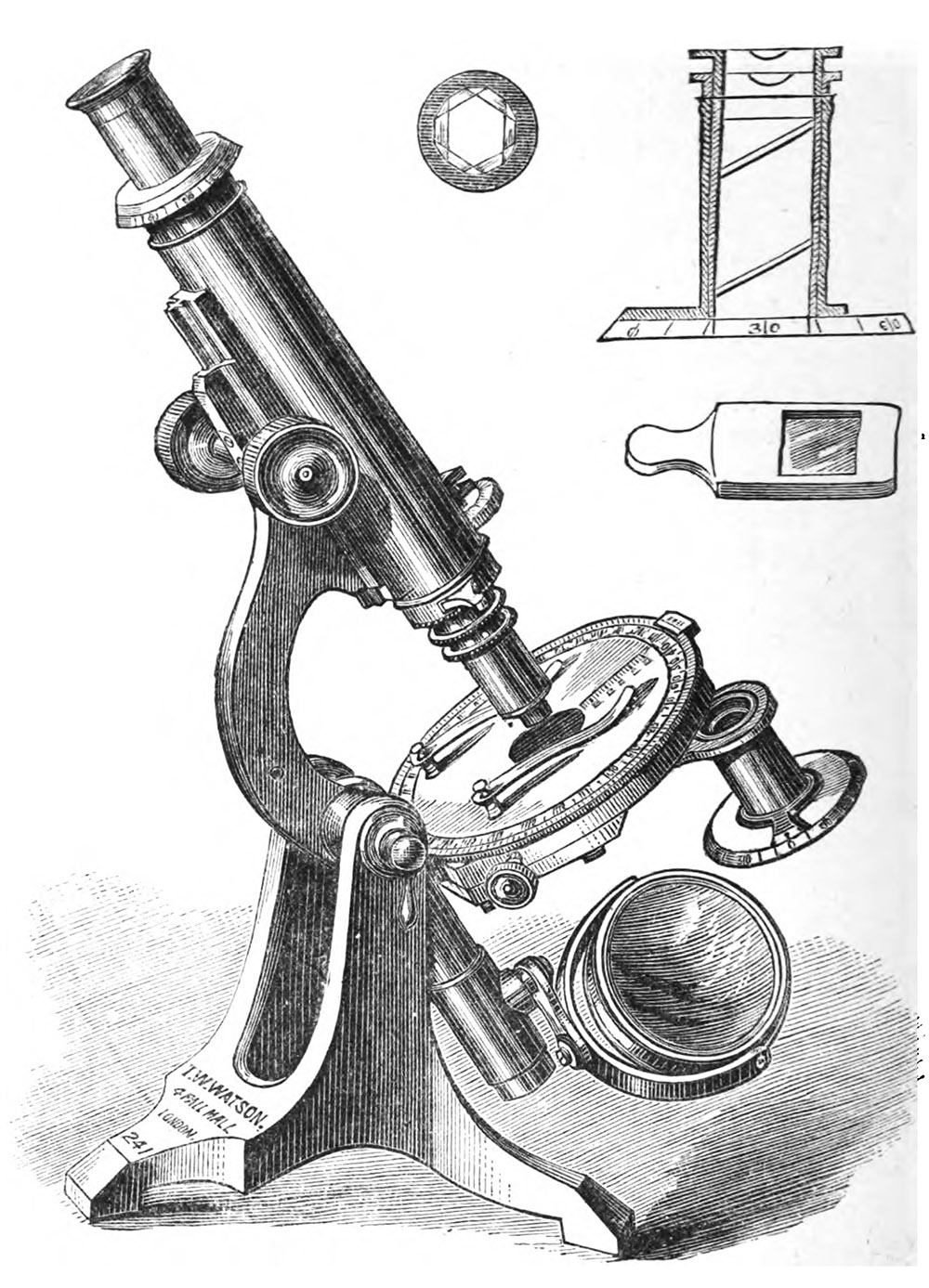
Figure 3.
Geologist Frank Rutley (1842-1904) engaged Thomas W. Watson to produce a purpose-built petrological microscope that incorporated designs of Karl H.F. Rosenbusch onto an English-style instrument. Rutley wrote about this new instrument in his 1879 “The Study of Rocks: An Elementary Text-book of Petrology” and in a letter to “Nature” that same year. It was also featured in "The Journal of the Royal Microscopical Society". Rutley described it as “a sound and serviceable instrument, and, after long experience of microscopes, I can confidently say that I have never seen one better suited for the work for which it is designed.”
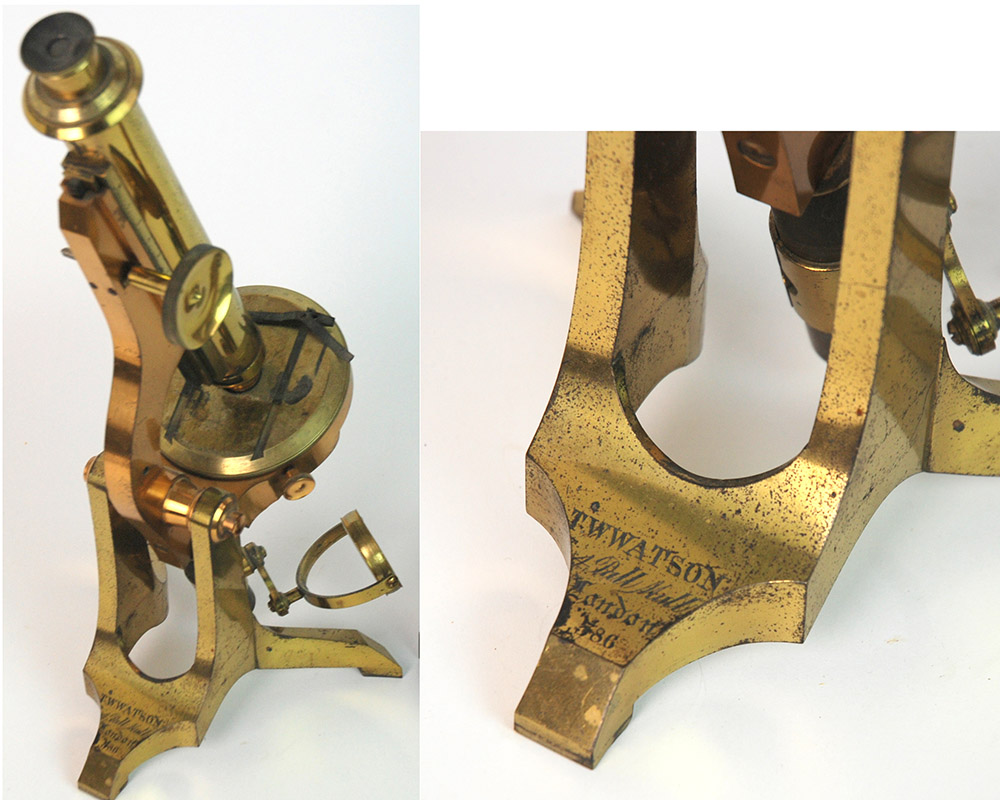
Figure 4.
A Rutley model monocular microscope by T.W. Watson, serial number 586. Images adapted for nonprofit, educational purposes from an internet sale site.
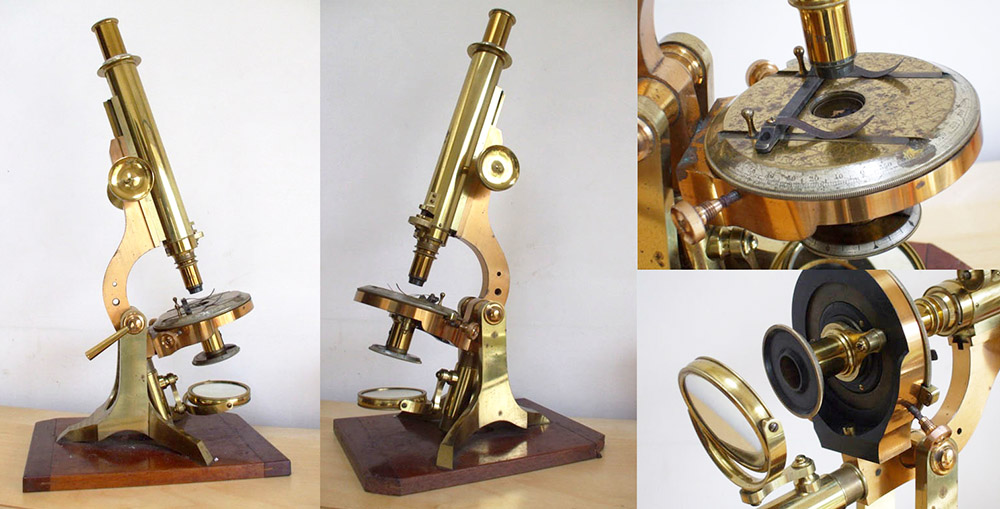
Figure 5.
A Watson Brothers Rutley model microscope, serial number 5159. It is engraved with the address of 4 Pall Mall, thus dating it to between 1884 and ca. 1890. Images adapted for nonprofit, educational purposes from https://www.mineralogy.eu/optical/microscopes/Watson_5159.html
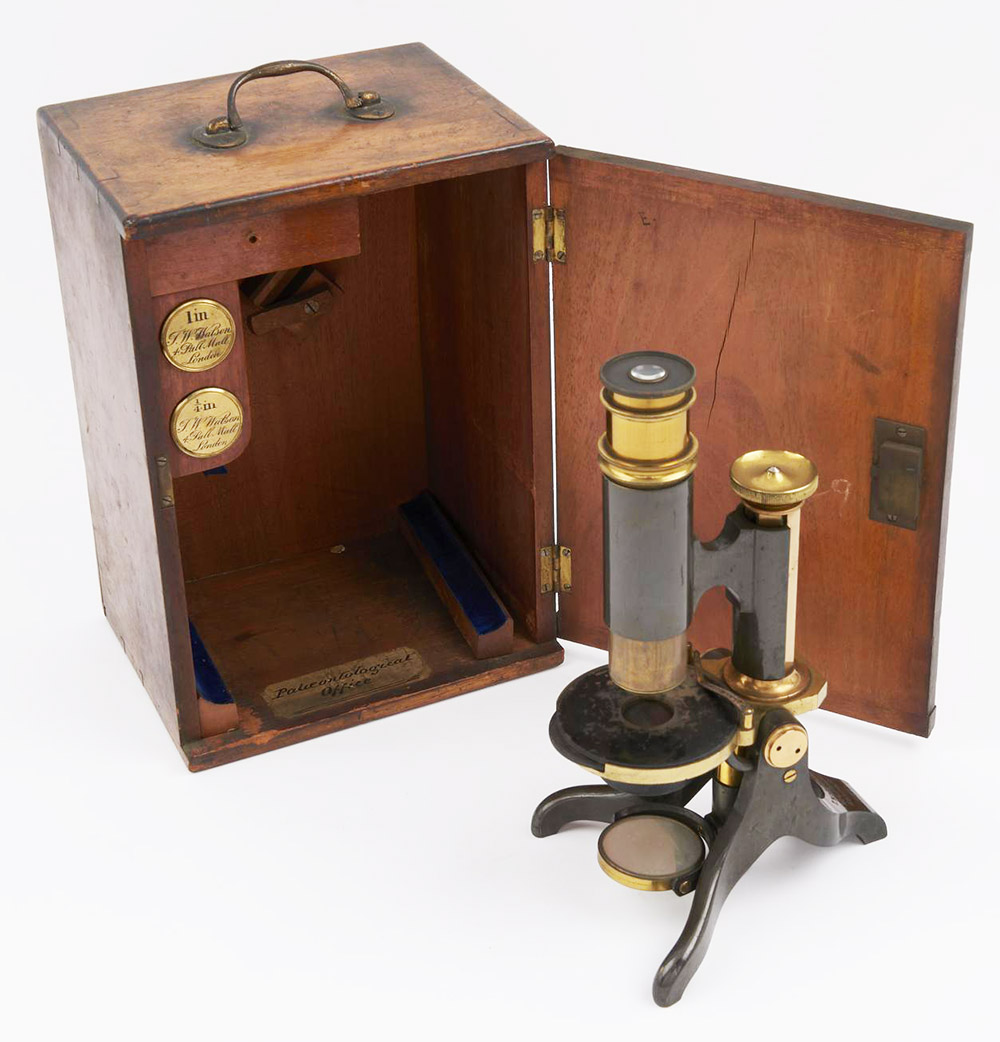
Figure 6.
Signed by T.W. Watson, although probably manufactured by Baker, London. Serial number not shown in source material. Image adapted for nonprofit, educational purposes from https://collection.sciencemuseumgroup.org.uk/objects/co8477/microscope-made-by-t-w-watson-4-pall-mall
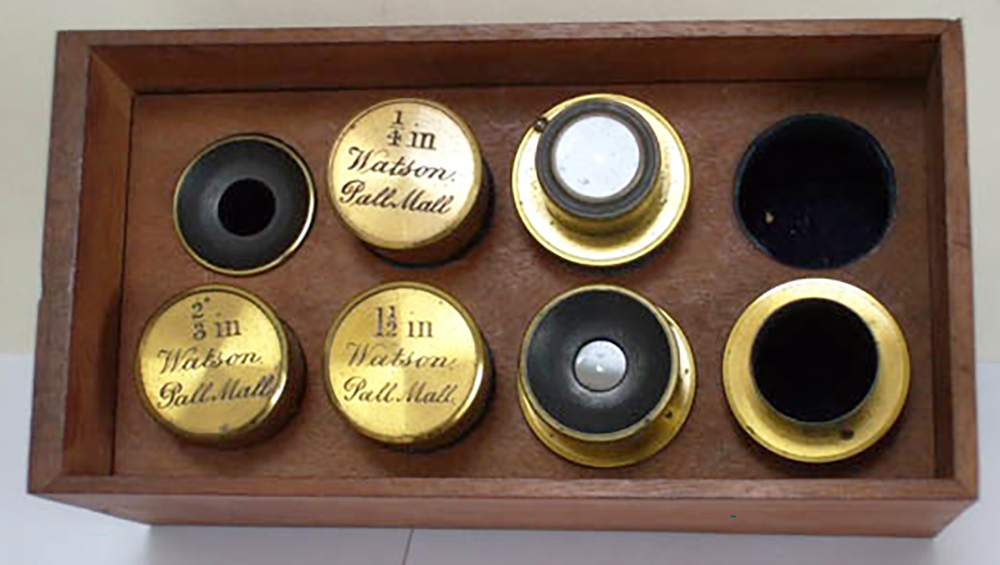
Figure 7.
Microscope objective lens canisters signed by T.W. Watson. Image adapted for nonprofit, educational purposes from https://www.mineralogy.eu/optical/microscopes/Watson_5159.html
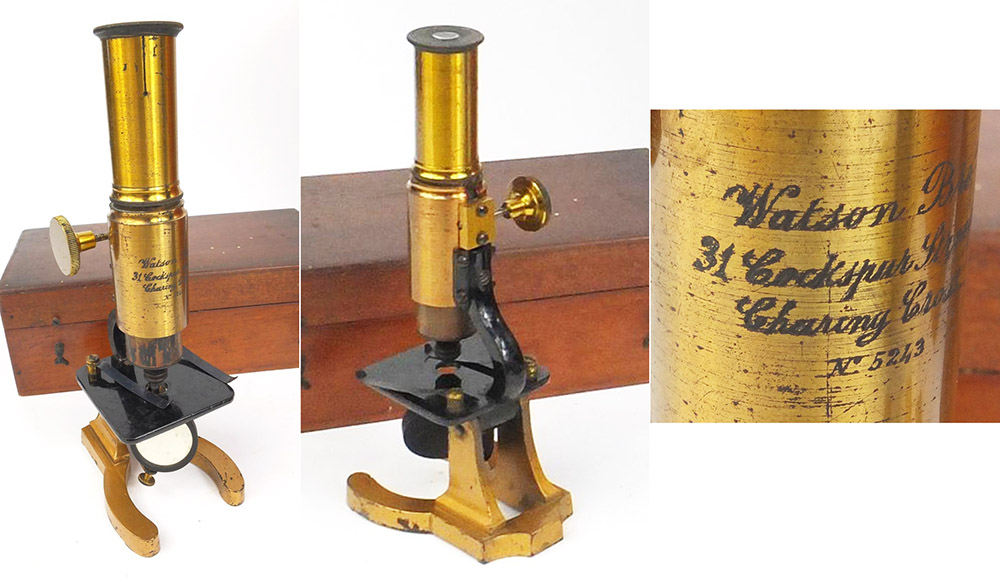
Figure 8.
Watson Brothers moved their scientific products business to 31 Cockspur Street, Charing Cross, around 1893, then closed it in 1898. This microscope, with serial number 5243, was imported from a French maker, and is more of a cheap toy than a serious optical instrument. Images adapted for nonprofit, educational purposes from an internet sale site.
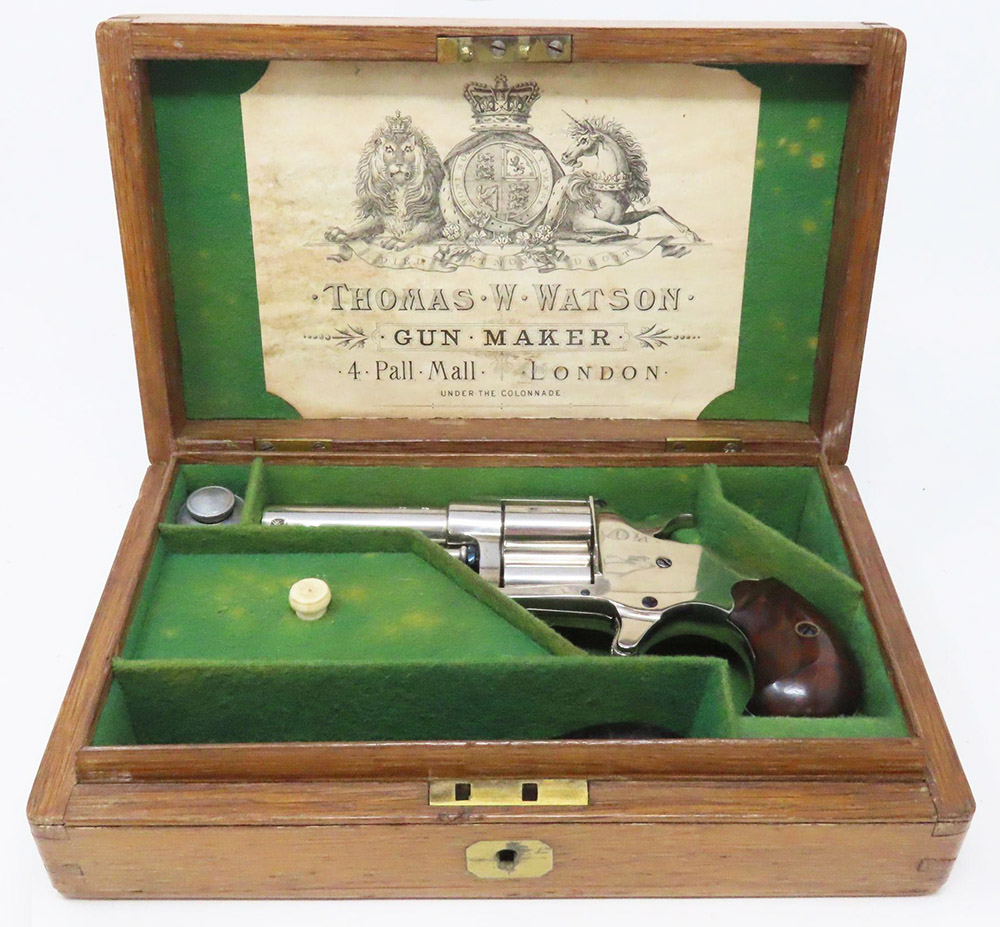
Figure 10.
A Colt pistol that was retailed by T.W. Watson. Image adapted for nonprofit, educational purposes from an internet sale site.
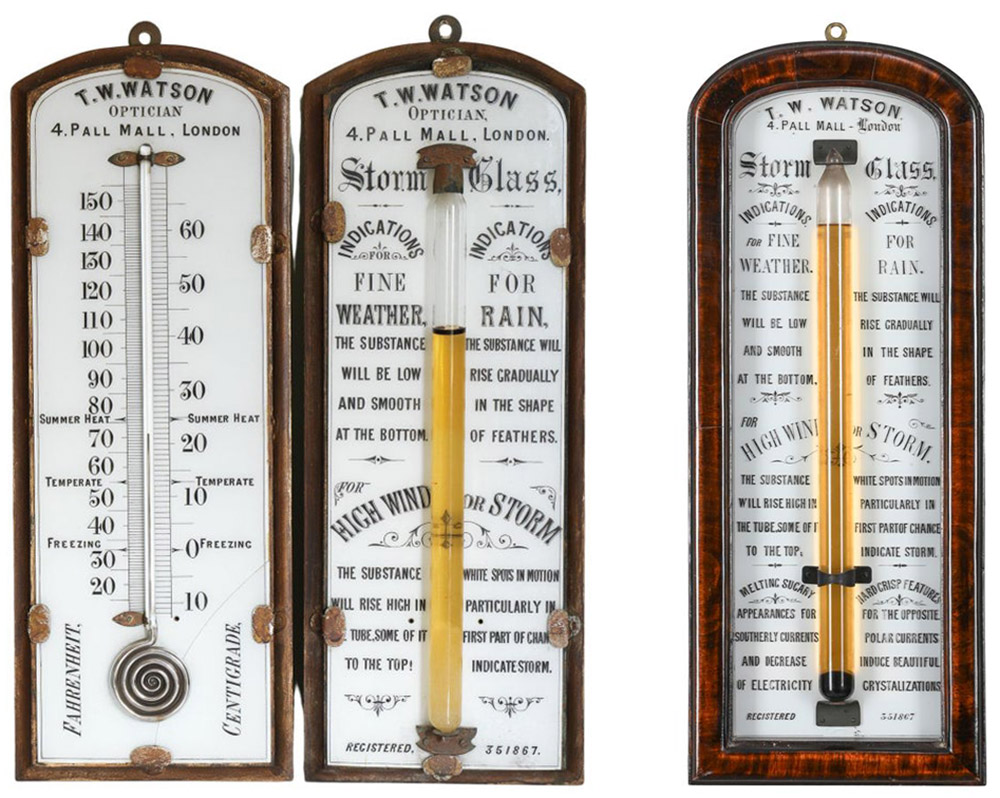
Figure 11.
“Storm glasses” and a thermometer, sold by T.W. Watson. Images adapted for nonprofit, educational purposes from internet sale sites.
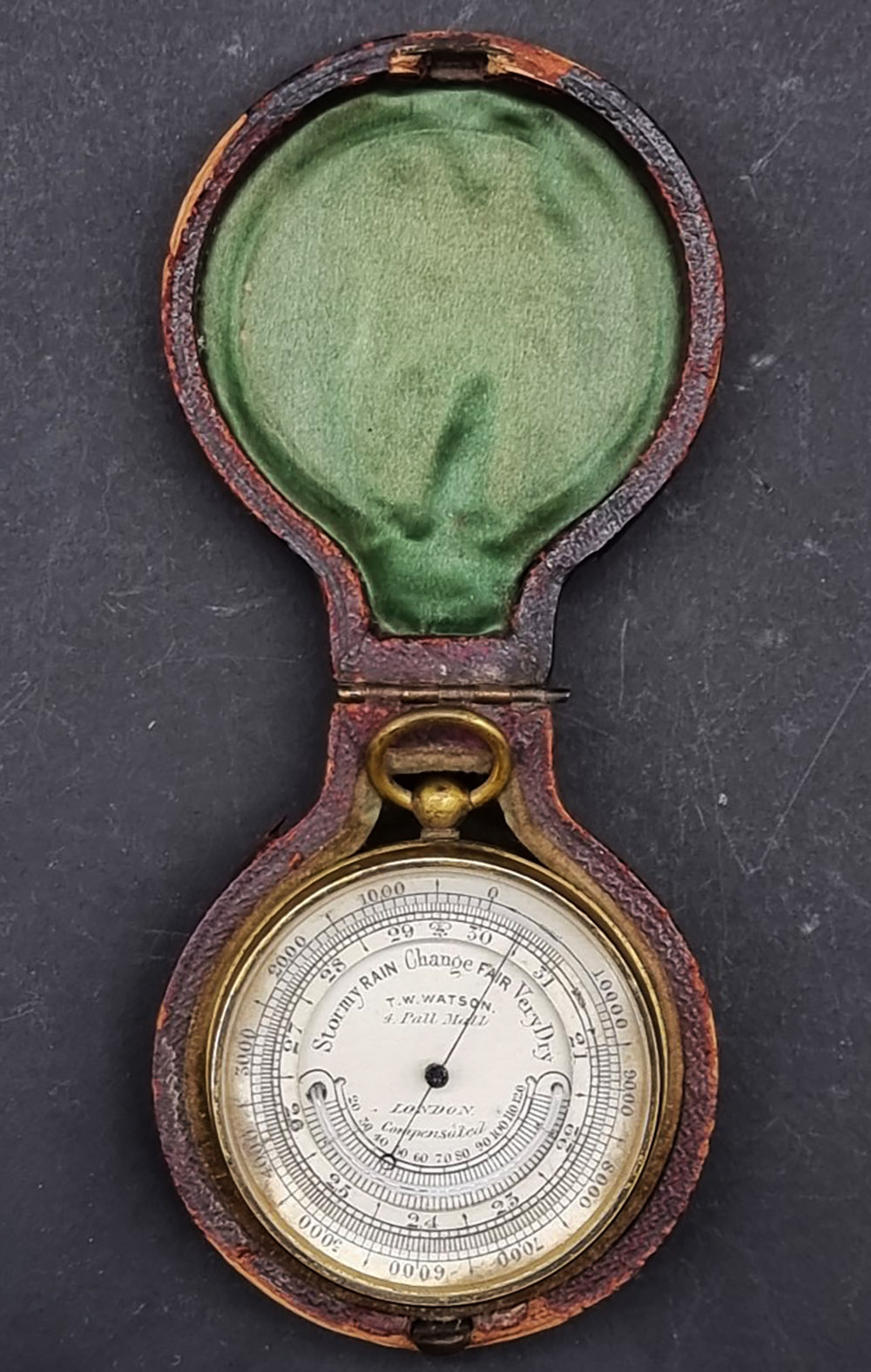
Figure 12.
A pocket barometer that was retailed by T.W. Watson. Image adapted for nonprofit, educational purposes from an internet sale site.
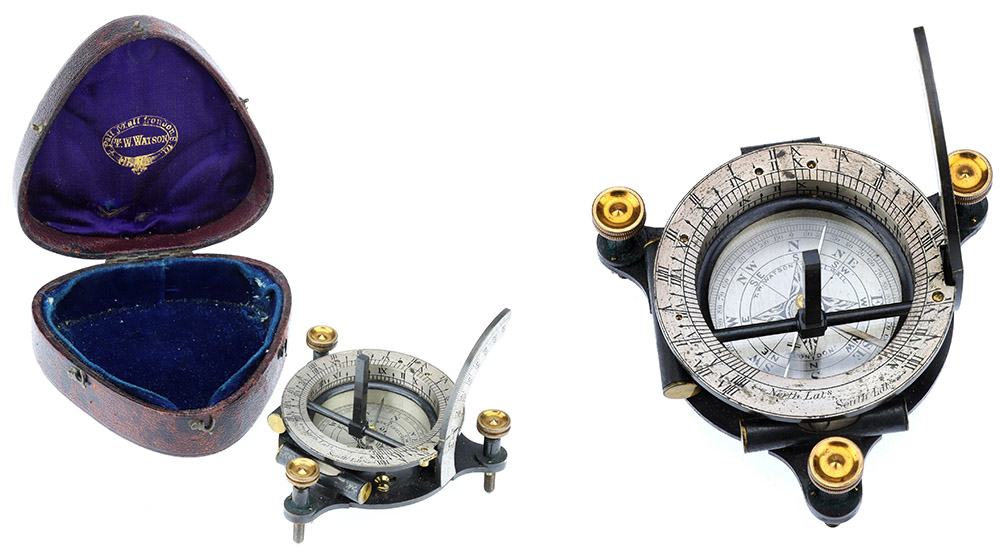
Figure 13.
Pocket compass / sundial by T.W. Watson. Images adapted for nonprofit, educational purposes from an internet sale site.
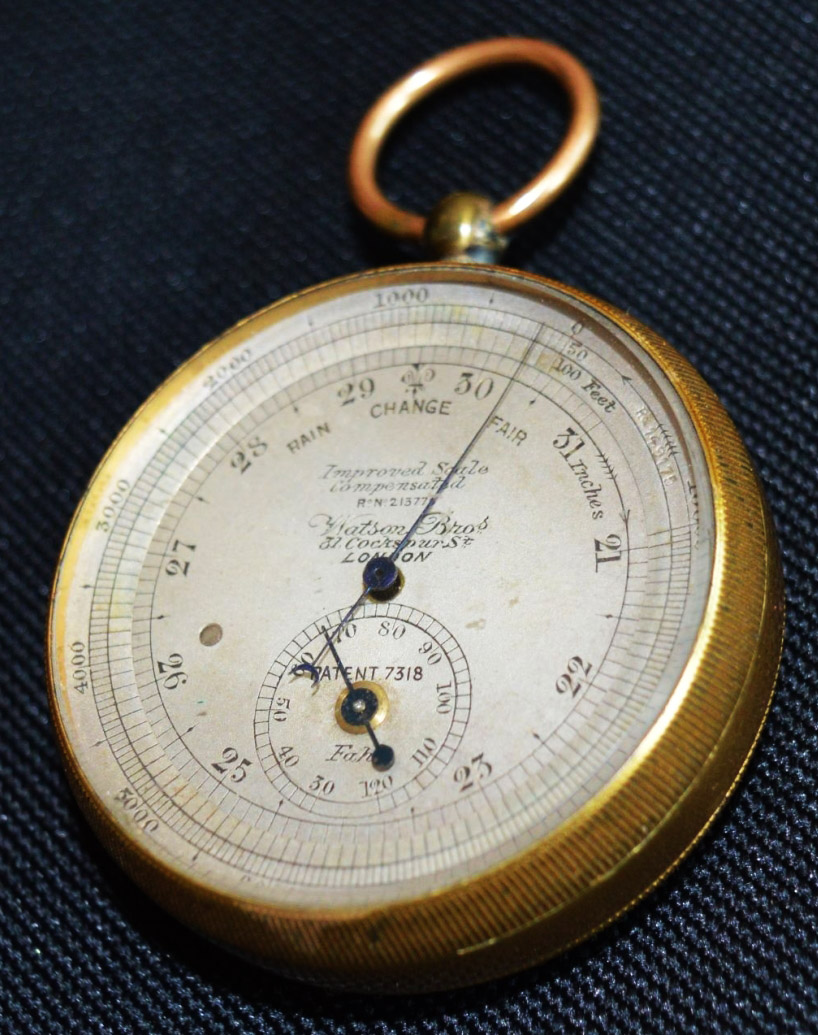
Figure 14.
A pocket barometer by Watson Brothers, 31 Cockspur Street, ca. 1893-1898. Image adapted for nonprofit, educational purposes from an internet sale site.
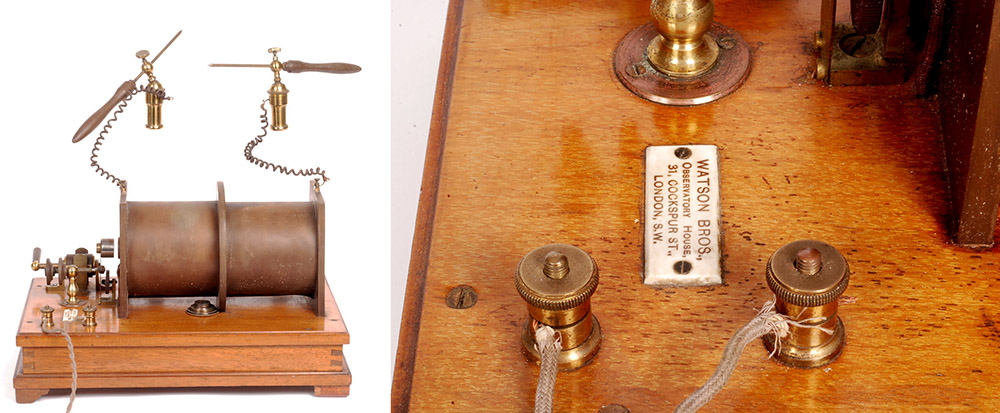
Figure 15.
Figure 15. Rumkorff coil by Watson Brothers, 31 Cockspur Street. Images adapted for nonprofit, educational purposes from https://www.antiq-photo.com/en/collections/museum/sciences-and-technology/large-ruhmkorff-coil/
Thomas William Watson was born in 1848, and Arthur Henry Watson was born in 1857, sons of Thomas and Jane Watson. Census records described the father’s occupation as “coach builder” and “wheelwright”. He was a younger brother of William Watson, whose business evolved into the W. Watson & Sons microscope enterprise. The two brother’s families were evidently closely knit, as evidenced by William’s 1 year-old daughter, Mercy, staying overnight with Thomas’ family at the time of the 1861 census.
William Watson’s business started as a shop that sold a wide variety of goods, and he was described in trade directories and censuses as “general dealer”, “sale shop keeper”, “curiosity dealer”, and “miscellaneous dealer”. By 1864, it appears that William Watson’s inventory had become more focused, with the 1864 and 1866 baptism records of two children listing his occupation as “gun dealer”. His business became “W. Watson & Son” ca. 1867. Advertisements from 1869 listed both firearms and scientific instruments for sale (Figure 16). The guns were “new and second-hand” and the scientific instruments were “second-hand”, all “by the best makers”. From those statements, it can be concluded that W. Watson & Son did not at that time manufacture any of the items that they sold.
The 1871 national census listed Thomas William Watson as living with his uncle William at 313 High Holborn, and working as a “shopman”. Arthur Henry Watson was then a 13 year-old “scholar”, living at home with his parents.
I have not found evidence to suggest that Thomas or Arthur Watson had any formal training in either gun-making or microscope building. As salesmen, they would surely have learned the intricacies of their merchandise. Considering Thomas’ work in his uncle’s second-hand shop, he may have learned rudimentary gunsmithing as a consequence of repairing used firearms. There are known examples of microscope retailers who produced their own instruments from components that were manufactured by major businesses, such as Walter Sparrow (1847-1930) who constructed microscopes from components that he acquired by J. Swift & Son. With time, one could become competent enough to design and construct apparatus from scratch. The business owners would probably also hire skilled craftsmen to make their products. Also note that T.W. Watson / Watson Brothers retailed firearms from Colt and other well-known manufacturers as a major component of their business.
Thomas left his uncle’s shop to open his own business at 4 Pall Mall, in either 1876 or 1877. This crossed his path with a famous family of London gun-makers, which has led to confusion on relationships. A brief diversion is necessary to clear things up:
4 Pall Mall, a brief history:
The Watson Brothers made a lot about a connection between them and a celebrated, early London gun-maker named Durs Egg. For example, an 1895 Watson Brothers advertisement described the business as “Formerly Egg, established in the reign of King George III” (Figure 32). Thomas wrote in 1911 that, “Some forty years ago I took over the shop in Pall Mall in which D. Egg's business had been carried on since the early part of the century”. Those statements can be interpreted as being technically true, but leave out a lot of important details. Both Durs Egg and the Watson Brothers operated gun shops at 4 Pall Mall, but between their proprietorships that space was occupied by two other, unrelated gun businesses and a chocolate factory(!).
Durs Egg (1745-1831, original surname Eck) was born in Switzerland, trained as a gunsmith in Paris, then established a gun-making business in London. The original business number was 1 Pall Mall, changing to 10 Opera Arcade, Pall Mall around 1840, then to 4 Pall Mall in the 1850s. After the death of Durs Egg in 1831, his son, John Egg, took over the business and operated for several years under his own name. During the early 1850s, John renamed the business to use his father’s name, likely to draw attention to Durs Egg’s excellent reputation (Figure 17). It was written in records as both “Durs Egg” and “Dures Egg”. The name change may have been driven by competition with the gun-making business of Joseph Egg (1775-1837) and Joseph’s sons, Charles (1809-1867) and Henry (1810-1869), who operated nearby at 1 Picadilly (Joseph Egg was a son of Durs Egg’s brother, Johann, and therefore Durs’ nephew and John Egg’s cousin). Thomas Watson later wrote as if he had known Durs Egg, but was probably referring to John Egg’s business of that name, “His proper name may have been Durward, but we knew him as ‘Durs’ Egg”.
John Egg retired in 1865, and the premises at 4 Pall Mall were taken over by another gun shop, styled “The Breech-Loading Armoury Company” (Figure 18). This was an offshoot of the Calisher and Terry gunworks of Birmingham and London. It appears to have retailed guns from various makers, but did not manufacture anything on site. There were financial shenanigans with the company, and it was liquidated in 1867.
The “Compagnie Coloniale de Paris” chocolate-making business moved into 4 Pall Mall during November, 1868 (Figure 19). The chocolatier occupied the premised through 1873 or 1874, after which they relocated to 90 Great Tower Street.
The Post Office Directory of London for 1875 listed two businesses at 4 Pall Mall: a “goldsmith” named William Thorn and a “barrister” named Octavius March. William Burnaford Thorn (1837-1875) sold second-hand guns, in addition to jewelry and gold/silver items (Figure 20). Thorn’s effects were auctioned off in the spring of 1876.
Noting that Thomas W. Watson began his business at 4 Pall Mall around 1876-77, it is highly likely that Watson purchased Thorn’s inventory of guns at the estate liquidation, and took over the building’s lease.
The earliest published records of T.W. Watson’s business that I have located were from 1877. He announced a product line of three different microscope stands, consisting of a “New Pattern Large”, a “Student’s”, and a “Pocket” microscope. The large stand was probably that shown in Figure 2 (above) and the basis for Watson’s Rutley-model petrological microscope (Figures 3-5). The pocket microscope “stands ten inches high, and for carriage packs up in a mahogany case seven inches by two inches, without being taken to pieces”, suggesting that it was a folding instrument similar to that designed by William Moginie (1828-1881) and marketed by Baker, Murray & Heath, and several other manufacturers of the period. Advertisements from 1877 indicate that Watson also sold prepared microscope slides (Figure 21).
Possibly a move to introduce himself to new clientele, Thomas Watson joined the Quekett Microscopical Club on December 28, 1877.
Firearms were also an important component of T.W. Watson’s inventory, and he styled himself as a “Gun Maker and Optician” (Figures 22 and 23). This suggests that he was constructing his own guns during the late 1870s, as well as retailing new and used weapons.
Watson must have been capable of manufacturing custom-built microscopes by the late 1870s. Geologist Frank Rutley (1842-1904) enlisted Thomas Watson to build a state-of-the-art petrological microscope, which Rutley described in his 1879 The Study of Rocks: An Elementary Text-book of Petrology and in a letter to Nature. The Journal of the Royal Microscopical Society devoted two pages and an engraving on this microscope, stating, “An examination of one of the microscopes devised by Professor Rosenbusch and manufactured by Fuess, of Berlin, showed that, although that instrument possessed many features of great merit, it also had certain defects which could be best overcome by adopting and modifying a good English model. The great defects in most of the microscopes built on the continental patterns consist in their fixed vertical position, the smallness of their stages, and, very commonly, in the absence of any means of coarse adjustment, except by a sliding movement of the body or tube, which, if working stiffly, is very inconvenient, while, if sliding easily, it is apt to be shifted by a very slight touch. The instrument now manufactured by Mr. Watson is in most respects quite equal in performance to Rosenbusch's, so far as the mechanical appliances and adjustments are concerned, and is, in point of convenience, decidedly superior to the latter instrument.” This was undoubtedly a major boost for T.W. Watson’s microscope business, and the Rutley model was manufactured into at least the late 1880s (Figures 3-5).
The 1881 national census created some confusion for researchers tracking the life of Thomas W. Watson, as a man with the same name, age, and occupation as “gun maker” appeared in two different locations: 4 Pall Mall, London, and Granville House, Ryde, Hampshire. Each entry gave a different place name for their birth, Notting Hill and Kensington, respectively. However, Notting Hill is within Kensington, and both Thomas and Arthur interchangeably provided both addresses as their birthplaces over the years. Moreover, the Thomas W. Watson in Ryde must have been the same man who owned the shop in Pall Mall, as he was staying in Granville House with his future wife and her parents. The solution to this apparent conundrum is undoubtedly due to the mechanism by which the national census was taken: census forms were delivered to every address 2-3 days before April 3, 1881, residents were expected to complete the form with information of everyone who spent the night of April 3, and then the forms were collected on April 4. This assumed that everyone would wait until the evening of April 3 or morning of April 4 to complete the forms, but it is very likely that some people filled out their forms ahead of time. Since all other evidence indicates that the Thomas W. Watsons in Pall Mall and Ryde were the same man, the simple answer is that Thomas filled out his Pall Mall form when he first received it, then traveled to see his fiancé and future in laws in Ryde on April 3.
Also notable in the 1881 census is that Arthur was living with Thomas at 4 Pall Mall, and also described as being a “gunmaker”. However, advertisements from as late as 1883 referred to the business as “T.W. Watson”, indicating that Arthur worked with his brother for some time before becoming a partner (Figures 27 and 28). The earliest reference to the shop as “Watson Brothers” was published in 1884 (Figure 29).
Thomas Watsom married Mary Tranter on April 22, 1882. They set up their home at 21 Haycroft Rd, Brixton. Arthur evidently lived with them there, as he gave that address as his home on the record of his 1885 marriage to Mary Ann Parson. Arthur and Mary Ann moved to Bayswater, then to Wimbledon during the late 1880s.
The inventory of Watson Brothers expanded through the years. By 1890, they evidently had a considerable interest in electrical products, even filing for patents on their own devices (Figure 30). This field was pursued to such an extent that Arthur described his profession as “electrical engineer” on the 1891 census.
Watson Brothers split their scientific instrument business away from their firearms during the early 1890s, with their microscopes, electrical devices, and other apparatus relocating to 31 Cockspur Street (Figures 31 and 32). The 1884 Electrician Electrical Trades Directory and Handbook indicated that the Watson Brothers had a branch in Liverpool – I have not found further information on this, and suspect that it might have been a confusion of similarly-named businesses by the publisher.
The gun shop moved to 29 Old Bond Street ca. 1894. An 1895 advertisement described the Watson Brothers as “formerly Egg, established in the reign of King George III”. As discussed above, this was advertising nonsense, as there were no direct connections between Egg and the Watsons.
The scientific and electrical branch on Cockspur Street was taken over by Ross, Ltd. in 1898 (Figure 33). This seems to have been the end of the T.W. Watson / Watson Brothers dealings with microscopes and other scientific devices. The business appears to have focused solely on firearms manufacture and retail from then onward.
Thomas retired between 1901 and 1911, according to his statements on census records. Arthur continued the business as sole operator of Watson Brothers.
In 1911, Thomas Watson read an article on early London gunmakers in a popular magazine, and was spurred to write a response to correct a few points (although he also added some confusion with regard to the Egg family’s business relationships):
“I have had fifty years' personal connexion with the London gun trade, and a previous generation of the family had thirty years' similar connexion. I have constantly been on the look-out for anything in print which would form a history of the trade, but have not found anything of the kind.
For generations the gunmaker has been individual artificer, or nearly so, the two or three men of each generation who proved themselves the cleverest craftsmen generally becoming of note as years went by, and keeping the secrets of their speciality to themselves and just a small band of helpers. The publicity of print would have been regarded by them as little short of sacrilege.
Mr. Rodger in his contribution offers one or two conclusions which I believe are erroneous. Staudenmayer, he suggests, did not mind which way his name was spelt. I have not the least doubt he spelt spelt his name in its proper way, but his reputation was considerable, and after his death his name was pirated, and to avoid the risks of prosecution certain letters of the name were altered, which the unwary did not observe. As a young man I was taught that when the name was spelt other than Staudenmayer the weapon was spurious, and should be dealt with as such.
‘Collaboration’, I think, is a misleading term in this connexion. I have never heard of two rival gunmakers working to produce the same gun, but what often happens is that a gun is met with of which the barrels bear one name and the locks another. The reason for this generally is that some accident has happened to the original barrels, or they may have actually worn out before the locks, and new barrels have been fitted by a different maker to the old locks, the new barrels being engraved with the name of the maker of them.
Tatham & Egg are quoted. This probably arises from such a cause as mentioned above, because Egg was in business before Tatham was born. I have conversed with the younger generation of the Egg family and seen Tatham, but knew them as rivals, not partners.
Some forty years ago I took over the shop in Pall Mall in which D. Egg's business had been carried on since the early part of the century. His proper name may have been Durward, but we knew him as ‘Durs’ Egg in contradistinction to his brothers Joseph and Henry, the two latter carrying on business at the original address, No. 1, Piccadilly. This was the prominent corner of Piccadilly and Glasshouse Street until that island block of houses was pulled down to make room for the enlarged thoroughfares and fountain now known as Piccadilly Circus. This was about 1880. (As noted above, “Durs Egg” was the man’s real name, Joseph Egg was his nephew, and Henry Egg was Durs’ great-nephew).
Section 4 mentions Baker several times These references are probably to the business of F.T. Baker, who died a few years ago, and was the third generation of Bakers who had carried on the business. This was carried on at three different addresses to my knowledge, being for about a quarter of a century in Fleet Street, next door to the publishing offices of Punch.
To division 4 should be added S. & C. Smith, Prince's Street, the inventors of a kind of percussion cap which had much vogue in its day.
Goldsmiths and silversmiths have at times to be brought to the aid of the gunmaker when costly decorated weapons are required, and such I have had recourse to in quite recent years, the gunmaker possibly first making the part in steel, the silver worker then copying in silver a part to be used in substitution for the steel, and between these two workers an artist is employed to design ornamentation which will decorate the part without destroying its efficiency.”
The Watson Brothers shop moved to 13a Pall Mall in 1929.
Thomas Watson died on November 2, 1933.
Arthur Watson sold the business out of the family in 1935, then died in late 1937.
The “Watson Brothers” business name and records were subsequently bought and sold several times by different entities. A gun making firm currently operates under the name.
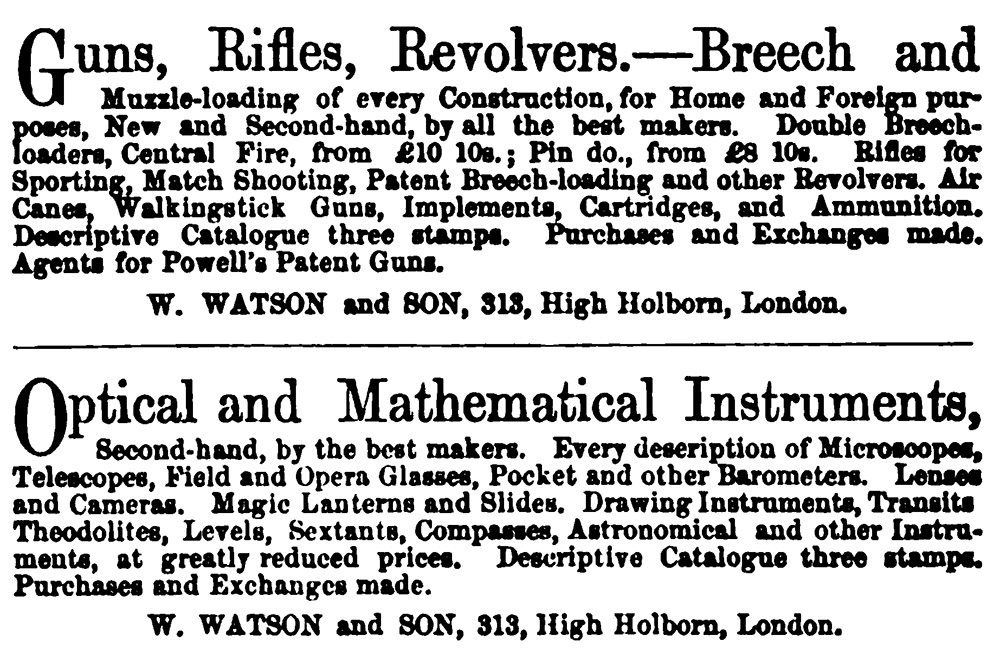
Figure 16.
1869 advertisements from W. Watson & Son, with whom Thomas W. Watson worked as a “shopman”. Note that Watson sold new and used guns, microscopes, and other items that were produced by other manufacturers. From “The Lancet”.

Figure 17.
Excerpt of “Gun and Pistol Makers” from the 1865 “Post Office Directory of London”. The business known as “Durs Egg” was actually operated by Durs’ son, John. John Egg retired that year, and the space was taken over by The Breech-Loading Armoury Company (see Figure 18). Henry Egg was a cousin, and successor to the gun-making business of Joseph Egg.
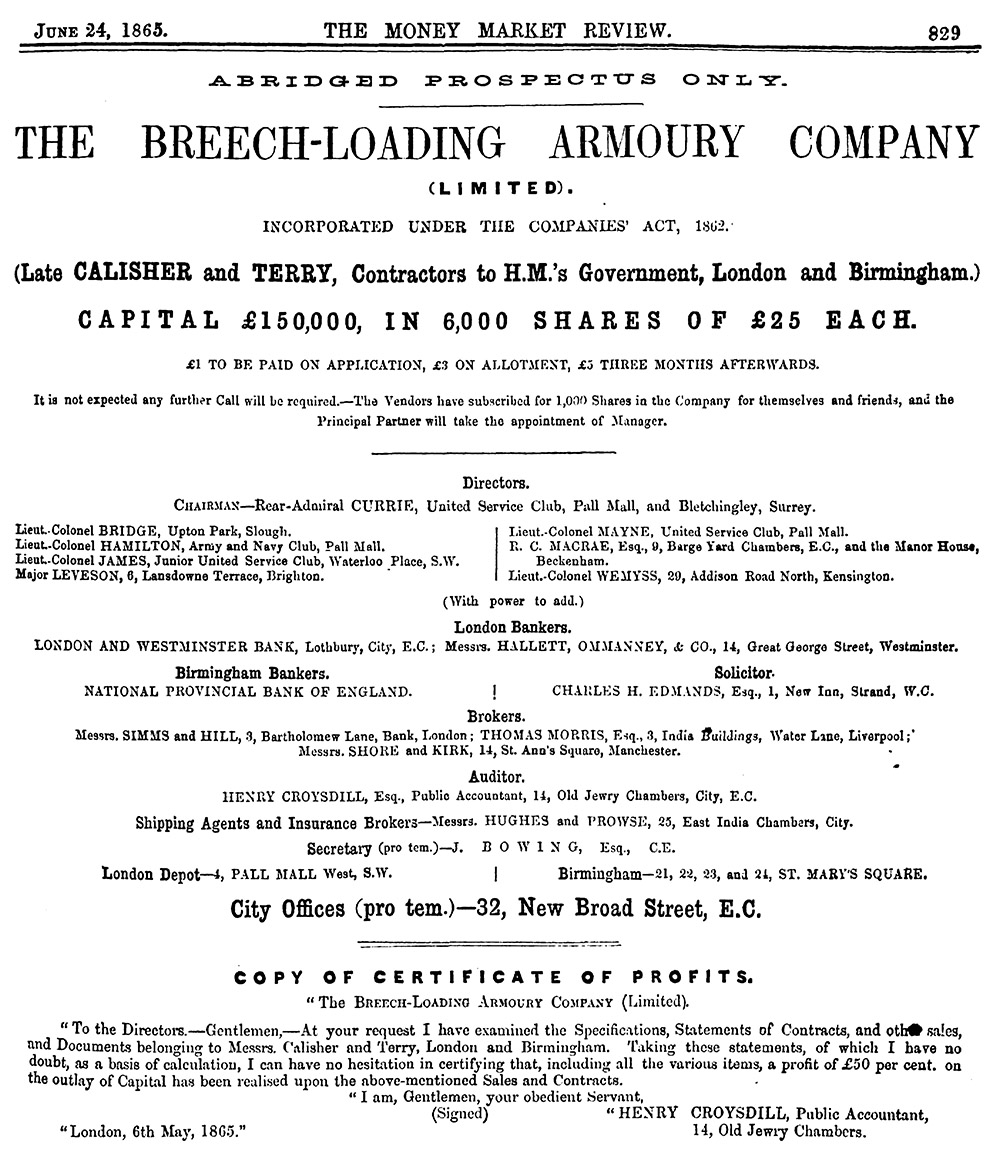
Figure 18.
An 1865 prospectus for the new Breech-Loading Armoury Company, with London depot at 4 Pall Mall. From “The Money Market Review”. The business closed during 1867.
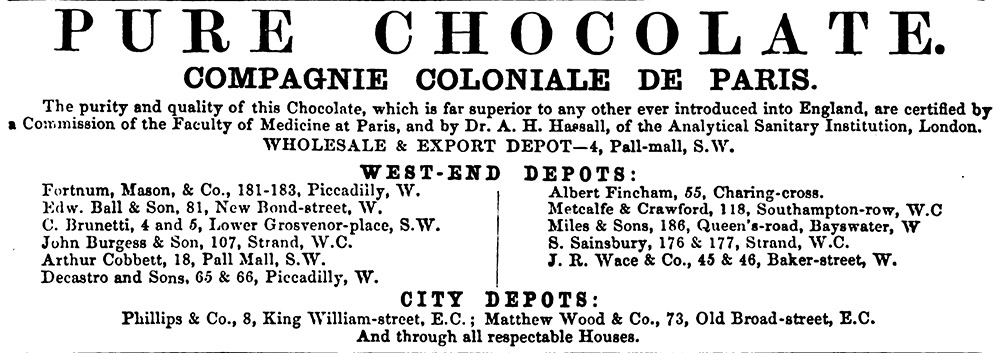
Figure 19.
The Compagnie Coloniale de Paris chocolate business took over 4 Pall Mall in November, 1868, and remained at the site until 1873 or 1874. From “The Medical Times and Gazette”.
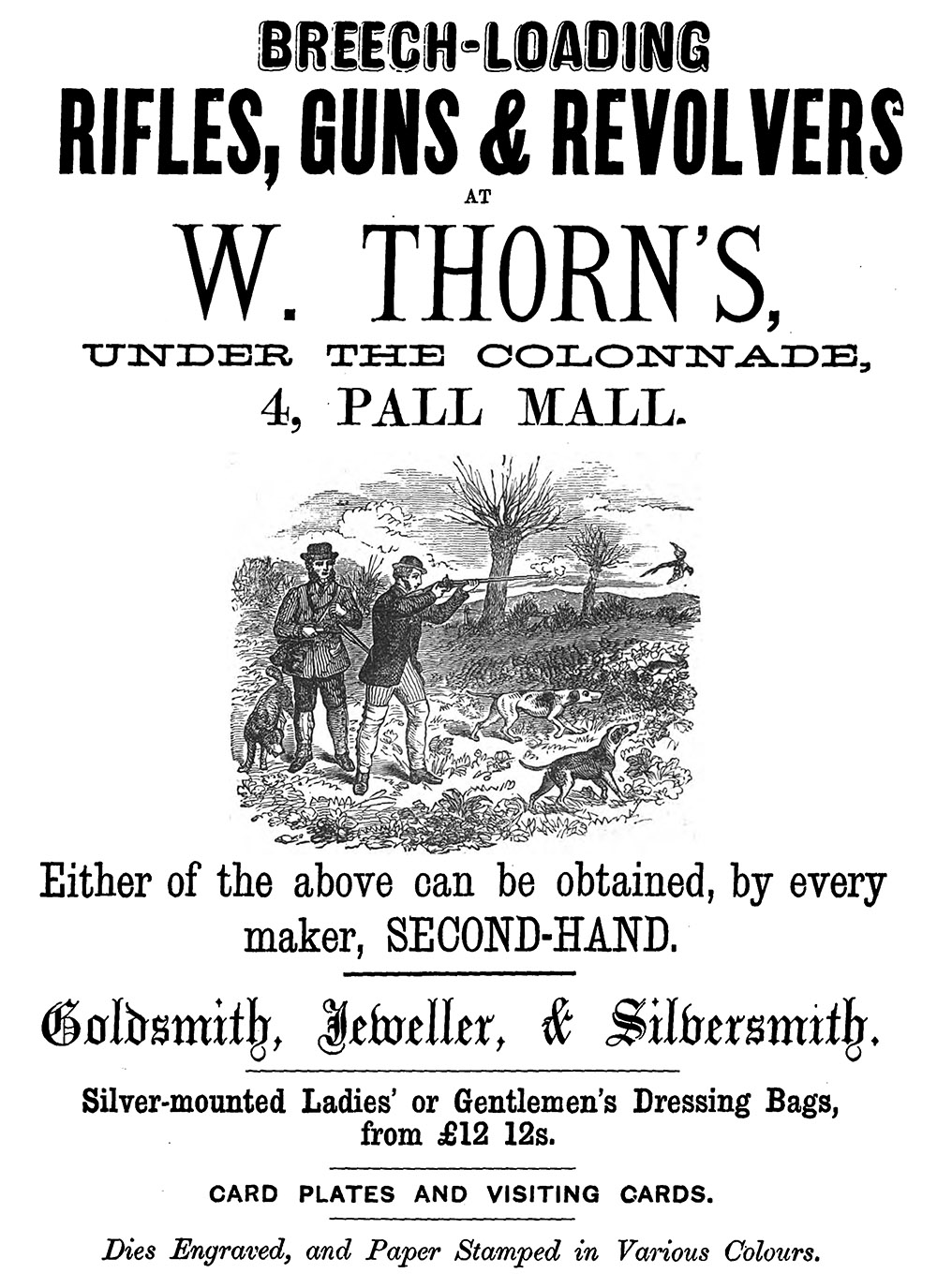
Figure 20.
An 1876 advertisement for William Thorn’s gun and jewelry shop at 4 Pall Mall. Thorn died in January, 1875, but the business continued until well into 1876. From “The Foreign Office List”.
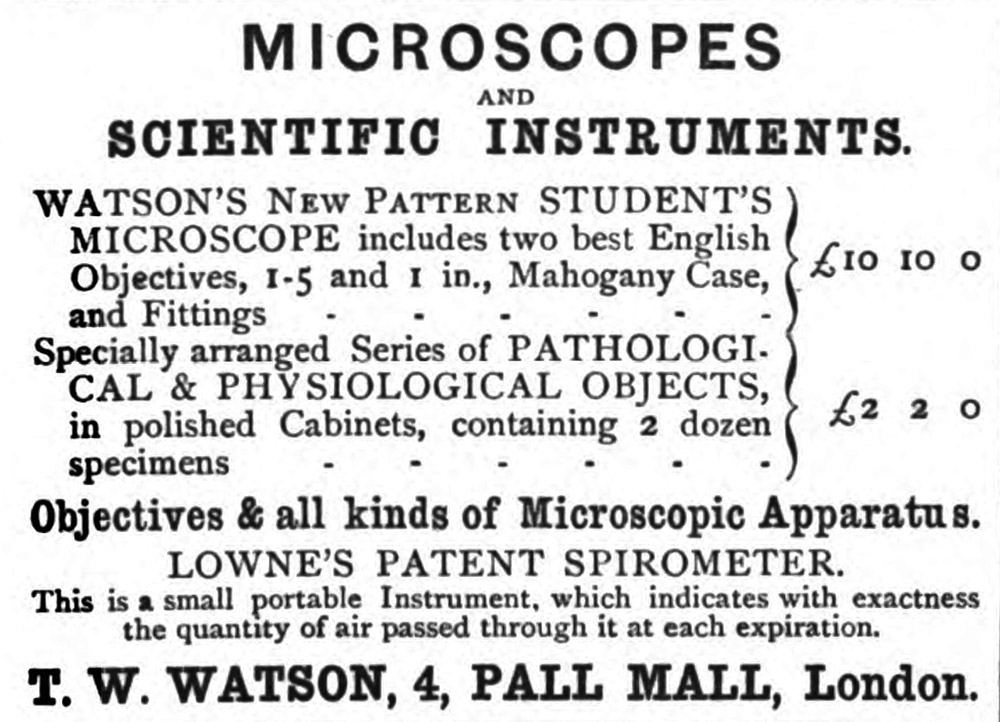
Figure 21.
An 1877 advertisement for T.W. Watson’s microscopes and other scientific instruments. This is one of the earliest records of his business. From “The London Medical Record”, September, 1877.
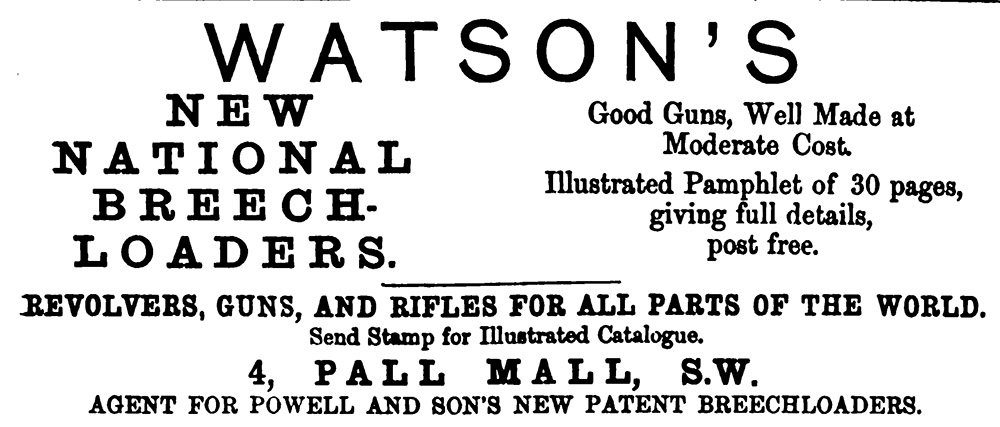
Figure 22.
An 1878 advertisement for T.W. Watson’s firearms. From “Allen's Indian Mail and Official Gazette”.
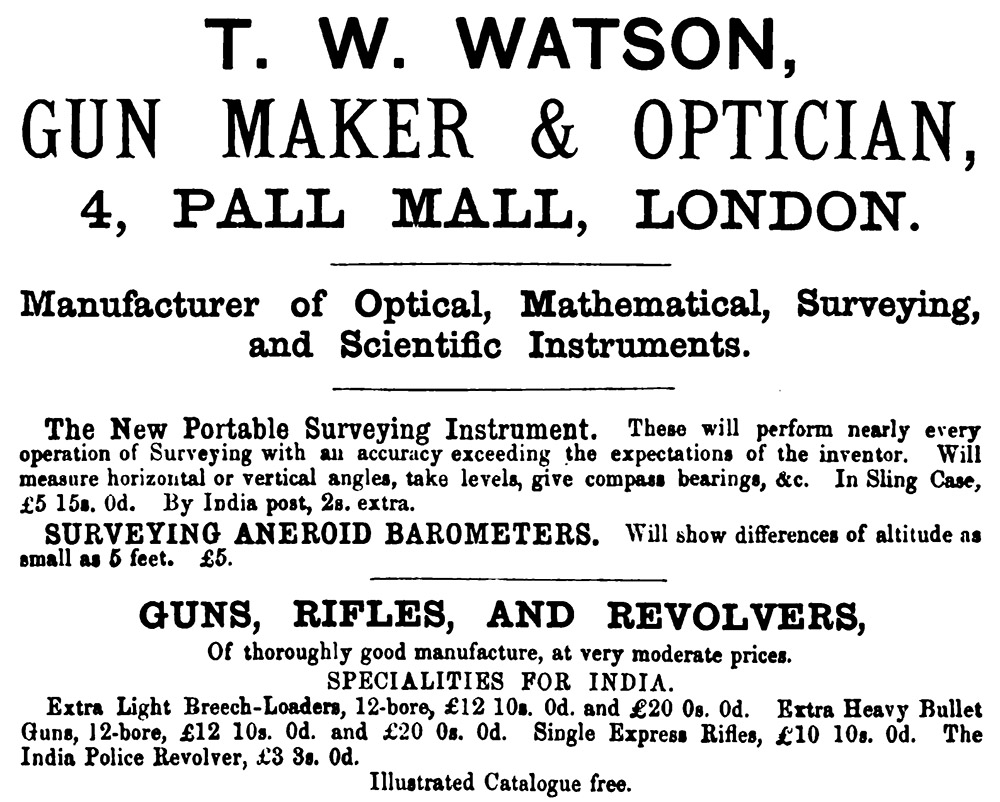
Figure 23.
Another 1878 advertisement from T.W. Watson. From “The India List, Civilian and Military”.
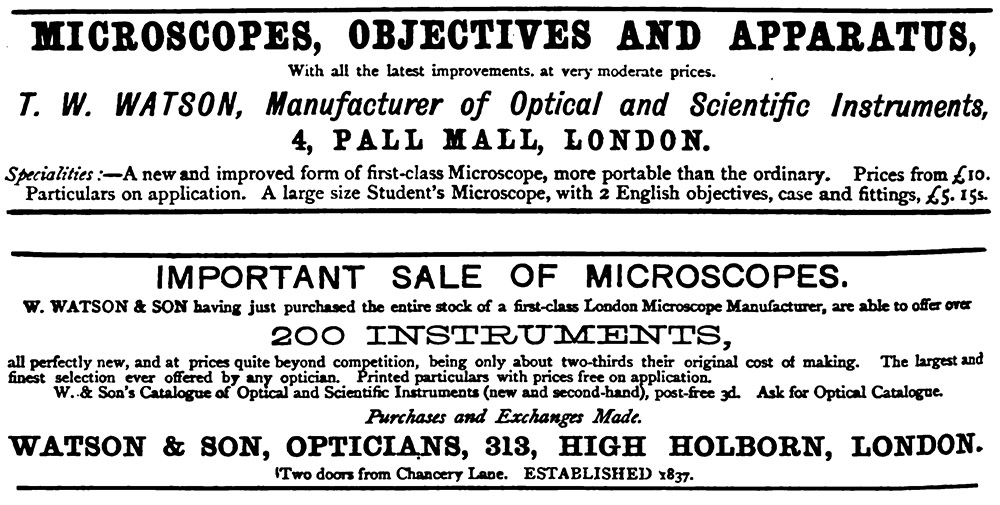
Figure 24.
Two 1878 advertisements for microscopes, from T.W. Watson and from Watson & Son, noting that Thomas advertised instruments of his own manufacture, while his Uncle William was still selling microscopes that were produced by other makers. Both from “Hardwicke’s Science-Gossip”.
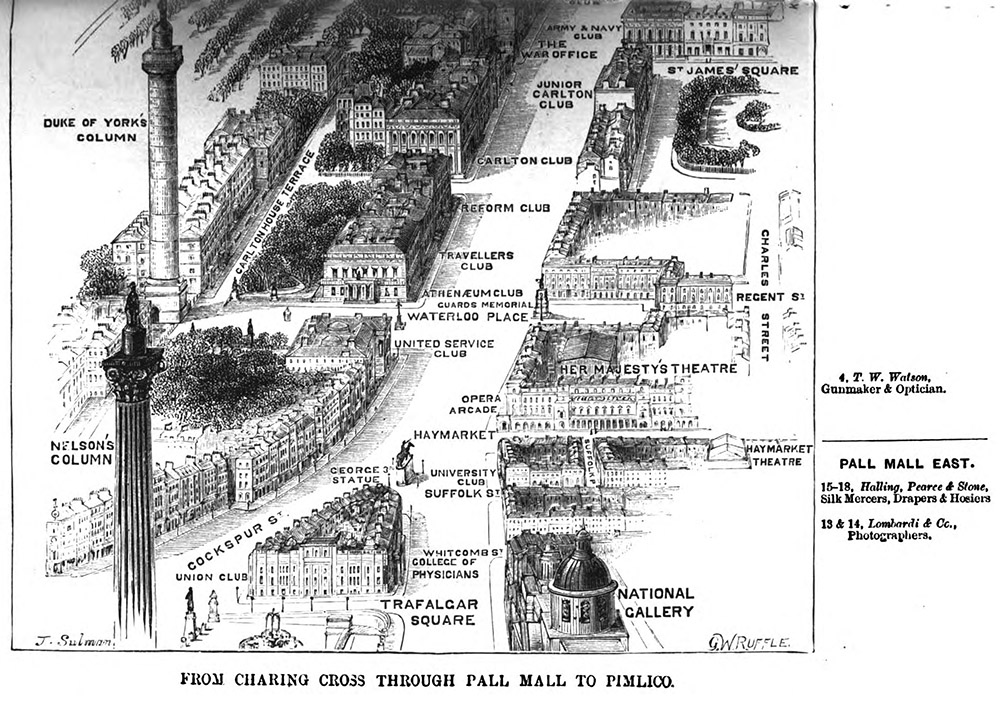
Figure 25.
The shop of “T.W. Watson, Gunsmith & Optician” was marked on a map of Pall Mall in Fry’s “London in 1880, Illustrated with Bird's Eye Views of the Principal Streets”. Watson undoubtedly paid for this highlight, as very few other businesses are noted on the maps.
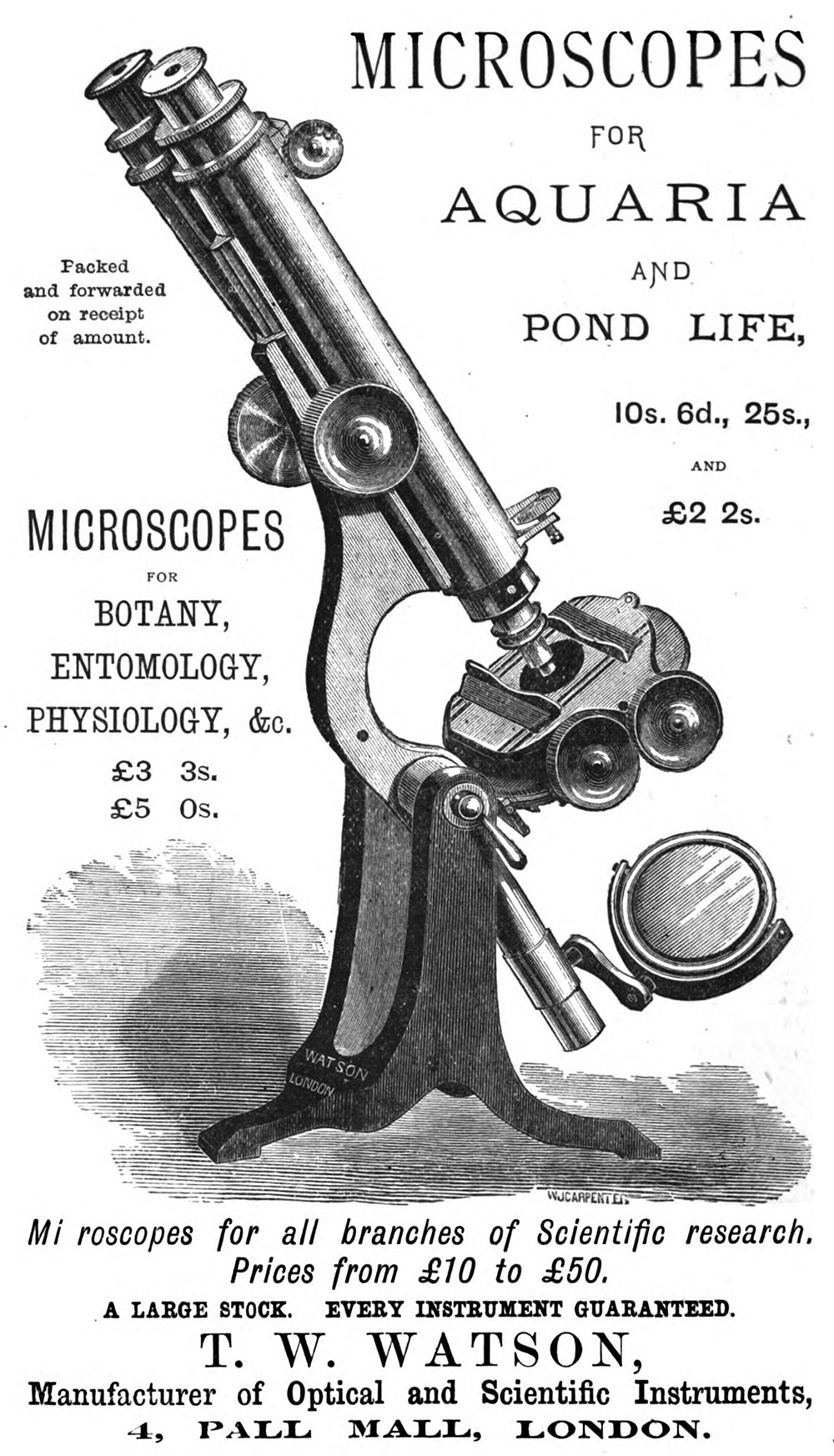
Figure 26.
An advertisement from Taylor’s 1881 “The Aquarium; its Inhabitants, Structure and Management”. The illustrated microscope is the same model as shown in Figure 2, above, and is presumably Watson’s “New Pattern Large Microscope”.
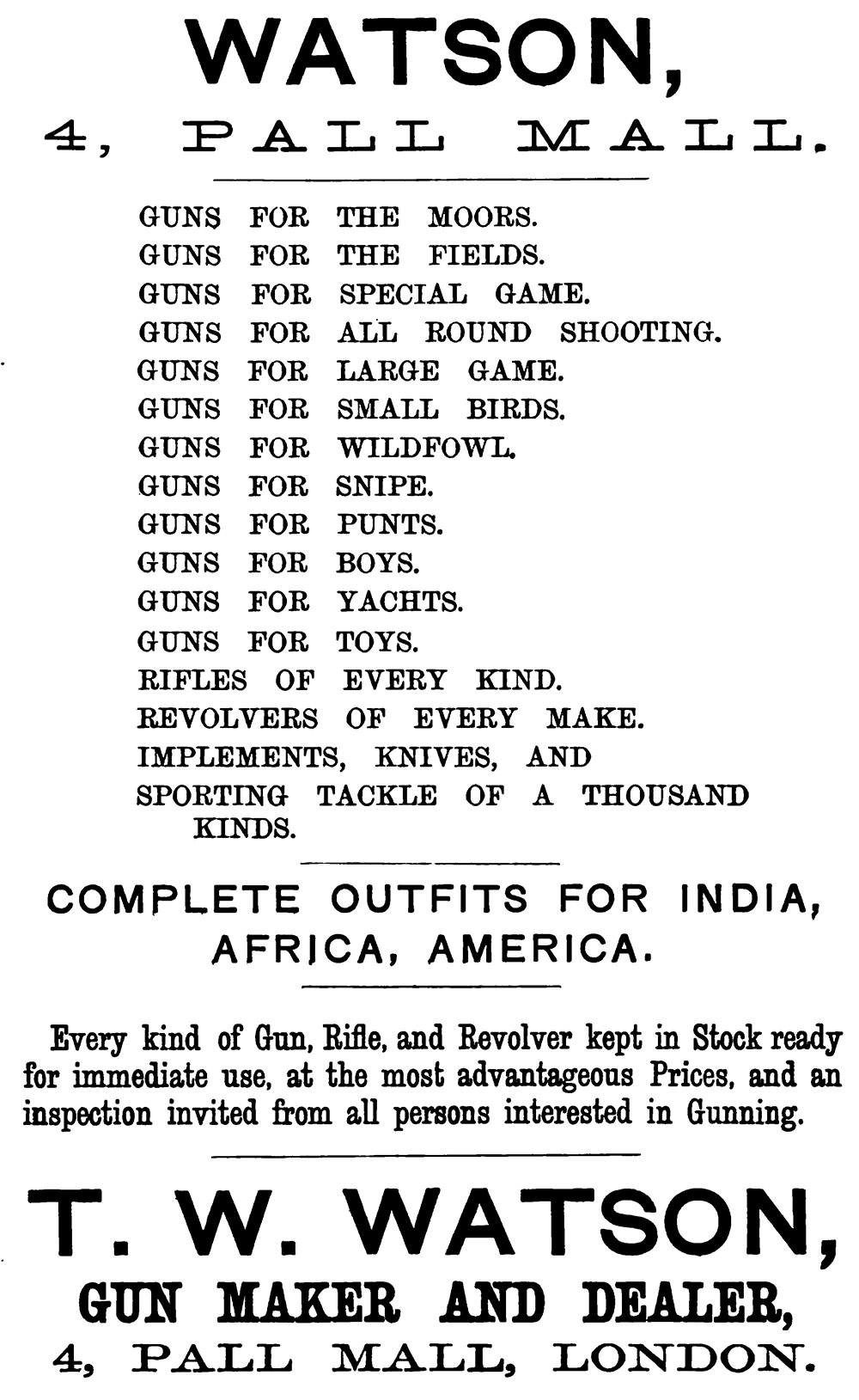
Figure 27.
An 1882 advertisement for T.W. Watson’s guns, from J.H. Walsh’s “The Modern Sportsman's Gun and Rifle, volume 1”.
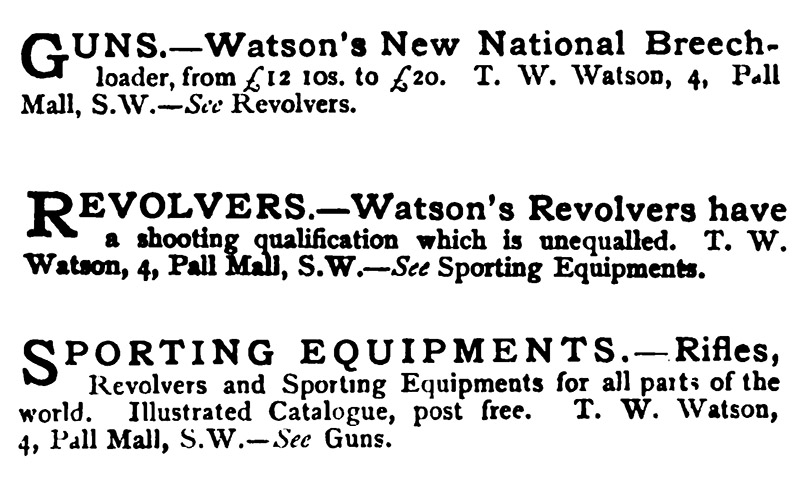
Figure 28.
1883 advertisements from “A Dictionary of Common Wants”.
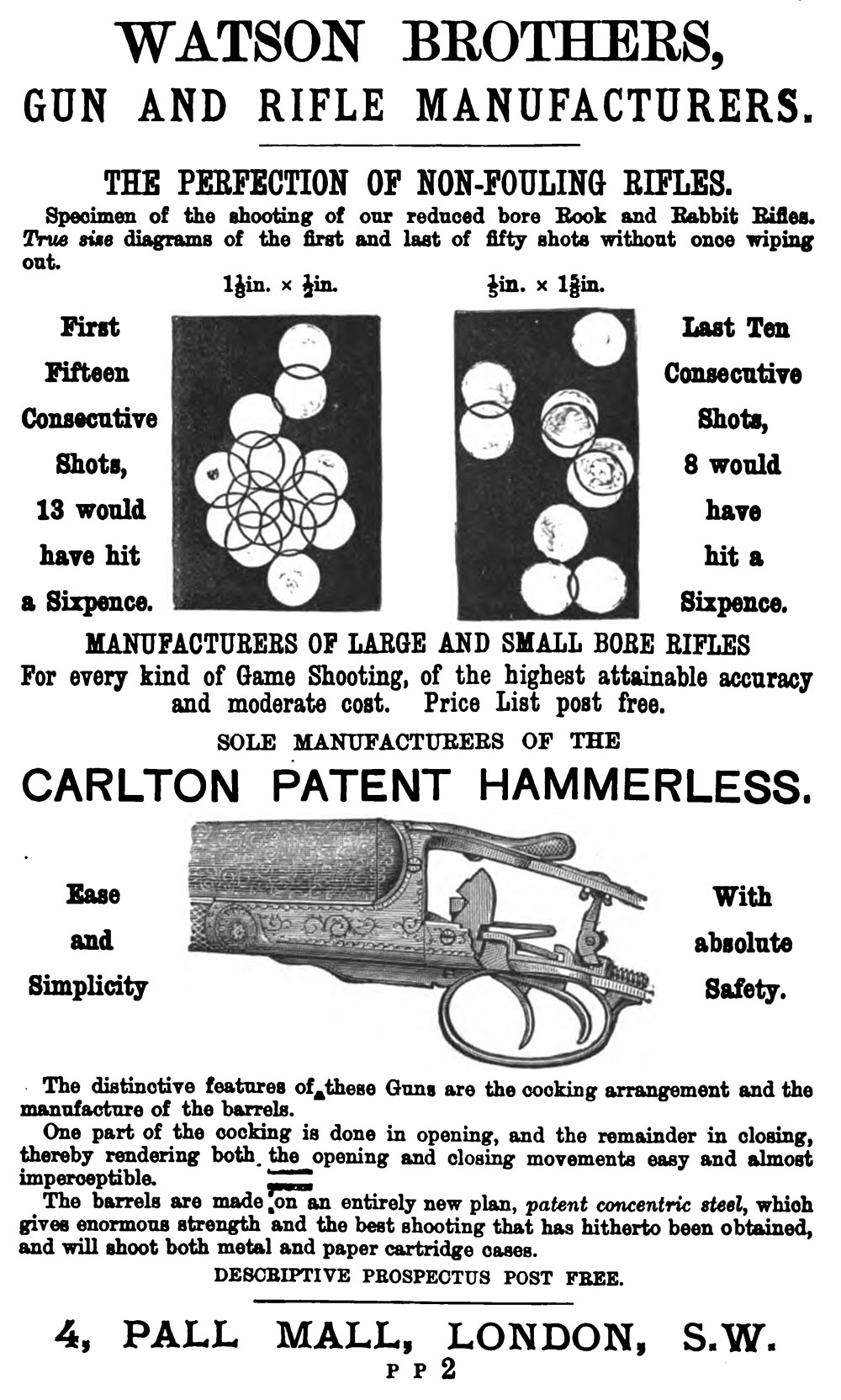
Figure 29.
T.W. Watson became Watson Brothers in 1884. Advertisement from “The Modern Sportsman's Gun and Rifle”.
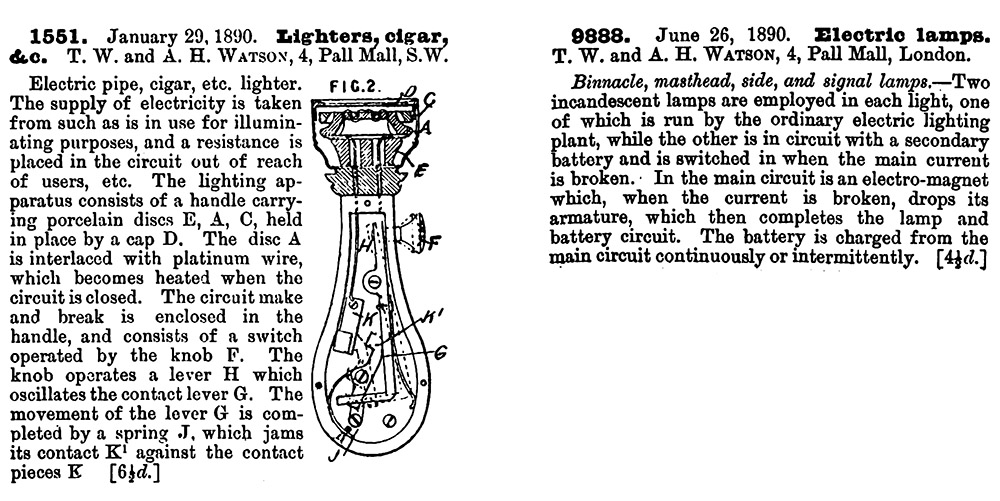
Figure 30.
Descriptions of two electrical devices that were invented by Thomas and Arthur Watson in 1890. From “The Illustrated Official Journal (Patents)”.
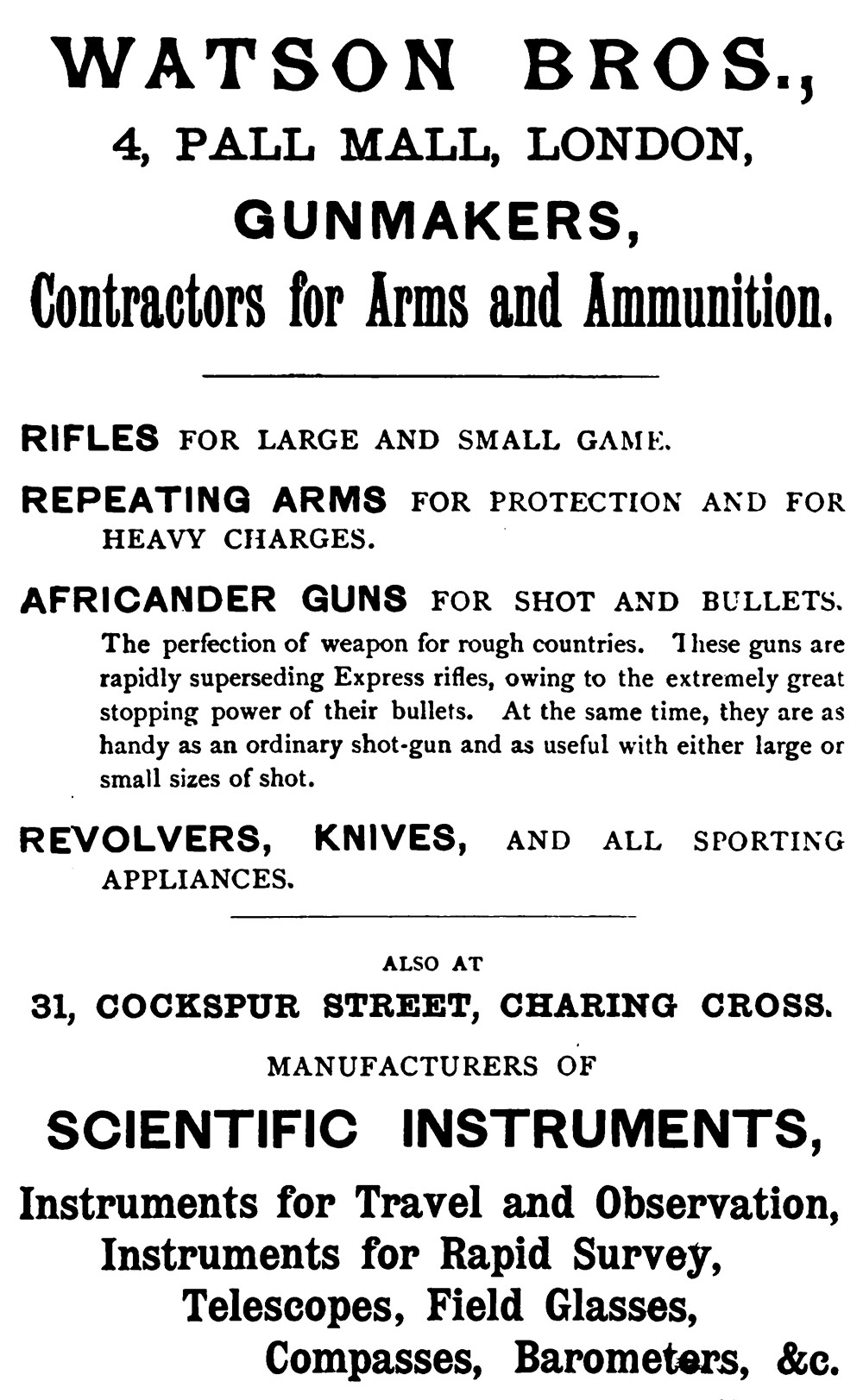
Figure 31.
An 1893 advertisement, noting that Watson Brothers had moved their scientific division to 31 Cockspur Street. From T.H. Parke’s “Guide to Health in Africa with Notes on the Country and Its Inhabitants”.
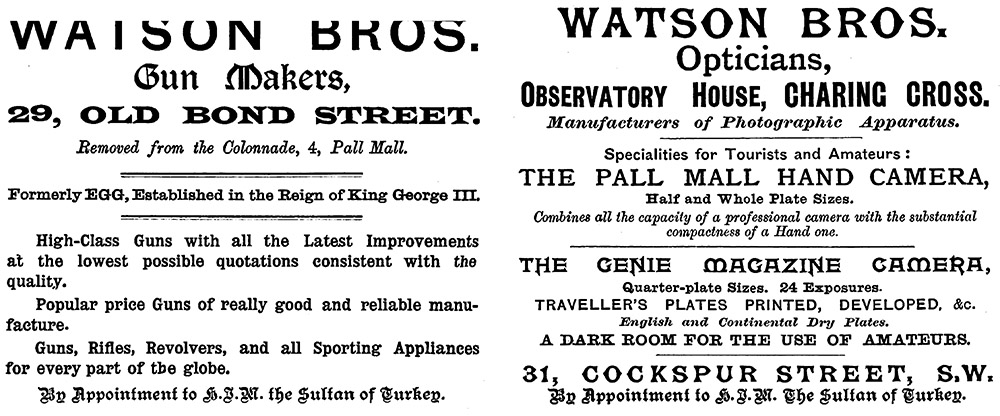
Figure 32.
From Herbert Fry’s 1895 “London”. The firearm division had recently moved to 29 Old Bond Street. Note that the Watsons played up their (tenuous) connection to Durs Egg in this advertisement.
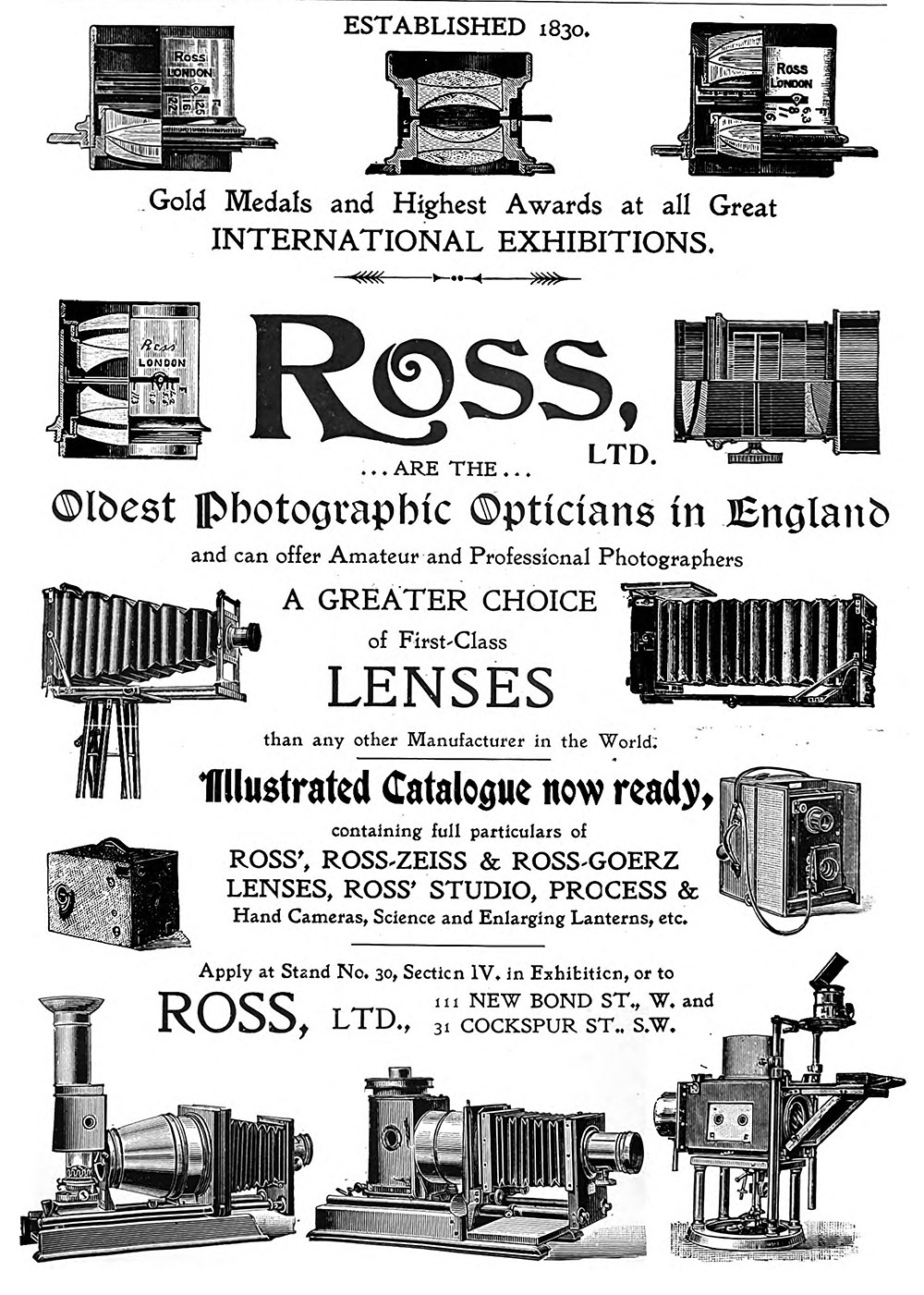
Figure 33.
Watson Brothers’ optical and scientific shop at 31 Cockspur Street was acquired in 1898 by Ross Ltd., the successor to the optical business of Andrew Ross.
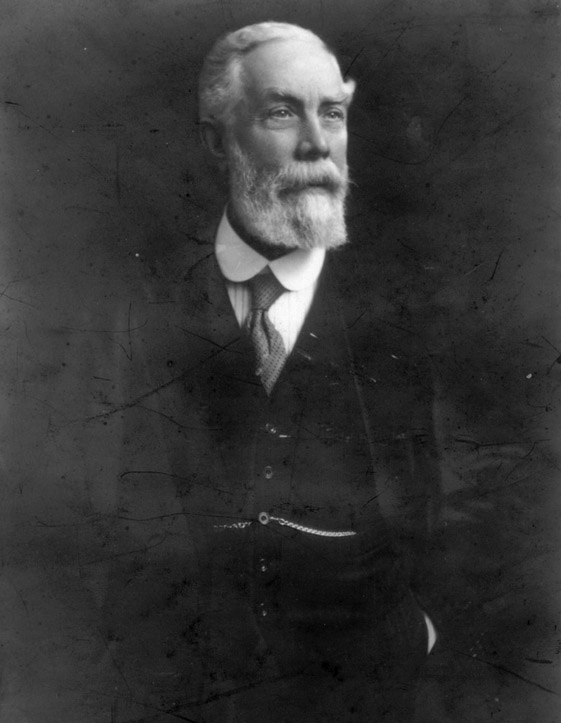
Figure 34.
An undated photographs of Arthur H. Watson. Adapted for nonprofit, educational purposes from https://www.ancestry.com/mediaui-viewer/collection/1030/tree/24133423/person/1480954541/media/e79bdacf-6584-442f-8159-eb4dfc31b6a7
Resources
Allen's Indian Mail and Official Gazette (1878) Advertisement from T.W. Watson, page 1004
The British, Foreign, and Colonial Tradesmarks' Directory (1866) “Breech-loading Armoury Co (NJ Calisher manager), 4 Pall Mall S.W.”, page 22
The Chemist and Druggist (1868) “The Compagnie Coloniale of Paris, whose excellent manufactures of chocolate we noticed last month, have removed their London wholesale depot from Moorgate-street to 4, Pall Mall”, December 15 issue, page 810
A Dictionary of Common Wants (1883) Advertisements from T.W. Watson, multiple issues
The Electrician Electrical Trades Directory and Handbook (1894) “Watson Bros, Opticians and Electrical Engineers, 31, Cockspur-st, London S.W., and 41B, North John-st., Liverpool”, page 430
England census and other records, accessed through ancestry.com
English Mechanic and World of Science (1897) Advertisements from Watson Brothers, 31 Cockspur Street, March 12 issue, page viii
The Foreign Office List (1875) Advertisement from William Thorn, January issue
Fry, Herbert (1880) London in 1880, Illustrated with Bird's Eye Views of the Principal Streets, Sixth edition, D. Bogue, London, map between pages 116 and 117
Fry, Herbert (1895) London: Illustrated by 20 Bird's-eye Views of the Principal Streets and by a Street-Map of Central London, Fifteenth edition, W.H. Allen, London
Galignani's New Paris Guide (1874) Advertisement from Compagnie Coloniale, 90 Great Tower Street, E.C., A. and W. Galignani, Pari
Hardwicke’s Science-Gossip (1878) Advertisements from T.W. Watson, multiple issues
Hardwicke’s Science-Gossip (1881) Advertisements from T.W. Watson, multiple issues
Hawker, Peter (1853) “Egg, D., 10 Opera Arcade, Piccadilly”, Instructions to Young Sportsmen: In All that Relates to Guns and Shooting, Second American / Ninth London edition, Blanchard & Lea, Philadelphia, page 178
Hawker, Peter (1854) “Egg, Dures, 4, Pall Mall”, Instructions to Young Sportsmen: In All that Relates to Guns and Shooting, Tenth edition, Longman, Brown, Green, and Longmans, London, page 485
Illustrated Catalogue of the Royal Photographic Society's International Exhibition (1898) Advertisement from Ross Ltd., page L
The Illustrated Official Journal (Patents) (1890) Patents by T.W. and A.H. Watson, pages 164 and 1102
The India List, Civilian and Military (1878) Advertisement from T.W. Watson, W.H. Allen, London, advertiser section
International Inventions Exhibition Official Catalogue (1885) “1928. Watson Brothers, 4 Pall Mall, London, W. - (1) Improvements in hammerless sporting guns, whereby greater safety and ease of manipulation is obtained, and the process of manufacturing the barrels for same [Tranter's Patents]. (2) Concentric steel barrels, obtaining greater uniformity and largely increased shooting powers. (3) A breach-loading automatic cannon”, W. Clowes & Sons, London, page 235
Journal of Applied Science (1873) Advertisement from Compagnie Coloniale, advertising section, April 1 issue
Kelly's Directory of Merchants, Manufacturers and Shippers (1897) “Gun, Rifle, and Pistol Manufacturers … Watson Brothers, 29 Old Bond street W”, page 296
Kelly's Directory of Merchants, Manufacturers and Shippers (1897) “Mathematical Instrument Manufacturers … Watson Brothers, 31 Cockspur street sw”, page 2125
The Law Reports (1867) In re Breech-Loading Armoury Company, page 453
The London Gazette (1875) Notice toward resolution of the estate of William Thorn, February 25 issue, page 925
The London Medical Record (1877) Descriptions of three microscope stands by T.W. Watson, page 382
The London Medical Record (1877) Advertisement from T.W. Watson, September 15 issue, advertiser page xviii
Marriage record of Arthur Henry Watson and Mary Ann Parson (1885) Parish records of St. Paul Brixton, accessed through ancestry.com
The Medical Times and Gazette (1867) Advertisement from Compagnie Coloniale de Paris, 4 Pall Mall, November 28 issue
The Modern Sportsman's Gun and Rifle (1884) Advertisement from Watson Brothers, page 571
The Money Market Review (1865) Abridged prospectus of The Breech-Loading Armoury Company, page 829
The Pall Mall Budget (1882) “Watson-Tranter - At Chester-road, Birmingham, Mr. Thomas W. Watson, of Pall-mall, London, to Mary L., daughter of Mr. William Tranter, of Birmingham, April 22”, page 32
Parke, Thomas H. (1893) Advertisement from Watson Brothers, Guide to Health in Africa with Notes on the Country and Its Inhabitants, Sampston Low, Marston & Co, London
Piggot’s Directory of London (1838) “Egg, John, 10 Opera arcade, Pall Mall”, page 130
Post Office Directory of London (1865) “Egg Durs, 4 Colonnade, Pall mall SW”, page 1723
Post Office Directory of London (1870) “Pall Mall S.W. … 4 Compagnie Coloniale (de Paris) chocolate manufacturers”, page 473
Post Office Directory of London (1875) “Pall Mall S.W. … 4 Thorn William, goldsmith; March Octavius, solicitor”, page 495
Post Office Directory of London (1875) “Thorn Wm. goldsmith, jeweller, silversmith, dressing case & bag maker & gun maker, 4 Pall mall SW”, page 1363
Journal of the Quekett Microscopical Club (1878) Members, “Dec. 28, 1877. Watson, Thos. W., 4 Pall Mall, S.W.”
Journal of the Royal Microscopical Society (1879) English microscope for students of mineralogy and petrology, pages 470-471
Probate of the will of Thomas Watson (1933) “Watson Thomas William of Valetta Palace-road Streatham Surrey died 2 November 1933 Probate Birmingham 6 February to Constance Amelia Watson spinster. Effects £6271 7s 5d”, accessed through ancestry.com
Robson's London Commercial Directory (1830) “Egg D. Gun maker, 1 Pall Mall”
Rutley, Frank (1879) The Study of Rocks: An Elementary Text-book of Petrology, Longmans, Green & Co, London, Appendix
Rutley, Frank (1879) An English microscope for the use of students of mineralogy and petrology, Nature, Vol. 20, pages 13-14
The Sportsman (1867) “Messrs Johnson and Dymond have received instructions to sell, as above, on Thursday, October 24, at twelve precisely (in the large room, on the first floor), the last of the remaining portion of the stock of the late Breech-Loading Armoury Company, now in the course of winding up; consisting of patent central-fire shot guns of every description, 120 best regulation muzzle-loading carbines, a selection of sporting rifles, Deane, Hardinge, and Deane’s, Colt’s, and Lefaucheux revolvers, and miscellaneous stock”, October 22 issue, quoted in https://www.vintageguns.co.uk/magazine/law-s-pinfire
Taylor, John E. (1881) Advertisement from T.W. Watson, The Aquarium; its Inhabitants, Structure and Management, second edition, back page
trw999 (anonymous username) (accessed August, 2025) Discussion of Watson Brothers, including errors in identifying Thomas W. Watson, https://doublegunshop.com/forums/ubbthreads.php?ubb=printthread&Board=1&main=30938&type=thread
Venters, Vic (2010 ) Gun Craft: Fine Guns and Gunmakers in the 21st Century, Shooting Sportsman, page 186
Walsh, John H. (1882) Advertisement from T.W. Watson, The Modern Sportsman's Gun and Rifle, Vol. 1, page 495
Watson Brothers (modern company) (accessed August, 2025) https://www.watsonbrosgunmakers.com/
Watson Brothers (modern company) (accessed August, 2025) https://www.spellbrand.com/portfolio/rebranding-a-135-year-old-gunmaker-brand
Watson, Thomas W. (1911) London gunsmiths and their work, Notes and Queries, page 210
Williams's Manufacturers' Directory, for London and Principal Market Towns (1864) “Egg D 4 Pall-mall St James’s sw”, page 61