Gaspard Rochette (“Rochette Père”), 1755 - 1846
Jean-Jacques Rochette (“Rochette Jeune”), 1777 - 1844
Jean-Pierre Rochette, 1802 - 1875
by Brian Stevenson
last updated May, 2026
During the late 1700s to the mid-1800s, there were three separate businesses named “Rochette” along the Quai de l’Horloge, Paris.
Gaspard Rochette (“Rochette Père”) opened the first Rochette optical shop, ca. 1794, at 75 Rue de l’Horloge. From 1798 until 1816, he ran a second shop at Palais Égalité / Palais Tribunat / Palais Royal (the name changed as France moved from the Revolution through Napoleon to the Bourbon Restoration). He retired from business in 1822.
Jean-Jacques Rochette (“Rochette Jeune”) was Gaspard’s half-brother, from their father’s second marriage. In 1798, Jean-Jacques married Gaspard’s daughter. He was thus both brother and son-in-law to Gaspard. Reflecting that relationship, Gaspard became popularly known as “Père” (“father”) and Jean-Jacques as “Jeune” (“junior” or “younger”). Jean-Jacques has occasionally been referred to as “fils” (“son”). He worked in partnership with Étienne Putois as “Putois and Rochette Jeune” from 1812 until 1815, then under his own name until his death in 1844. Jean Jacques' shop was located at 81 Quai de l'Horloge, Paris, a notable site known as “Au Griffon”. Most famously, he produced achromatic microscopes in collaboration with Alexandre François Gilles (known as “Selligue”) after that man had a falling out with co-inventors Vincent and Charles Chevalier (Figures 1-2).
Jean-Jacques’ son, Jean-Pierre, is presumed to be the operator an optical shop at 41 Quai de l’Horloge during the late 1850s, but does not appear to have manufactured scientific instruments.
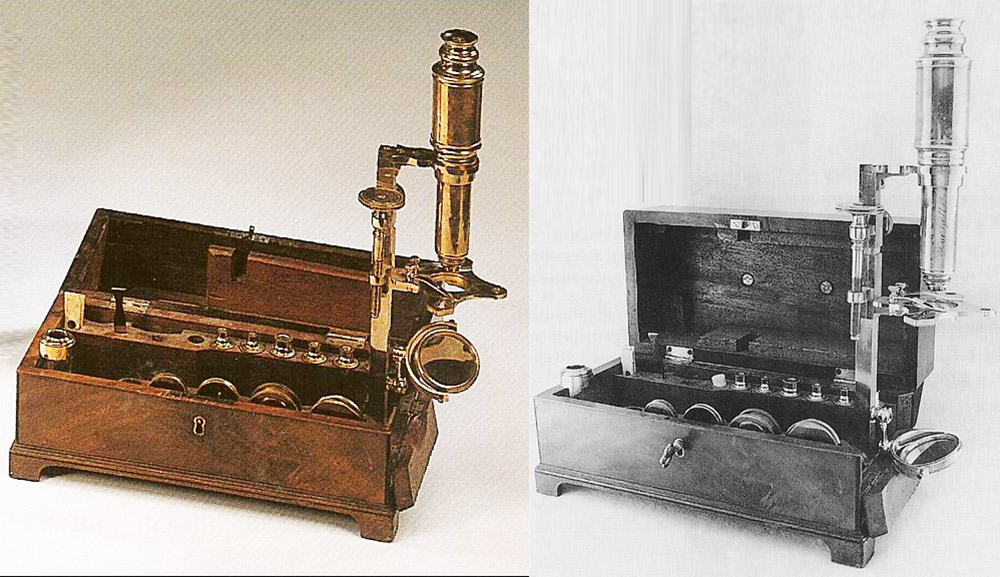
Figure 1.
Two views of a Nairne-type microscope, inscribed "Rochette a Paris". Such instruments date from the late 1700s to very early 1800s, so this was likely sold by Gaspard Rochette ("Rochette Père"). It strongly resembles microscopes manufactured by Dollond in England, and was probably manufactured by them for the wholesale market, then resold by Gaspard Rochette. Images adapted for nonprifit, educational purposes from auction catalogues.
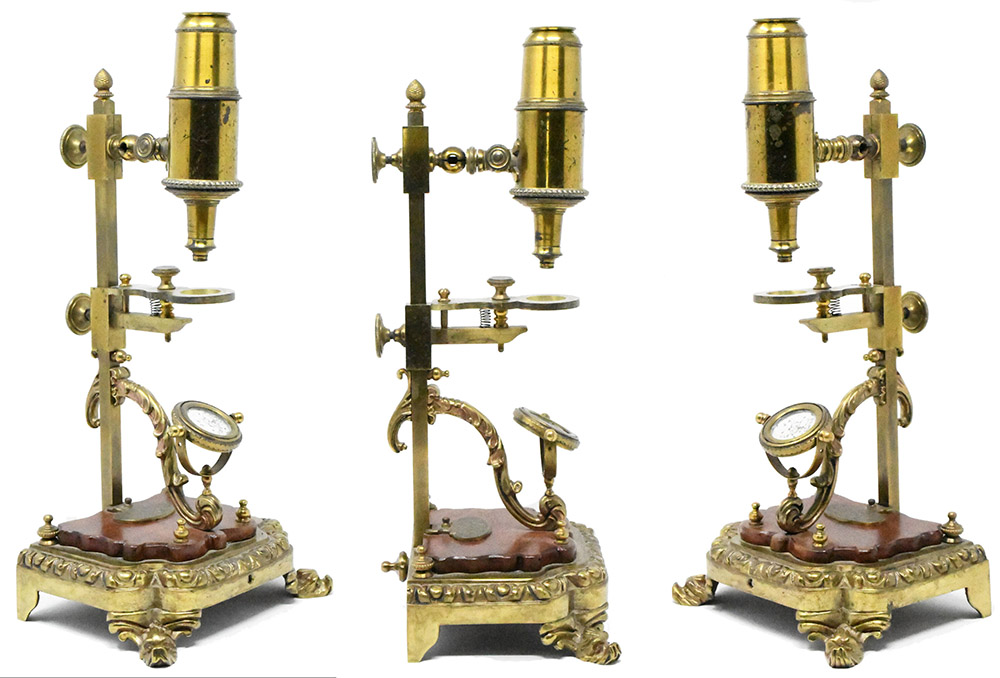
Figure 2.
A curious hybrid of a Benajamin Martin compound microscope body onto an elaborate stand, signed "Rochette Père". Presumably, he grafted the pieces together at the request of a client who wanted a fancier microscope. Adapted for nonprofit, educational purposes from an internet sale site.
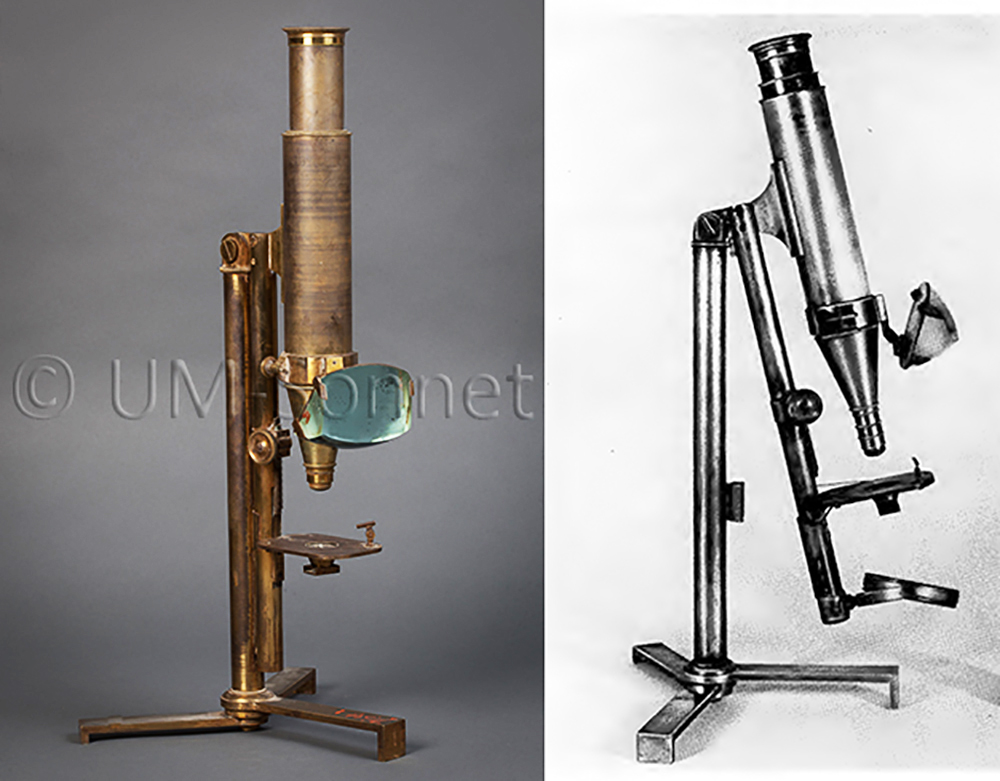
Figure 3.
Selligue-type achromatic microscopes, built by Jean-Jacques Rochette (“Rochette Jeune”), mid-1820s. Selligue developed the optics of this microscope in conjunction with Vincent and Charles Chevalier, but, after an 1823 presentation to the French Royal Academy of Sciences that failed to mention the Chevalier’s contributions, those opticians abandoned Selligue and developed their own achromatic microscopes. Selligue’s model was then built by Rochette Jeune and J.G.A. Chevallier (l'ingénieur Chevallier). Adapted for nonprofit, educational purposes from The University of Montpellier (https://collections.umontpellier.fr/collections/instrumentation-scientifique/physique/item/14-physique/20703-microscope-achromatique) and Frison, 1968.
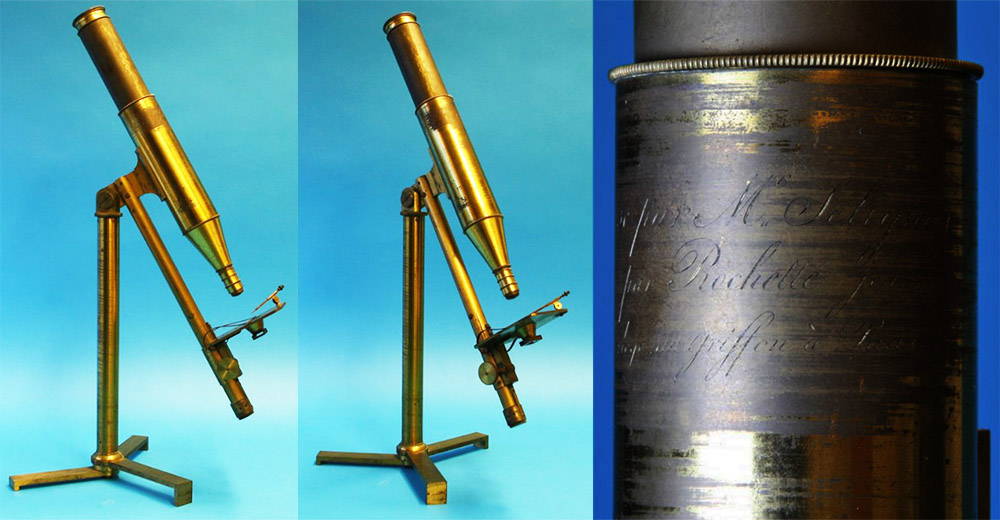
Figure 4.
An incomplete Selligue-type microscope, signed “Disposé par M. Seligue, Executé par Rochette jeune, Quai de l’Horloge au griffon à Paris”. Adapted for nonprofit, educational purposes from https://stichtinghistorischemicroscopie.nl/en/microscopen/compound-achromatic-microscope-sm-396 .
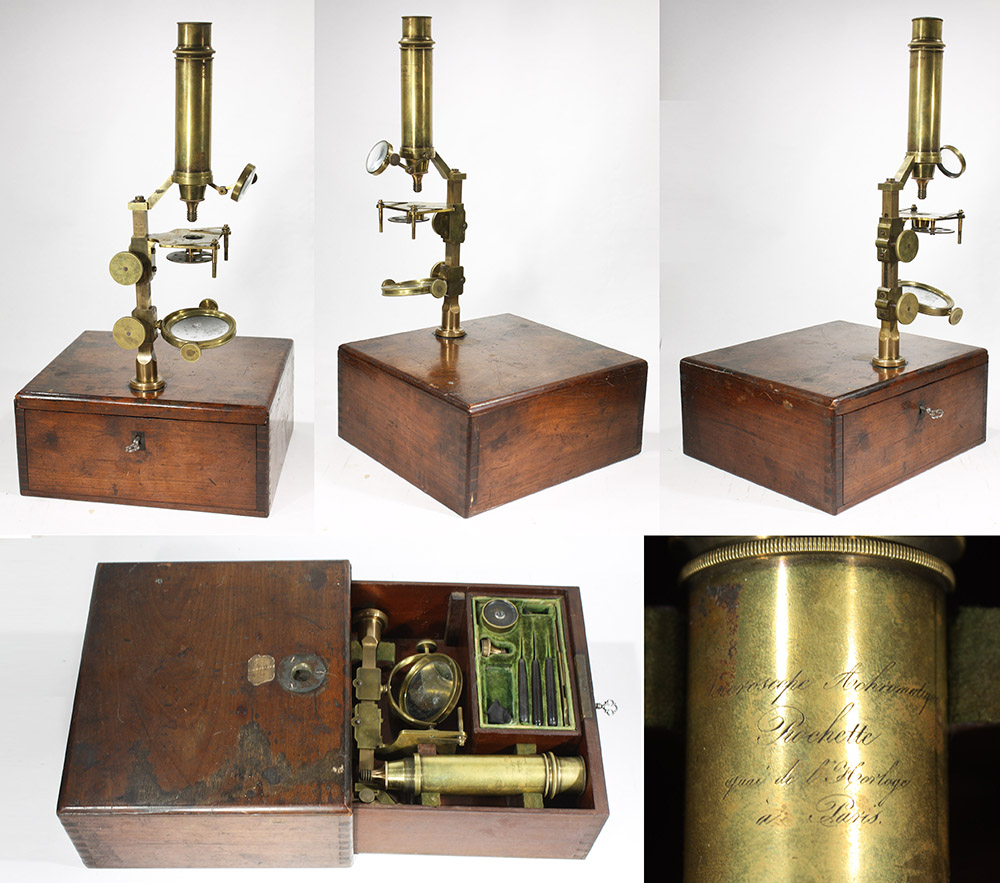
Figure 5.
A case-mounted microscope, signed simply “Microscope Achromatique, Rochette, Quai de l’Horloge, a Paris”. The pattern indicates production ca. 1830s, which is after Rochette Père had retired, so Jean-Jacques Rochette evidently did not need the epithet “Jeune” to differentiate himself. The style is similar to, but very distinct from, case-mounted compound microscopes that were made by other Parisian opticians, such as Charles Chevalier, Vincent Chevalier, and J.G.A. Chevallier. Jean Jacques Rochette is known to have manufactured microscopes, and so one can assume that he also made this one in his shop.
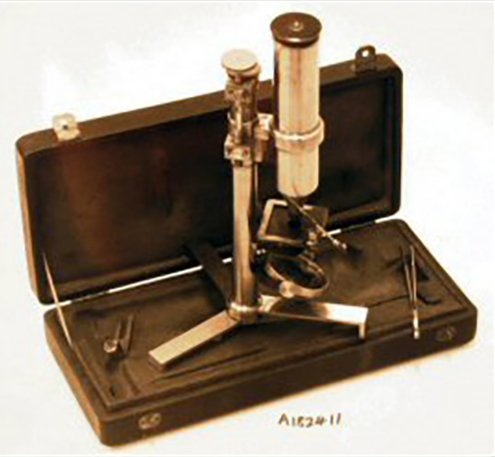
Figure 6.
A folding microscope, signed “Rochette Jne, Quai de l’Horloge, a Paris”. Adapted for nonprofit, educational purposes from Bracegirdle, 2005.
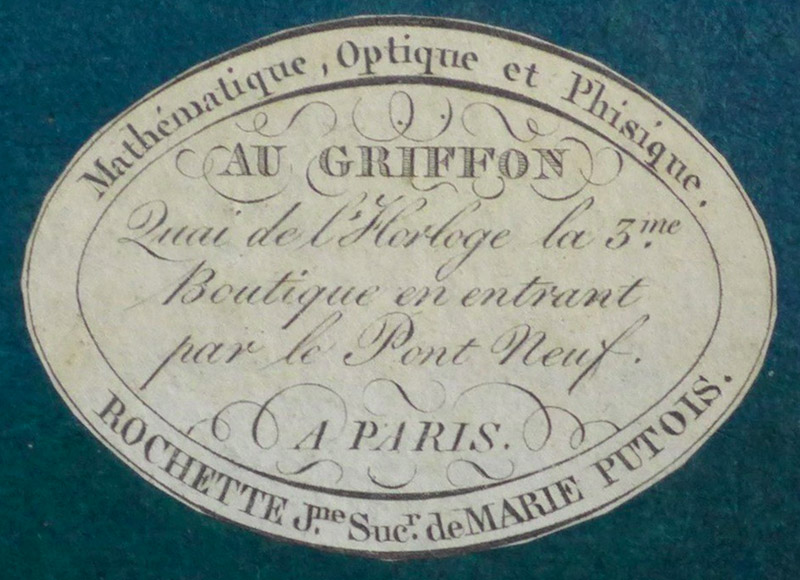
Figure 7.
Trade label from Rochette Jeune. He described his shop as “Au Griffon”” because of the building’s façade includes a statue of that mythical beast (see Figure 5). Adapted for nonprofit, educational purposes from https://planimetrica.jimdo.com/drawing-and-calculating/french-1/rochette/ .
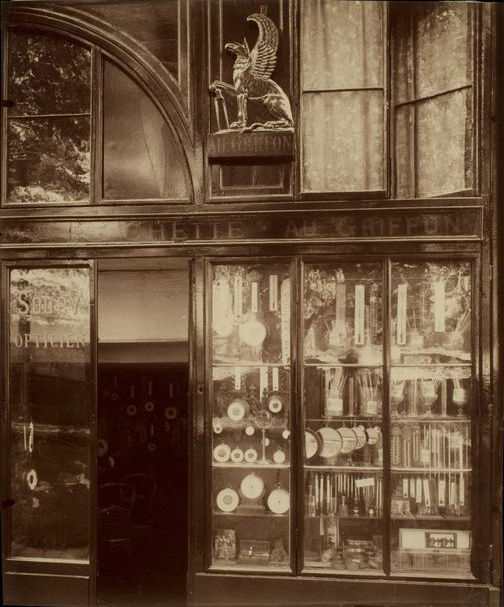
Figure 8.
Jean-Jacques Rochette operated his shop from this location on Quai de l’Horloge, known as “Au Griffon” because of the griffin statue on the façade. The griffin is known to have been present in the early 1700s, and a long sequence of businesses described themselves as “au Griffon”. This photograph was taken ca. 1902 by Eugène Atget (1857-1927). Rochette’s name is still visible over the doorway.
The elder brother, Gaspard, was born on April 13, 1755 in Annecy, Haute-Savoie, France, son of Joseph Marie Rochette and his first wife, Louise Burin.
Gaspard moved to Paris in 1774. A colleague later wrote that although “Arriving in Paris as a mere laborer, he succeeded - through his skill and tireless industry - in establishing a substantial business and amassing a fortune”.
Gaspard Rochette married Jeanne Charlotte Marion during the late 1770s. His marriage and subsequent family suggest that Gaspard was established in business by this time. Daughter Jeanne Charlotte Josephine Rochette was born on May 22, 1780. The 1789 baptism record of son Jean Gaspard Rochette described Gaspard Rochette as “opticien instrument a Paris rue la Bucherie no. 27” and proprietor of Rue Bretonvilliers No. 2. The 1839 Almanach du Commerce de Paris recorded that Rochette still owned and lived in the building at 2 Rue Bretonvillers, with rentals to 5 businesses.
Gaspard moved his shop to Quai de l’Horloge during the early 1790s. The 1797 Almanach du Commerce de Paris gave his address as 51 Quai de l’Horloge, and his occupation was listed as “miroitier” (“mirror maker”).
Gaspard’s mother died ca. 1770s, and his father remarried, to Marie Dunand. Their son, Jean-Jacques Rochette (i.e. Rochette Jeune) was born on October 29, 1777.
Jean-Jacques Rochette moved to Paris and learned skills as an optician and maker of scientific apparatus. It is reasonable to assume that he initially worked for his brother. He certainly was close to Gaspard and his family, as Jean-Jacques married Gaspard’s daughter, Jeanne Charlotte Josephine, on August 16, 1798. A son, Jean-Pierre Rochette, was listed as being an “opticien” on his 1827 marriage record, and is presumed to be the optician of that name who operated an optician business on Quai de l’Horloge during the 1850s.
One of the Rochette brothers acquired a shop at Palais Égalité in 1798, from an optician named Nozéda. In that year, an advertisement in Journal de Paris read, “Rochette, successeur de Nozéda, m. d'instrumens de physique & d'optique, Palais Egalité, côté de la rue des Bons-Enfans, no. 115”. That building later became Palais Tribunat, and then Palais Royal. That shop is last noted in the 1816 Almanach du Commerce de Paris, being absent from the 1817 edition. Of note, fellow optician Noel-Jean Lerebours also operated two shops at this time, at Quai de l’Horloge and the Palais.
I suggest that Gaspard Rochette was the most likely operator of that site. The 1799 Almanach du Commerce de ParisRochette, Palais Egalite, galerie de pierre 116” and “Rochette, Q. de l’Horloge 49 - Pont Neuf”, without discriminating “Père” or “Jeune”. This implies that only one person named Rochette was then a major figure in Paris optics.
The Almanach du Commerce de Paris often gave conflicting addresses for businesses. The 1797 edition gave Gaspard Rochette’s business address as both 51 and 52 Quai de l’Horloge, and the 1801 edition listed numbers 49 and 52. Yet the 1799 and 1800 editions, as well as those after 1801, gave only 49 Quai de l’Horloge. I suspect that typographical errors and either renumbering of the street or a short-distance move led to the multiple listings.
Quai de l’Horloge was certainly renumbered ca. 1806, with “Rochette père” now being listed at number 75.
The 1799 Almanach du Commerce de Paris also listed “Marie et Putois, Q de l’Horloge, 52 - Pont Neuf”. This was a business of Étienne Putois (1753-1828), begun ca. 1785 when he acquired the optical and scientific business of the Marie family. The presence of “Marie” in Putois’ business name has often been interpreted as evidence that he handed over the operation to his wife, whose name happened to be Marie. But, considering that “Marie et Putois” translates as “Marie and Putois”, and that Étienne Putois lived until 1828, I feel that it is much more likely that the use of “Marie” in the business name was to link it with his respected predecessors.
The 1806 Almanach du Commerce de Paris listed “Putois et companie” at Quai de l’Horloge. The house number was given as “19”, almost certainly a mistake, as subsequent records give the number as “81”. Jean-Jacque Rochette was probably “et companie”.
The 1806 edition is also the first known description of Gaspard Rochette as “père”, implying that Jean Jacques was becoming known as an optical dealer.
The partnership between Jean Jacque Rochette and Putois had certainly been formed by 1808, when they advertised, “MM. Marie Putois et Rochette, Ingénieurs en instrumens de mathématiques, demeurans quai de l'Horloge à Paris, ont déjà exécuté avec soin et beaucoup de précision, plusieurs des instrumens dont M. Gallois a donné la description dans son Mémoire, et on peut s’adresser à eux pour s'en procurer la collection complete” (“Messrs. Marie Putois and Rochette, Engineers of Mathematical Instruments residing on the Quai de l'Horloge in Paris, have already executed with care and great precision, several of the instruments described by Mr. Gallois in his ‘Memoir’; they may be contacted to obtain the complete collection.”). The business name “Putois et Cie.” was used through 1812, becoming “Putois et Rochette Jeune” in the 1813 Almanach du Commerce de Paris.
Rochette Jeune was full owner of the business by 1815. The shop’s façade included a statue of a griffon, a mythical dragon-like beast. The statue had been in place since at least the early 1700s, and the site was commonly known as “Au Griffon”. Rochette’s name was still present above the doorway of Au Griffon in the early 1900s, as seen in a famous photograph by Eugène Atget (1857-1927). An essay on the history of Au Griffon is presented elsewhere on this site.
Jean Jacques Rochette’s products at that time included gardening shears, as described in Annales de l'Agriculture Francaise, 1815: “M. Rochette, successeur de Marie-Putois, ingénieur-opticien, quai de l'horloge du Palais, n°. 81, s'est chargé de l'exécution du sécateur. Devenu commun et peu coûteux, il passera de la main des maîtres dans celle des jardiniers, qui ne tarderont pas à se féliciter de sa substitution à leur serpette, moins fidèle que notre sécateur.” (“Mr. Rochette, successor to Marie-Putois, engineer-optician at 81 Quai de l'Horloge du Palais, has undertaken the manufacture of pruning shears. Now that they have become commonplace and inexpensive, these shears will pass from the hands of the masters into those of the gardeners, who will soon congratulate themselves on having substituted them for their own pruning knives, tools far less reliable than our shears.”).
He also produced friction matches, as described in 1828, “Il est convenable de diviser la fabrication de ces briquets en deux parties. La première consiste à pulvériser impalpablement le chlorate de potasse, et à mélanger intimement sa poudre avec de la fleur de soufre. Or, comme on l'a dit plus haut, un semblable mélange détone violemment par la percussion, ou même par le simple frottement, entre deux corps durs, tels que le pilon et son mortier, ou une molette et sa table. L'accident arrivé à Essone n'est par le seul que nous signalerons. M. Rochette jeune, opticien, quai des Lunettes, à l'adresse du Griffon, l'un des premiers qui aient fabriqué des briquets oxigénés pour le commerce, a failli perdre la vie par suite d'une détonation occasionée dans la matière qu'il préparait pour cet usage, et il en a éprouvé un dégât de plus de 1200 fr." (“It is appropriate to divide the manufacture of these lighters into two stages. The first consists of pulverizing the potassium chlorate to an impalpable fineness and intimately blending the resulting powder with flowers of sulfur. Now - as previously noted - such a mixture detonates violently upon percussion, or even through mere friction between two hard surfaces, such as a pestle and mortar, or a muller and grinding slab. The accident that occurred at Essonne is not the only one we shall cite. Mr. Rochette ‘fils’ - an optician located on the Quai des Lunettes, at the sign of ‘Le Griffon’, and one of the very first to manufacture oxygenated lighters for the commercial market - very nearly lost his life following a detonation within the material he was preparing for this purpose; the incident resulted in damages exceeding 1,200 francs.”).
Rochette Père's business is last recorded in the 1822 Almanach du Commerce de Paris. The 1823 edition records “Magnien, opticien” as occupying 75 Quai de l’Horloge (see *Footnote after Figure 15 for information on Magnien). Gaspard’s wife, Jean Charlotte, had died in 1821, he was then in his mid-60s, and was reported to have “(amassed) a fortune”, so was probably ready to escape from the workaday life. He lived at his building at 2 Rue Bretonvilliers, where he died in 1846.
Chromatic aberration had long been a problem with microscopy, as different wavelengths of light bend at different angles in glass lenses, creating color artifacts. Major advances on the development of achromatic lenses in France were undertaken during the early 1820s by Alexandre François Gilles (1784-1845, better known by the nickname “Selligue”) and the father-son optical partnership of Vincent and Charles Chevalier. Their new, achromatic microscope was marketed as the "Selligue" model. Selligue publicly presented on their formulations in 1824. However, he failed to credit the contributions from the Chevaliers, so they split with him in anger and began producing an achromatic microscope with even better optics under the model name “Euler”. Selligue turned to other opticians, including Jean Jacques Rochette and J.G.A. Chevallier, to produce and sell his version. Examples of Rochette’s “Selligue” microscopes are shown above in Figures 3 and 4.
Another model of achromatic microscope that is signed simply “Rochette” is shown in Figure 5. Due to the timing of the development of achromatic microscopes, its resemblance to other French microscopes that were manufactured during the 1830s, and the retirement of Gaspard Rochette in 1822, this was evidently produced by Jean Jacques Rochette “jeune”.
Georges Oberhaeuser (1798-1868), who later became a major force in the development of microscopes in France, moved from Germany to Paris in 1816, and took work with an engineer named Henri Gambey. “Later, he exchanged this workshop with that of the mechanic Rochette, where he was offered the opportunity to make mathematical and especially optical instruments, as well as better pay”. Oberhaeuser is reported to have left Rochettte in 1830. That timing indicates that he worked and trained under Jean Jacques Rochette.
Rochette Jeune and Oberhaeuser produced competing models of clinometer compasses for the French army during the 1830s.
Jeanne Charlotte Josephine Rochette (wife of Jean-Jacques and daughter of Gaspard) died in August, 1826, at the age of 46.
Jean Jacques Rochette died on July 27, 1844. His business at a href="AuGriffon.html">“Au Griffon” was still in operation at the time of his death.
Gaspard Rochette, the elder brother, died on July 19, 1846. The Société Philanthropique Savoisienne wrote (translated), “Death has cast a somber shadow over one aspect of this picture. We have suffered the sorrow of losing four of the most honorable members of our Society. One of them, Gaspard Rochette - a distinguished optician - died at the age of 91, having been able to enjoy, throughout that long career, the prosperity he had earned through a lifetime of integrity and courageous perseverance. This estimable compatriot offered a fine example of what a man can achieve through hard work and intellect. Arriving in Paris as a mere laborer, he succeeded - through his skill and tireless industry - in establishing a substantial business and amassing a fortune.”
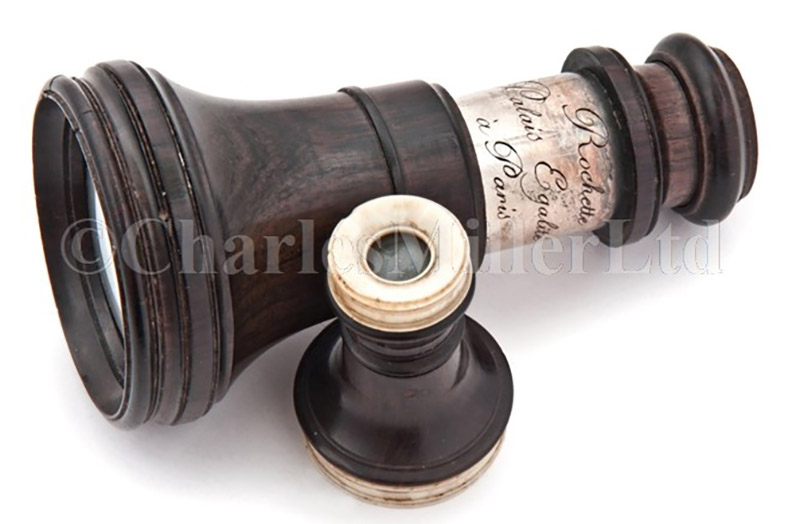
Figure 9.
A monocular opera glass, signed “Rochette, Palais Egalite, a Paris”. The address indicates production/retail by Gaspard Rochette between 1798 and 1800 (the building was renamed Palais du Tribunat in 1801, after Napoleon Bonaparte). The item at the front is not related to the opera glass. Adapted for nonprofit, educational purposes from an internet auction site.
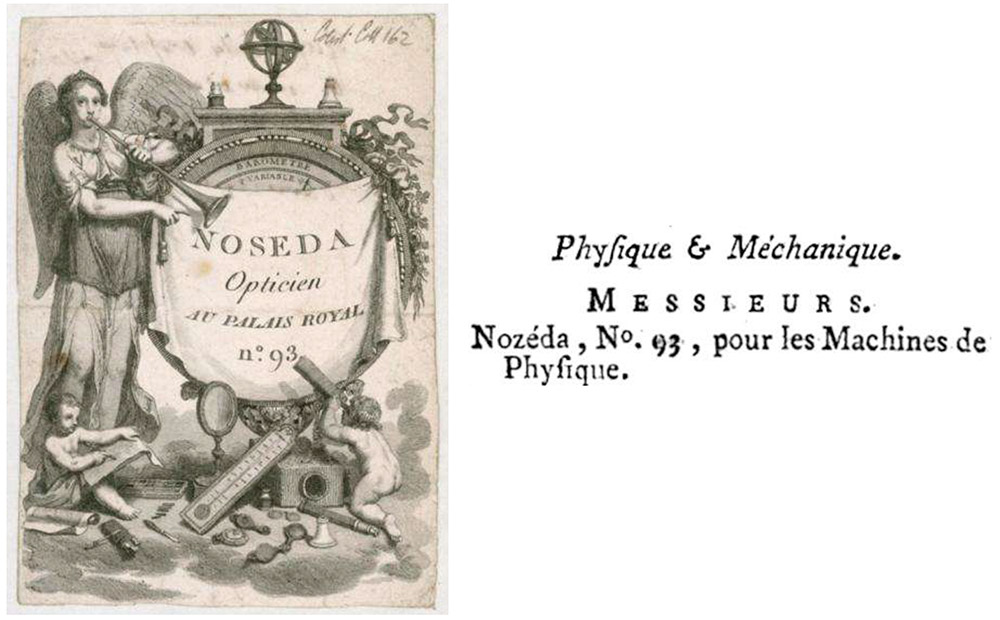
Figure 10.
Gaspard Rochette acquired the shop in Palais Egalite in 1798 from Noseda/Nozéda (possible first name Pascal). These ca. 1785 advertisements are adapted for nonprofit, educational purposes from Novella (accessed 2026).
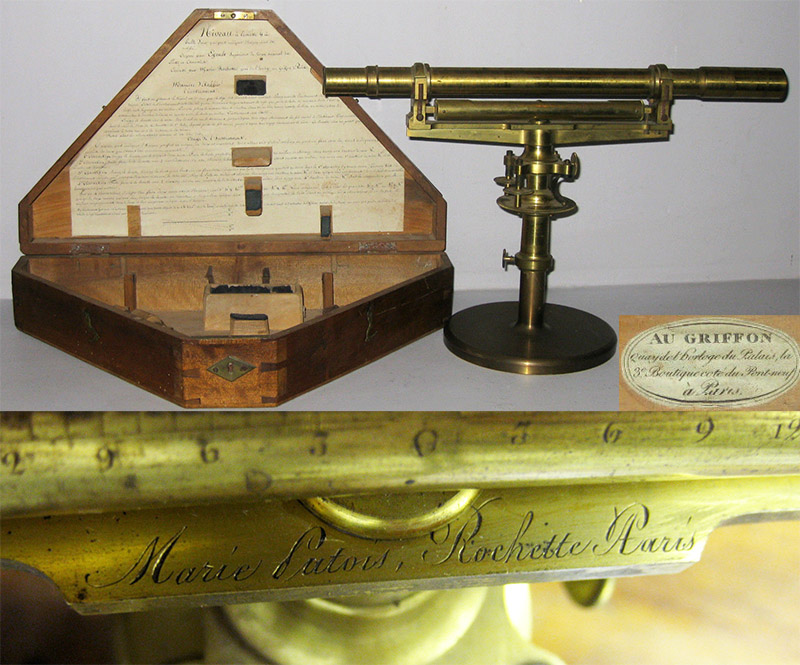
Figure 11.
A surveyor’s level, ca. 1808-1815, signed “Marie Putois, Rochette, Paris”. The case includes a label that reads, “Au Griffon, Quay de l’Horloge du Palais la 3e Boutique cete du Pont-neuf à Paris” (shown as inset). Adapted for nonprofit, educational purposes from an internet sale site.
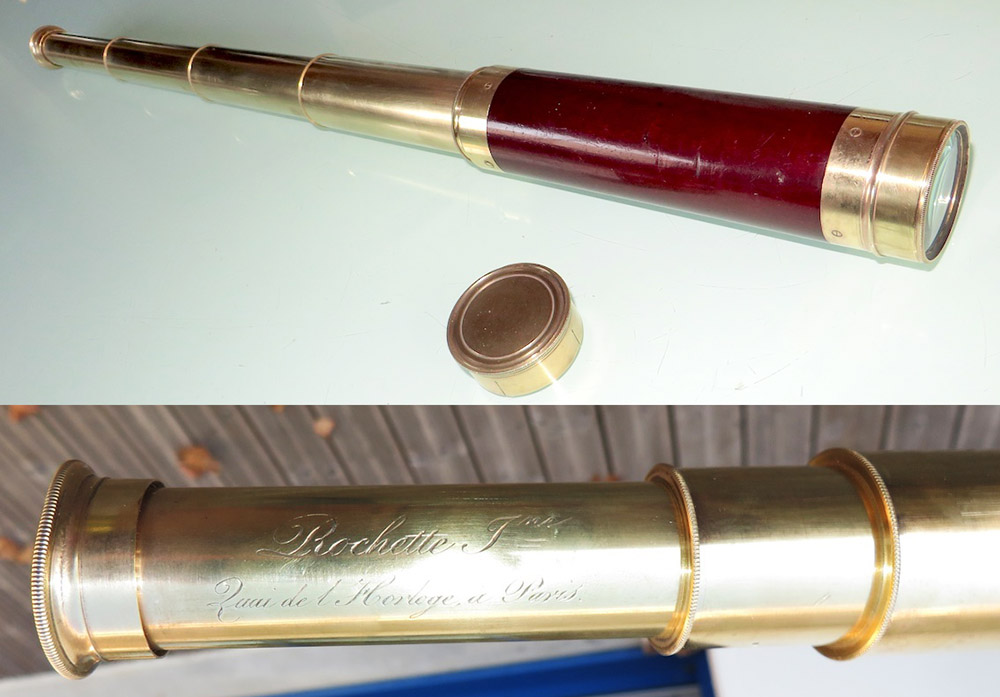
Figure 12.
Telescope by Jean Jacques Rochette. Adapted for nonprofit, educational purposes from an internet auction site.
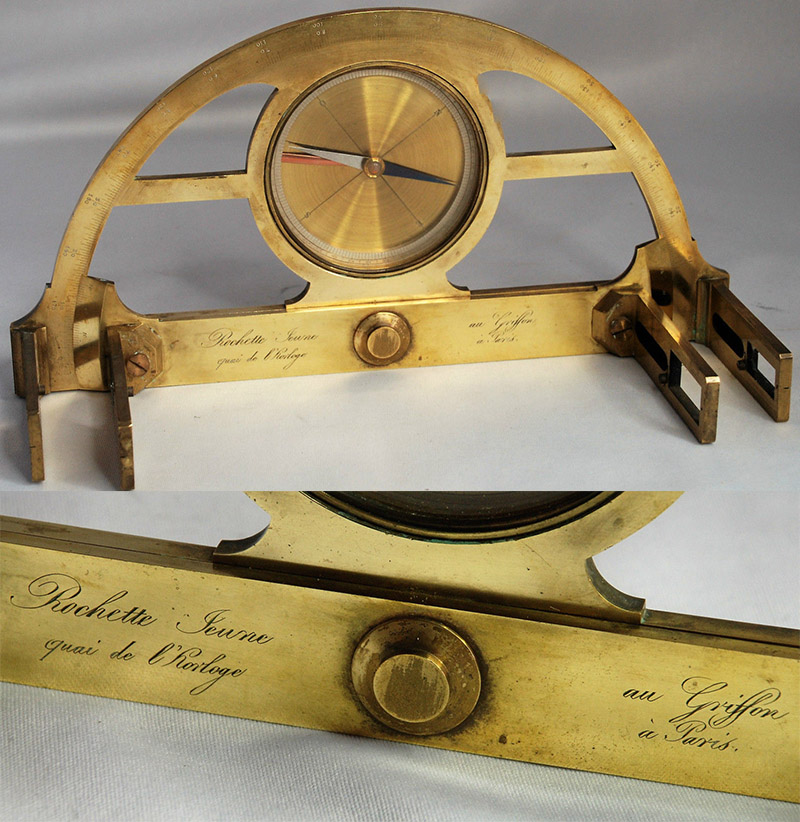
Figure 13.
A graphometer by “Rochette Jeune”. Adapted for nonprofit, educational purposes from an internet sale site.
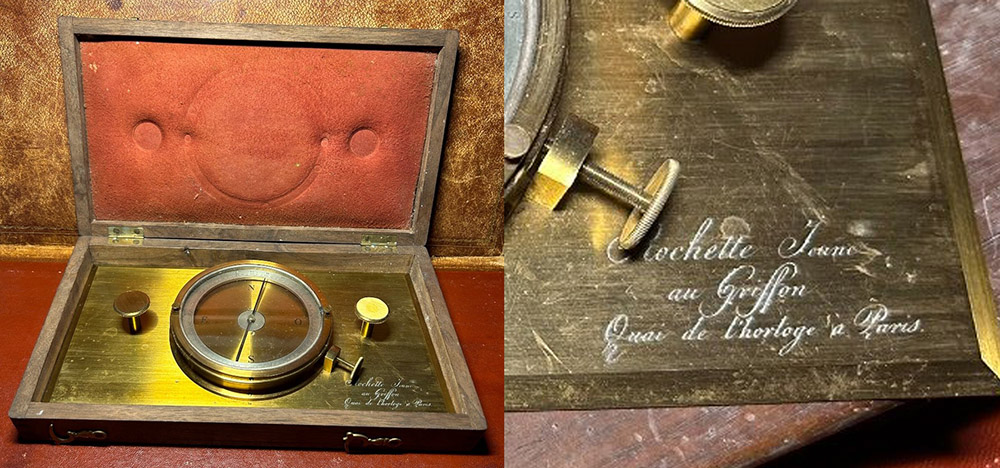
Figure 14.
Compass by Jean Jacques Rochette. Adapted for nonprofit, educational purposes from an internet auction site.
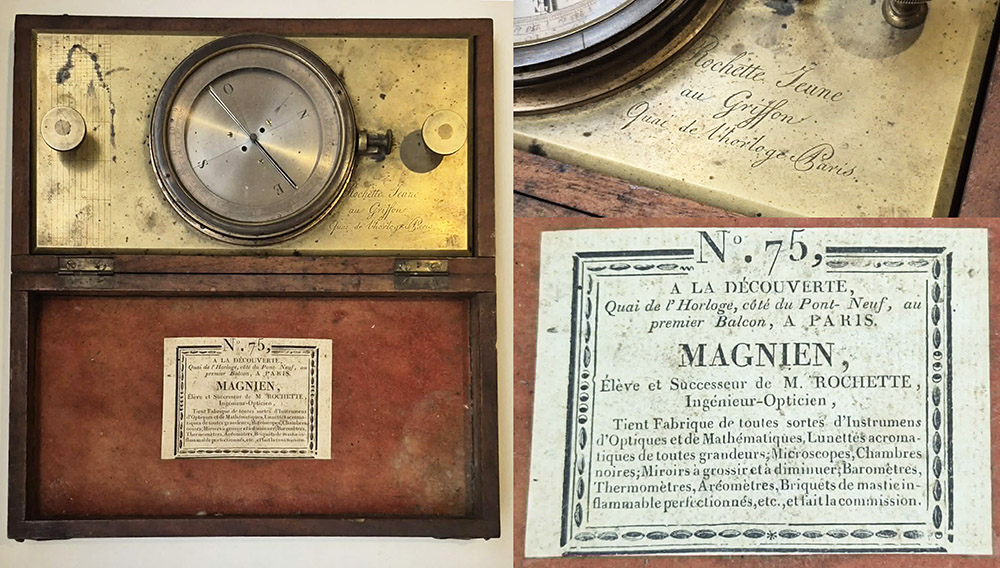
Figure 15.
Another example of compass from Jean Jacques Rochette, with a retail label from Magnien (who occupied the shop at 75 Quai de l'Horloge from 1822 until ca. 1830, which was the site of Gaspard Rochette's shop) See the footnote below for further information on Magnien. Adapted for by permission from Le Zograscope.
* Footnote: The first name of Magnien is not yet known. He described himself on a trade label as the student and successor of Gaspard Rochette (see Figure 12). The 1820 and 1822 editions of Almanach du Commerce de Paris, show him at 47 Quai de l'Horloge, and the 1823 edition has him at 75 Quai de l'Horloge (Gaspard's former shop). Magnien earned a silver medal at an exposition in 1829, with his address still at 75 Quai de l'Horloge. The 1833 Almanach du Commerce de Paris has an optician named Huette at 75 Quai de l'Horloge, and Magnien is absent from that and subsequent editions. The 1835 edition described Huette as "successeur de Maynien (sic)". Magnien was also absent from the 1817 edition, implying that he was working for Gaspard Rochette at that time. Charles Chevalier mentioned Magnien twice in his 1835 Notes Rectificatives pour Servir à l'Histoire des Microscopes, stating that Magnien produced microscope lenses for Achille Trecourt (who later collaborated with Georges Oberhaeuser in the production of microscopes).
Acknowledgements
Thank you to Joe Zeligs for sharing images from his electronic database of microscopes, Alexandre Piffault for sharing images of the Rochette-Magnien compass, and to John Vossepoel for clarifying relationships between Gaspard and Jean Jacques Rochette.
Resources
Almanach du Commerce de Paris (1797) pages 229 and 239
Almanach du Commerce de Paris (1798) page 361
Almanach du Commerce de Paris (1799) pages 238 and 252
Almanach du Commerce de Paris (1800) pages 196, 212, 252, and 258
Almanach du Commerce de Paris (1801) pages 155 and 189
Almanach du Commerce de Paris (1802) pages 173-174
Almanach du Commerce de Paris (1803) page 162
Almanach du Commerce de Paris (1804) page 118
Almanach du Commerce de Paris (1806) page 223
Almanach du Commerce de Paris (1811) page 284
Almanach du Commerce de Paris (1812) pages 240-241
Almanach du Commerce de Paris (1813) pages 283-284
Almanach du Commerce de Paris (1814) page 248
Almanach du Commerce de Paris (1816) pages 467 and 485
Almanach du Commerce de Paris (1817) page 196
Almanach du Commerce de Paris (1820) page 377
Almanach du Commerce de Paris (1822) page 487
Almanach du Commerce de Paris (1823) pages 391-392
Almanach du Commerce de Paris (1825) pages 170-171
Almanach du Commerce de Paris (1827) page 269
Almanach du Commerce de Paris (1833) page 281
Almanach du Commerce de Paris (1835) page 700
Almanach du Commerce de Paris (1839) page 586
Almanach du Commerce de Paris (1842) page 260
Almanach du Commerce de Paris (1856) page 390
Almanach du Commerce de Paris (1859) page 424
Almanach du Commerce de Paris (1863) page 500
Annales de l'Agriculture Francaise (1815) “M. Rochette, successeur de Marie-Putois, ingénieur-opticien …”, page 326
Berthaut, Henri Marie Auguste (1899) La Carte de France, 1750-1898: Étude Historique, Vol. 2, Service Geographique, Paris, pages 64-65
Birth, marriage, and death records of the Rochette family, accessed through ancestry.com, genenet.com, and familysearch.org
Bracegirdle, Brian (2005) A Catalogue of the Microscopy Collections at the Science Museum, London, Little Imp Publications
Chevalier, Charles (1835) Notes Rectificatives pour Servir à l'Histoire des Microscopes. Adressées à Messieurs les Membres de l'Académie Royale des Sciences de France, pages 9 and 16
Dandois, Nadège (2015) Les Journaux de Mode en France (1785-1792), accessed through https://dumas.ccsd.cnrs.fr/dumas-01266886v1/file/Dandois%20Nad%C3%A8ge%20-%20Les%20journaux%20de%20mode%20en%20France%20%281785-1792%29.pdf
Fresnel, Augustin (1824) Rapport sur le Microscope Achromatique de M. Selligue, Extrait des Annales des Sciences Naturelles
Journal de Paris (1787) “Nozéda , Opticien , au Palais Royal , No. 93
Journal de Paris (1798) pages 542 and 572
Journal des Mines (1808) “MM. Marie Putois et Rochette, Ingénieurs en instrumens de mathématiques, demeurans quai de l'Horloge à Paris, ont déjà exécuté avec soin et beaucoup de précision, plusieurs des instrumens dont M. Gallois a donné la description dans son Mémoire , et on peut s’adresser à eux pour s'en procurer la collection complète”, Vol. 24, page 168
Mayall, John (1886) Cantor Lectures on the Microscope, Society of the Encouragement of Arts, Manufactures, and Commerce, London, pages 62-62
Novello, Pedro J. (accessed May, 2026) Cañones Meridianos Francia I, https://ccs.saf-astronomie.fr/wp-content/uploads/2021/Info_Mail/IM_24_2021_PJ2.pdf
Recueil de la Société Polytechnique (1828) page 117
Répertoire du Commerce de Paris (1828) page 642
Société Philanthropique Savoisienne. Compte-rendu de l'état de la Société Pendant l'Année 1846-47 (1847) page 7
Stenger, Alain (2014) Illustrated History of the Box Microscope, Stenger, Paris, pages 54-57
Strebel, Lorenz Friedrich (1868) Rede bei der Beierlichen Preise-Vertheilung am 14. August 1868, https://books.google.com/books?id=ew1FAAAAcAAJ