Thomas Rubergall, 1775 - 1854
by Brian Stevenson
last updated February, 2026
Thomas Rubergall operated an optical and scientific instrument shop in London between ca. 1800 and 1854. A number of microscopes and other apparatus are known that bear Rubergall’s name (Figures 2-8 and 10). All of his microscopes are similar to instruments with other retailer’s names or that lack signatures, and many resemble products of known manufacturers such as G. & W. Proctor and Watkins & Hill (Figures 9-10), suggesting that Rubergall obtained microscopes and other instruments from wholesale manufacturers. His business was modest in size – census records show that he had two live-in assistants in 1841, an assistant and an errand boy in 1851, and no mentions of other employees at either of those times. Moreover, the shop was not particularly large, being two windows wide and four storeys tall (Figure 11). Rubergall was appointed Optician to The Duke of Clarence / King William IV (became King in 1830), Queen Victoria (became Queen in 1837), and “Their Majesties” (Queen Victoria and Prince Albert, who married in 1840), so he undoubtedly manufactured lenses for eyeglasses.
Addresses on Rubergall’s apparatus can help date their production/sale. He began his apprenticeship as an optician in 1790, so would have been freed in 1797. Tax records indicate that he operated a shop at Old Crown Court, St James, Piccadilly in 1800. By 1804, he had moved to 27 Coventry Street, St Martin in the Fields, Westminster. At a time between 1823 and 1830, the address changed to 24 Coventry Street, and Rubergall remained at that number for the remainder of his life.
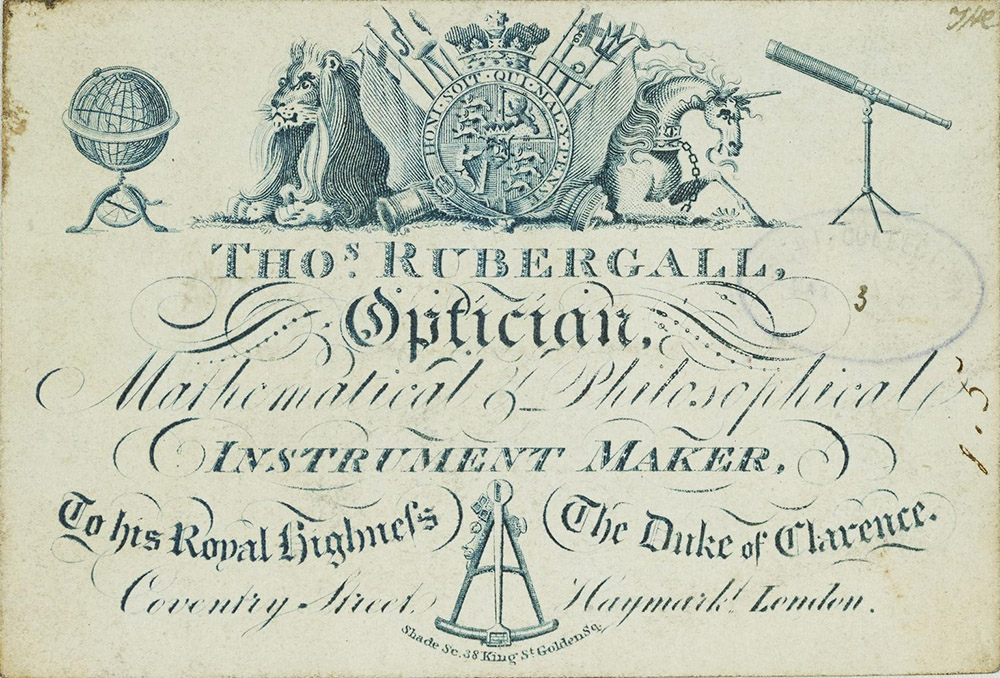
Figure 1.
Early trade label of Thomas Rubergall. The Duke of Clarence was the future King William IV, who ascended to the throne in 1830. An 1840 receipt that is held in the National Library of Ireland described Rubergall as “Optician to His Majesty” (i.e. King William IV). A trade card from Rubergall’s successors, Bithray & Steane, states that Rubergall was “Optician to the Queen” (i.e. Queen Victoria). Adapted for nonprofit, educational purposes from https://collection.sciencemuseumgroup.org.uk/objects/co8002250/trade-card-thomas-rubergall .
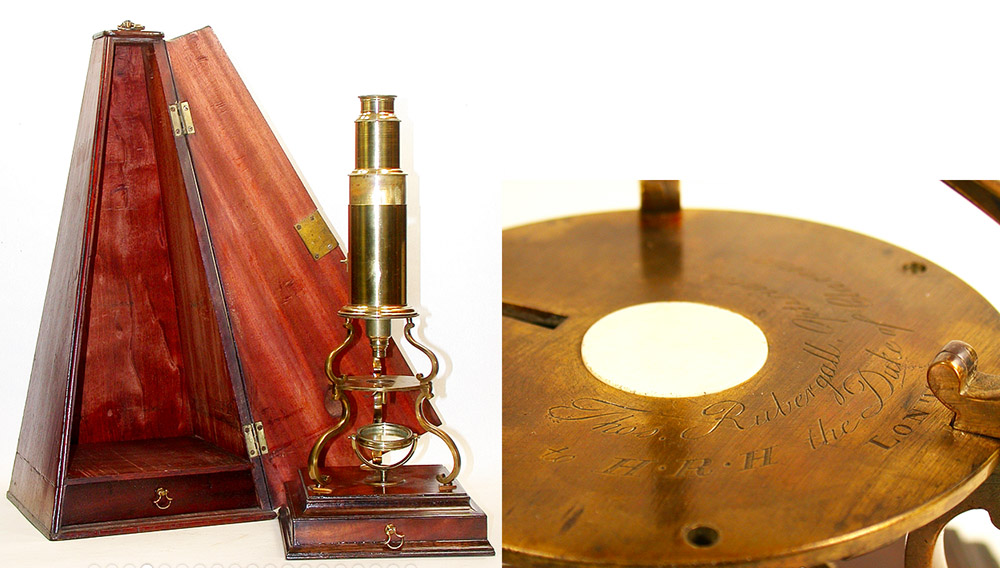
Figure 2
Culpeper-type microscope, signed “Thos. Rubergall Opticians to H.R.H. the Duke of Clarence, London”. The signature dates it to before 1830, when the Duke became King William IV. It may have been produced for the wholesale trade by a large-scale manufacturer such as G. & W. Proctor of Sheffield (see Figure 9). Adapted for nonprofit, educational purposes from an internet sale site.
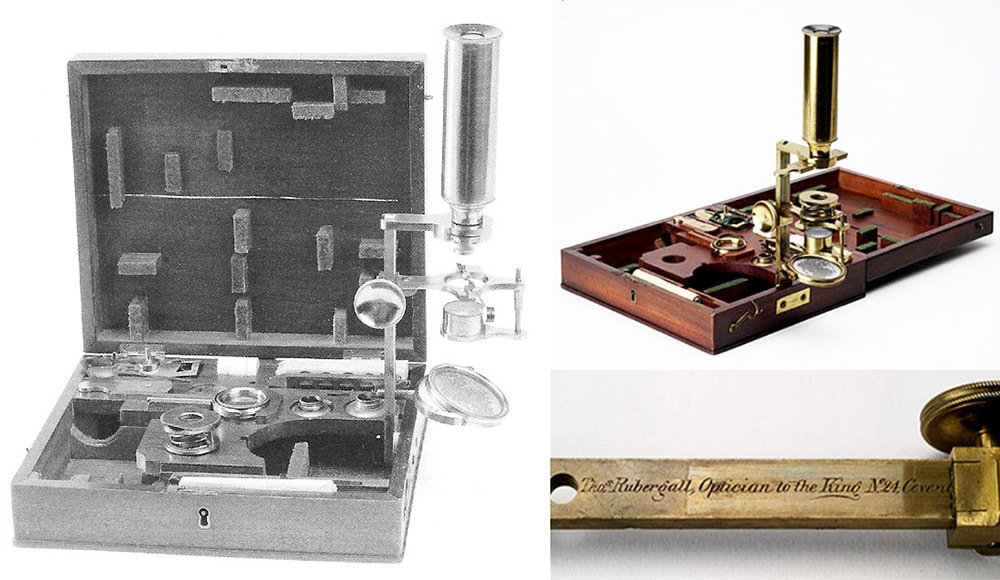
Figure 3.
“Timothy Lane”-type microscope, signed “Thos. Rubergall Optician to the King 24 Coventry St.”. The signature dates it to between 1830 and 1837, the reign of King William IV. This type of microscope was first built ca. 1810 by Thomas Harris (ca. 1757 - 1831). Adapted for nonprofit, educational use from the Boerhaave Museum, Leiden, Netherlands.
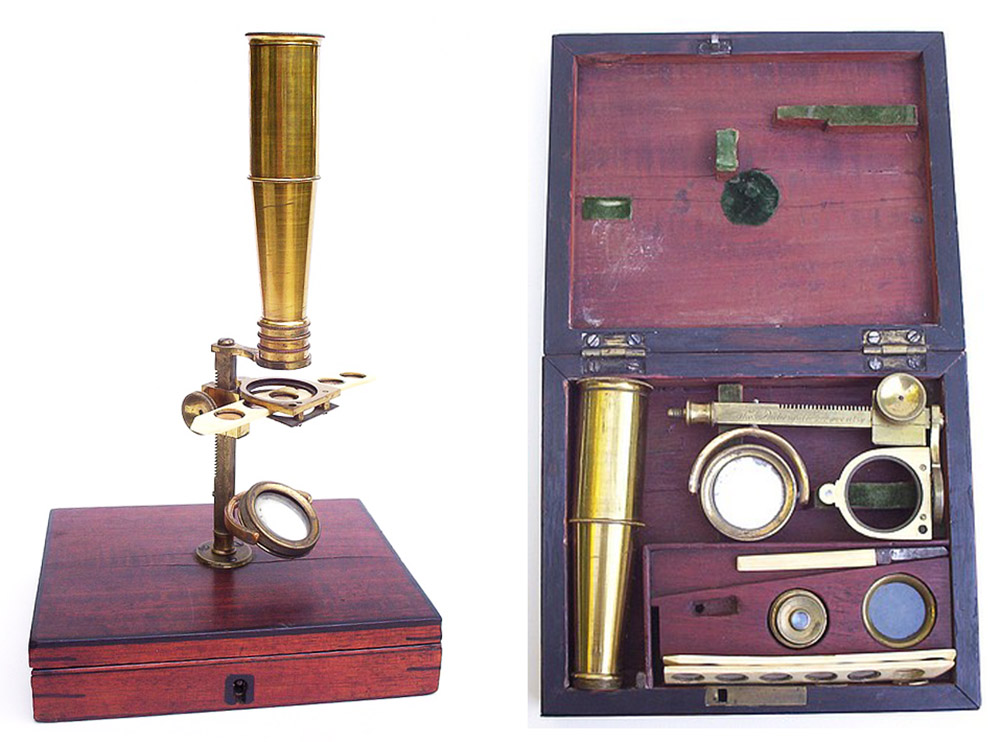
Figure 4.
A case-mounted microscope, signed “Thos. Rubergall 27 Coventry St.”. The address dates it to before 1823-1830. Adapted by permission from http://www.antique-microscopes.com/photos/Rubergall.htm .
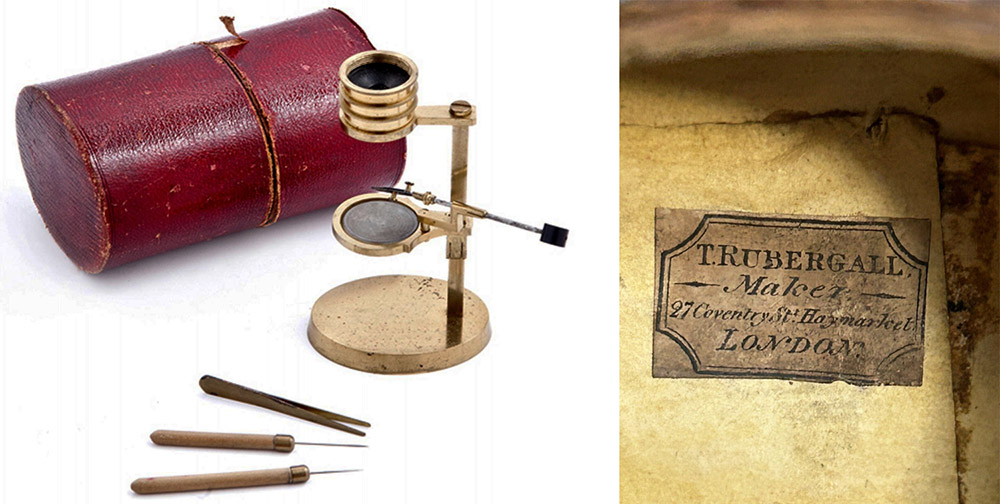
Figure 5.
A small “botanical” microscope, with a label inside the case that reads, “T. Rubergall – Maker - 27 Coventry St. Haymarket, London”. The address dates it to before 1823-1830. Adapted for nonprofit, educational purposes from an internet sale site.
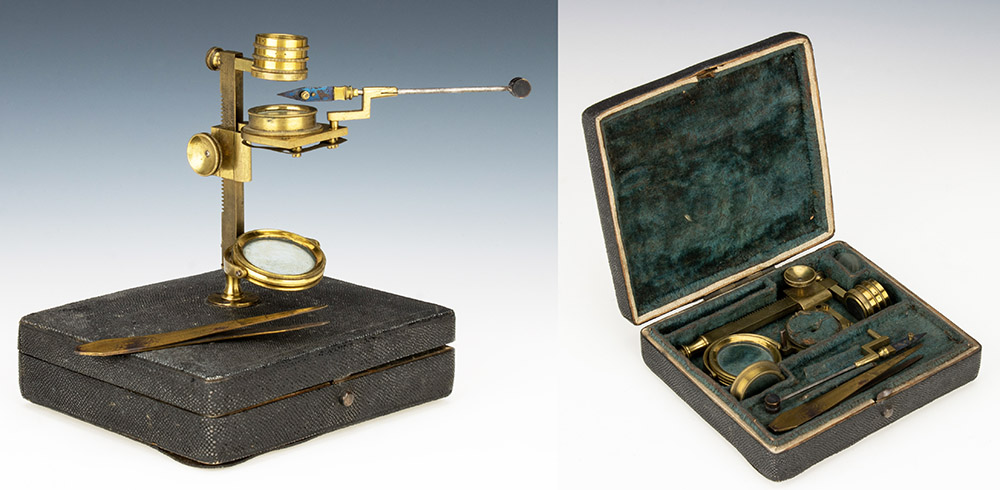
Figure 6.
A small case-mounted microscope, engraved “Thos Rubergall, Coventry St, London”. It may have been produced for the wholesale trade by Proctor & Beilby / G. & W. Proctor of Sheffield (see Figure 9). Adapted for nonprofit, educational purposes from an internet sale site.
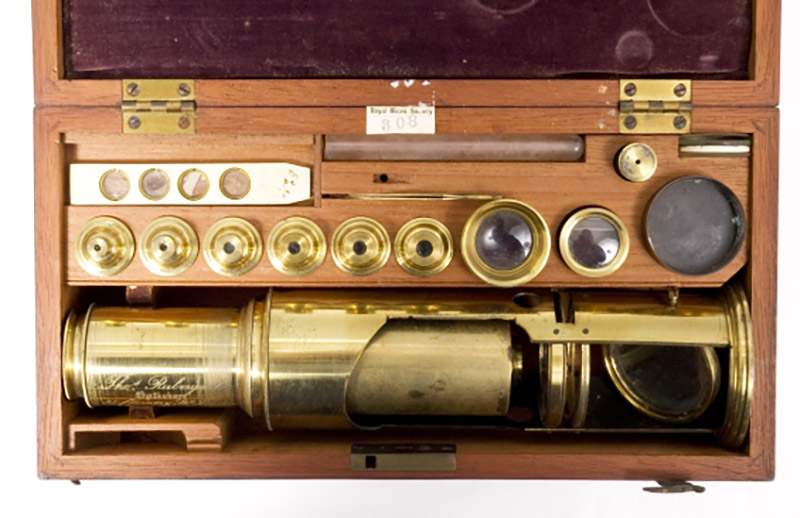
Figure 7.
A drum-type microscope, signed “Thos Rubergall, Optician, 24 Coventry St London”. The address dates it to after 1823-1830. Adapted for nonprofit, educational purposes from http://www.mhs.ox.ac.uk .
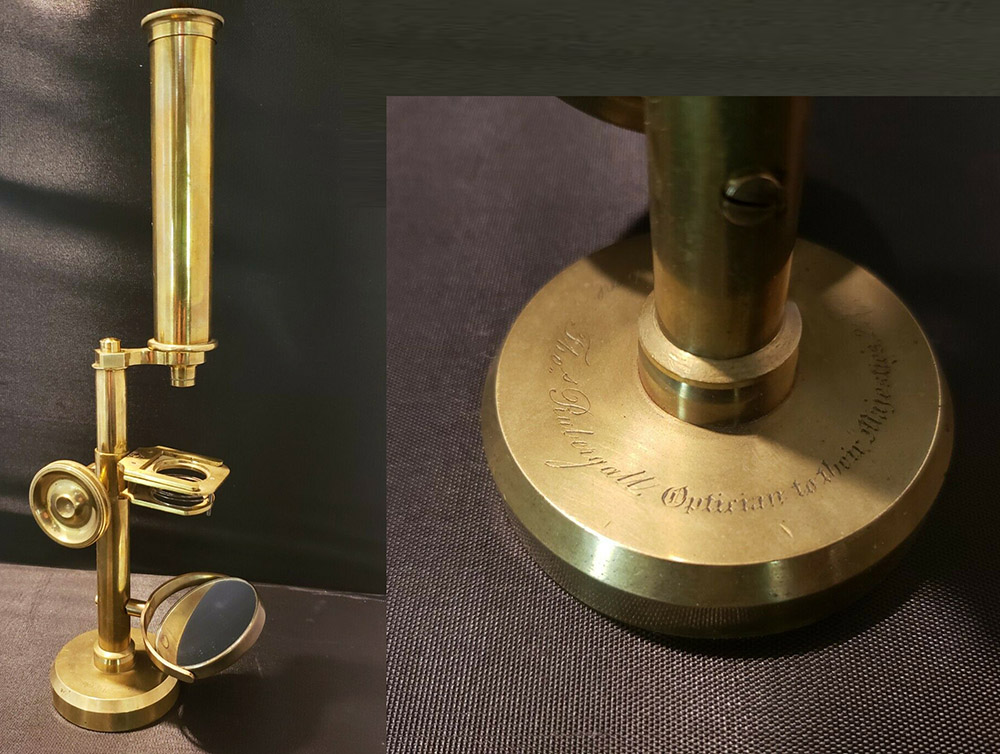
Figure 8.
Compound microscope, signed “Thos Rubergall, Optician to their Majesties”. Queen Victoria married Prince Albert in 1840. It was probably manufactured by Watkins & Hill, London, and acquired on the wholesale trade (see Figure 9). Adapted for nonprofit, educational purposes from an internet sale site.
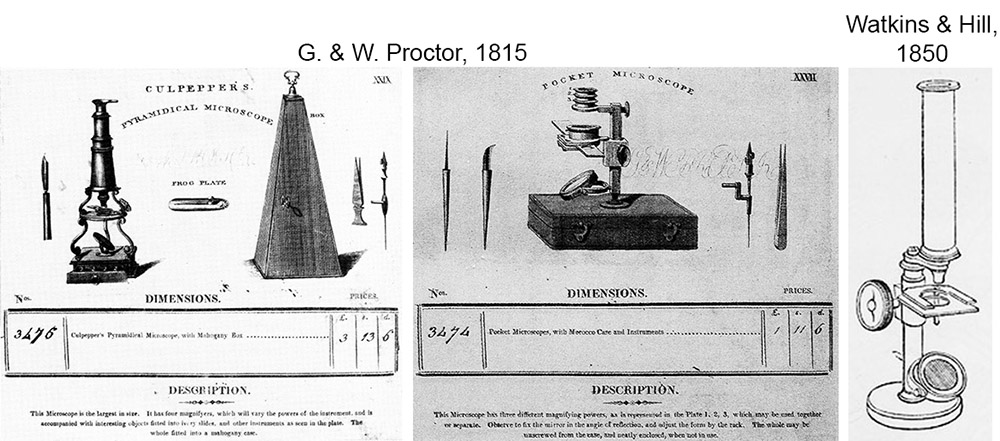
Figure 9
Excerpts from catalogues of large-scale manufacturers who supplied microscopes to the wholesale market that are very similar to some that were retailed by Thomas Rubergall (see Figures 2, 6, and 8, above). G. & W. Proctor, a successor to Proctor & Beilby, was a major manufacturer in Sheffield, England, during the early 1800s. Watkins & Hill, of London, produced the illustrated model of microscope in the 1840s-50s.
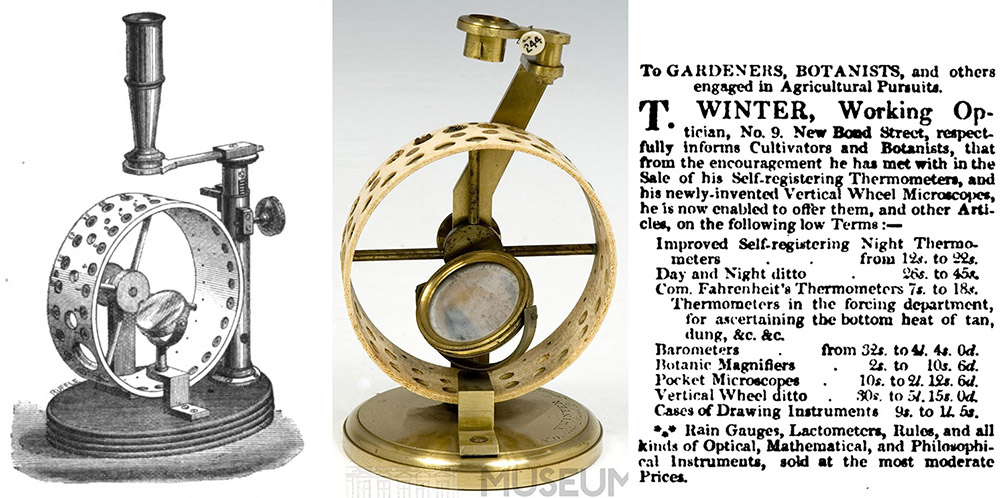
Figure 10.
(Left) Illustration of a compound “vertical wheel microscope”, engraved “Thomas Rubergall, Optician to H.R.H. the Duke of Clarence, 24, Coventry Street, London”, from “The Journal of the Royal Microscopical Society”, 1884. (Center) A simple version of the same microscope that bears “T. Winter, No. 9, New Bond Street, London”. Adapted for nonprofit educational purposes from the Oxford Museum of the History of Science. (Right) An 1827 advertisement from Winter - note that he described the vertical wheel microscope as "newly-invented". In 1884, Thomas Phillips Harris, owner of the T. Harris & Son optical and scientific business, wrote, “Thomas Winter was the ‘first and true inventor’ of these instruments … Winter worked for Mr. Harris, and sold the first model to him. Later Winter made some for Rubergall, probably the compound one. He also made some much smaller ones, which were sold for a few shillings.”

Figure 11.
View of Coventry Street, 1838-1840. Thomas Rubergall operated from 24 Coventry Street after 1823/1830. Prior to this, his address was 27 Coventry Street – it is not clear whether he physically moved between buildings or if the numbering scheme changed. In addition to the shop on the ground floor, the building included an additional three storeys of living and storage space. From “Tallis London Street Views, 1838-1840”.
The Rubergall family is reported to have moved from France to England during the eighteenth century, establishing vegetable farms in Chelsea and Kensington. Thomas Rubergall’s father, John, is said to be the first person to successfully grow lettuce in England.
Thomas Rubergall was baptized on September 7, 1775, in Kensington, son of John and Mary Rubergall. Presumably, he was born a few days or weeks before that date. Thomas had at least three older sisters.
On January 22, 1790, fourteen year-old Thomas was apprenticed to Thomas Taylor, an optician in the parish of St. Martin in the Fields. Little is known about Taylor. He has an entry in Clifton’s Directory of British Scientific Instrument Makers 1550-1851, which gives addresses but does not mention any known items attributable to this man. Most likely, Taylor’s primary products were eyeglasses. A 1788 poll book recorded that he was located at 17 Hemming’s Row, and an 1802 poll book placed him at Castle Street. Other known apprentices of Taylor were John Richardson (begun 1780) and James Parker (begun 1788).
Standard apprenticeships lasted for seven years, so Rubergall would have been free of his master by early 1797. It is not known where he worked for the next three years. His father, John Rubergall, died in November, 1799, so an inheritance might have helped Thomas to establish his own shop. London tax records of 1800 show that Thomas Rubergall then had a business in Old Crown Court, St. James, Picadilly. Clifton gives addresses of 10 Crown Court and Princes Street (Crown Court was adjacent to or part of Princes Street).
By 1804, Rubergall had relocated to Coventry Street. On January 27th of that year, he took his first known apprentice, James Phillips. An 1806 poll book gave Rubergall’s complete address as 27 Coventry. An 1823 directory of London gave his address as 27 Coventry, while an 1830 directory listed 24 Coventry. It is not known whether this was a physical move or a renumbering of the street.
Rubergall appears to have operated a relatively small business. The shop at 24 Coventry Street consisted of a ground floor showroom with a large glass front, and three additional floors, which were his home and those of employees (Figure 11). Two other people lived there at the time of the 1841 census, William Bithray (“apprentice optician”) and Thomas Steane (“male servant”). Bithray had completed an apprenticeship as an optician with his uncle, Stephen Bithray (ca. 1789 - 1858), so was more likely an assistant optician. In 1851, Bithray still worked for Rubergall but lived elsewhere in London, while Steane (“optician’s assistant”) lived at 24 Coventry Street with an errand boy and a domestic servant. Bithray and Steane formed a partnership after Rubergall’s death and continued the business from 24 Coventry (Figure 13).
Spectacles and other optical aids appear to have been Rubergall’s major products (Figure 12). These would have been produced by Rubergall, Bithray, and Steane, although at least three other men claimed to have produced eyeglasses for/with Rubergall. In 1834, John Thomas Hudson wrote that he had made spectacles for Rubergall and dozens of other “opticians and spectacle vendors in Great Britain”. John Whitehouse (1838-1891), of 8 Coventry Street, London, claimed in 1867 to be “son of the manufacturer to the late Thomas Rubergall” (Figure 14). Frederick Clark, of 13 Park Side, Knightsbridge, stated that he had been “employed thirty years by the late Thomas Rubergall and C.W. Dixey” (Figure 14). These men might have might have produced frames, lenses, or complete eyeglasses.
The size of Rubergall’s shop suggests that he had limited space for production. The small number of known employees implies a narrow range of skills on-site. It is unlikely that these few men could have manufactured eyeglass lenses and frames, plus microscope bodies and lenses, as well as the glass and frameworks of telescopes, barometers, thermometers, and engineering instruments. As with many other small-scale opticians of the period, Rubergall undoubtedly acquired many of the items in his shop from wholesale manufacturers, then engraved them or attached labels with his name. For example, the Rubergall-signed microscope shown in Figure 10 is known to have been manufactured for him by Thomas Winter (ca. 1808 - 1851).
Thomas Rubergall died on April 29, 1854.
His former employees, William Bithray and Thomas Steane, acquired the shop, then continued as Bithray and Steane. William Bithray died in January, 1855. Steane appears to have continued the business for a few months after that, then established himself elsewhere as an optician, jeweler, and watchmaker.
Bithray and Steane either did not acquire all of Rubergall’s inventory, or it was re-sold after their partnership ended. In October, 1863, J.C. Stevens auction house sold ”the Entire of the Valuable Stock-in-Trade the late Mr. Thomas Rubergall, Optician to Her Majesty, 24 Coventry-street, Haymarket: consisting of expensive Theodolites, Levels, Sextants, Quadrants, Compasses. Barometers. Thermometers, Microscopes, Telescopes, Opera and Race Glasses, Air Pumps, Gold, Silver, Steel and Tortoise-shell Spectacles, Eye-Glasses. Dissolving Views, Magic Lanterns and Slides, Mirrors, Object Glasses, Lenses, &c.” (Figure 15).
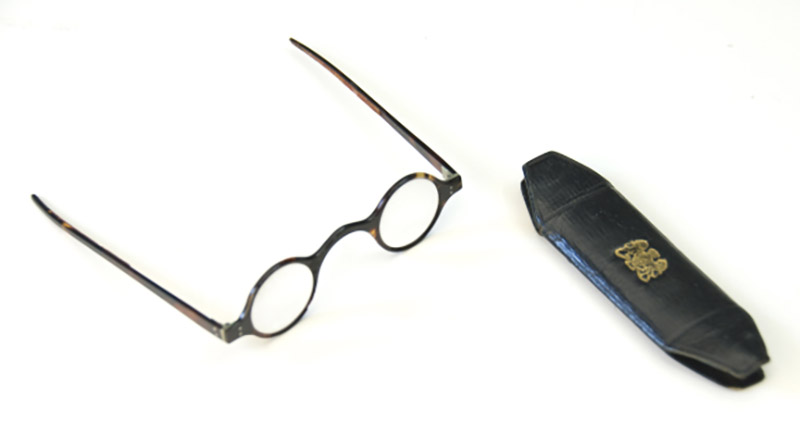
Figure 12.
Eyeglasses by Thomas Rubergall. The case is printed with “T. Rubergall, Optician to his Majesty, 24 Coventry St., London", dating them to the reign of King William VI (1830-1837). Adapted for nonprofit, educational purposes from http://www.mhs.ox.ac.uk .
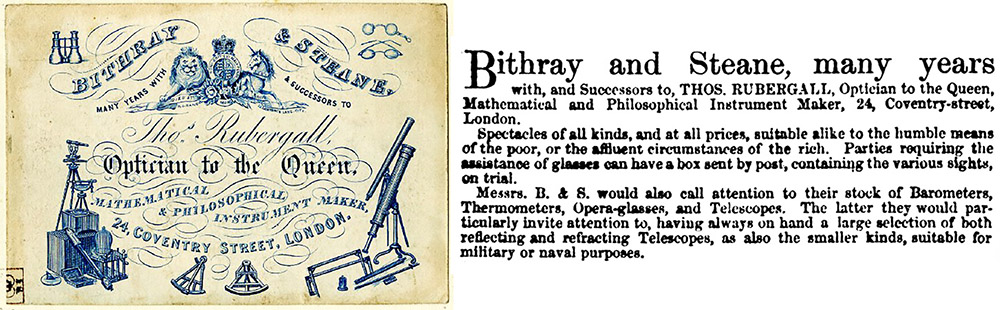
Figure 13.
William Bithray (1816-1855) and Thomas Steane (1825-1886) worked for Thomas Rubergall for for over 15 years, and formed a partnership to continue the business at 24 Coventry Street as "Bithray and Steane". Their trade card was based on Rubergall’s (see Figure 1, above). An 1855 advertisement from “The Lancet” (right) states that they sold spectacles, barometers, thermometers, telescopes, and opera-glasses (which were usually small binoculars). The business lasted only a year or so, between the time of Rubergall’s death (1854) until shortly after Bithray’s death in January, 1855. Left image adapted for nonprofit, educational purposes from an image made available by The British Museum.
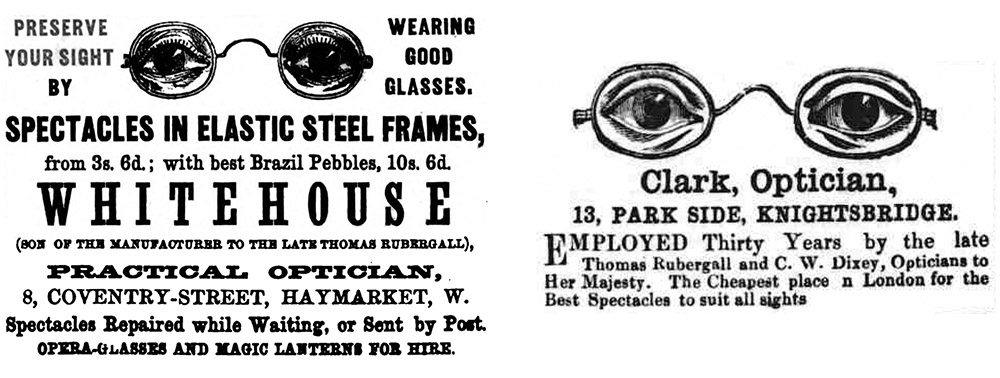
Figure 14.
Business advertisements from people who worked for/supplied Thomas Rubergall. (Left) John Julius Whitehouse (1838-1891) called himself the “son of the manufacturer to the late Thomas Rubergall” in this 1867 advertisement. He was a son of John Henry Whitehouse (1815-1874), who operated an optician’s shop at 29 William Street for many years. J.J. Whitehouse’s advertisement implies that his father provided eyeglasses and/or components to Rubergall at some point in time. From “The Illustrated London Almanack”. (Right) An undated advertisement from Frederick George Clark (1820-1891), who claimed to have been employed for thirty years by Rubergall and C.W. Dixey. Clark operated his own optician’s shop at 13 Park Side, Knightsbridge, since ca. 1842, suggesting that he actually worked as a contractor for Rubergall and Dixey.
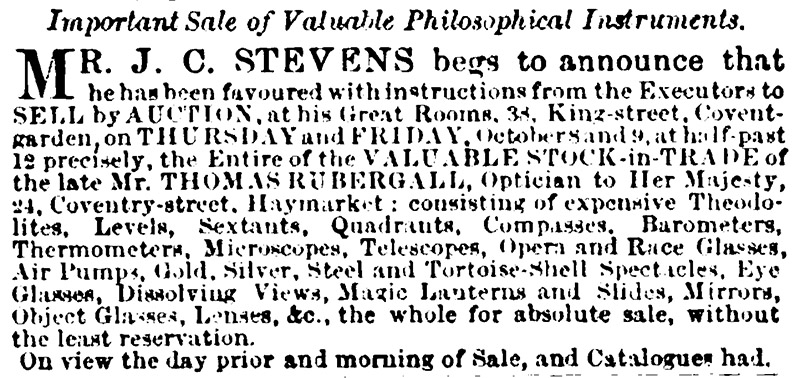
Figure 15.
“The valuable stock-in-trade of the late Mr. Thomas Rubergall” was auctioned in October, 1863. It is not clear why the auction occurred 9 years after Rubergall’s death. From “The Athenaeum”.
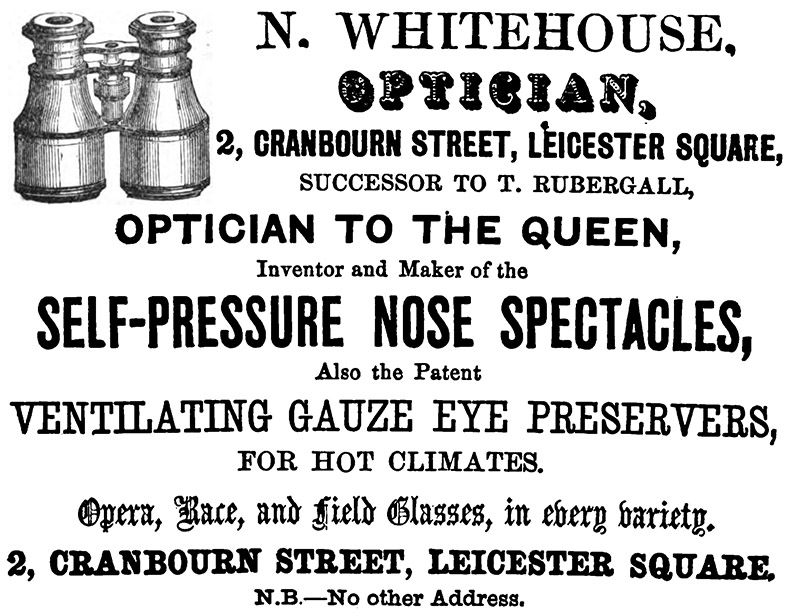
Figure 16.
An 1864 advertisement from Nathaniel George Whitehouse (1835 – 1900), claiming to be the “successor to T. Rubergall”. There are no known business or family connections between this Whitehouse and Rubergall, leaving me to conclude that Whitehouse purchased a substantial quantity of Rubergall’s stock at the 1863 auction (see Figure 15, above). A claim to being the successor would explain why he was selling items with Rubergall’s name on them. Nathaniel Whitehouse was a cousin of John J. Whitehouse (see Figure 14, above), descendants of a long line of London opticians. From “Debrett's Illustrated Peerage and Baronetage of the United Kingdom of Great Britain and Ireland”.
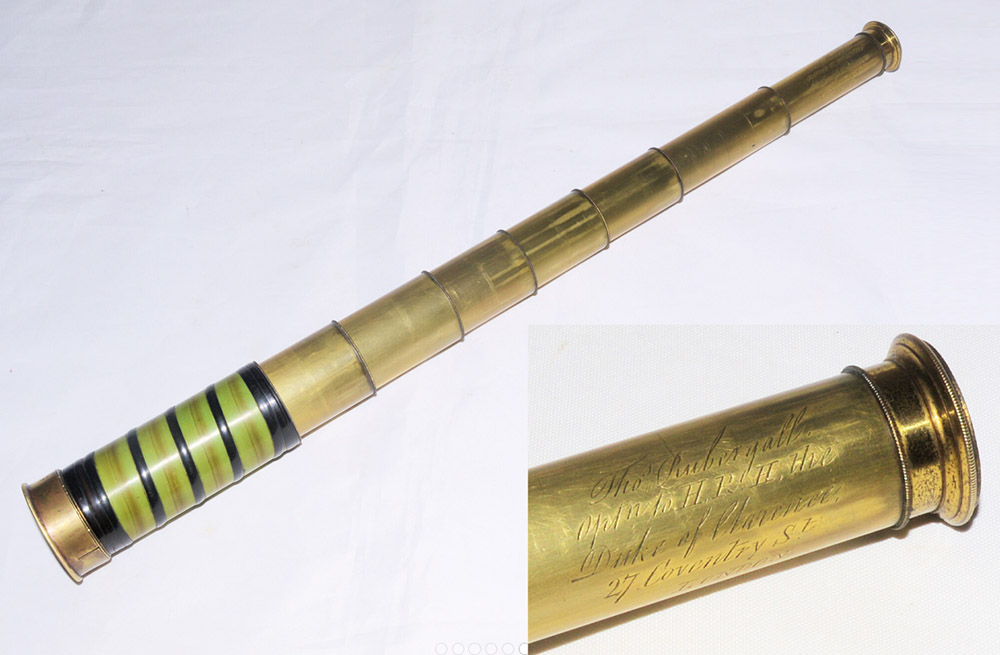
Figure 17.
A telescope engraved “Thos Rubergall, Optician to H.R.H. the Duke of Clarence, 27 Coventry St., London”, dating it to ca. 1820. Adapted for nonprofit, educational purposes from an internet sale site.
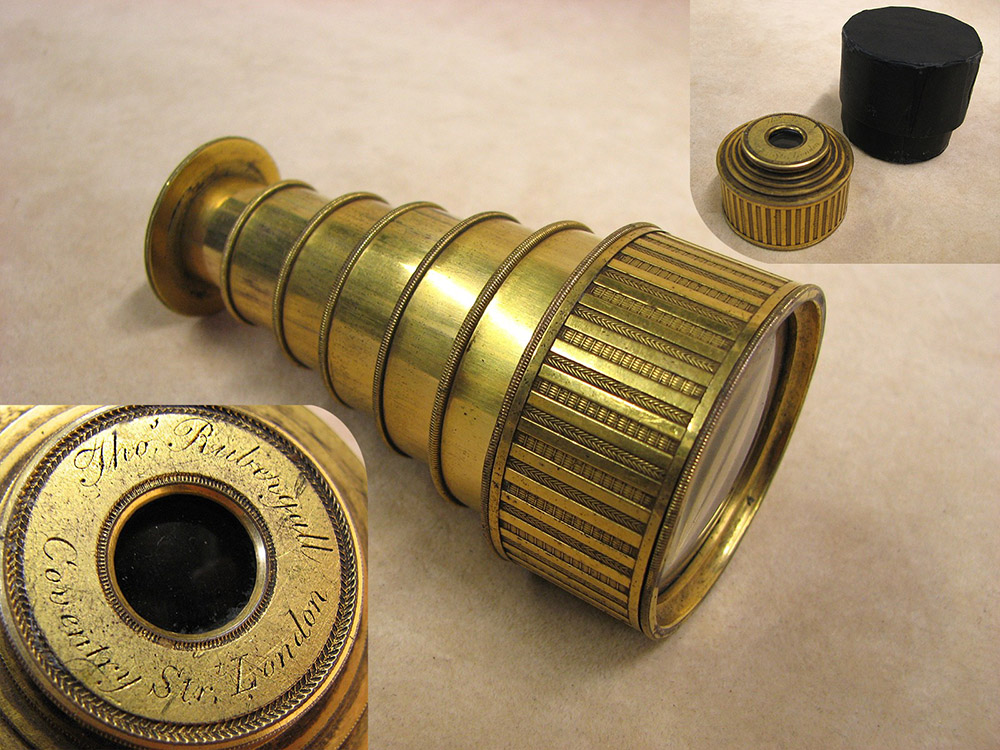
Figure 18.
A monocular opera glass engraved “Thos Rubergall, Coventry Str., London”. Adapted for nonprofit, educational purposes from an internet sale site.
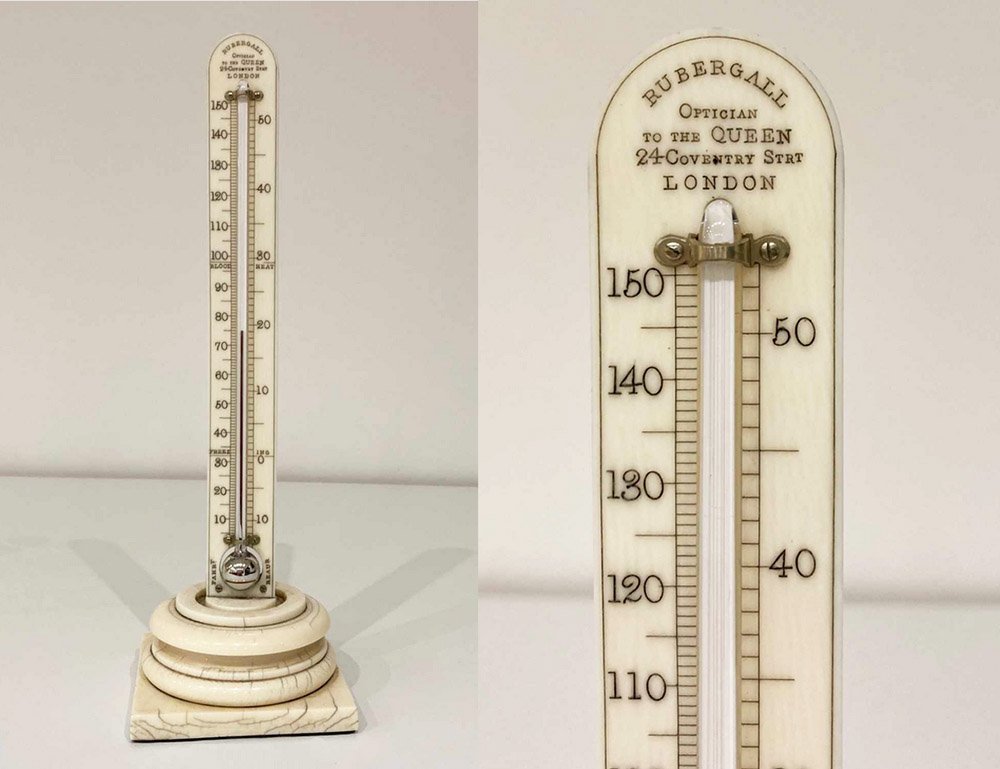
Figure 19.
An ivory thermometer marked “Rubergall, Optician to the Queen, 24 Coventry Strt, London”. Adapted for nonprofit, educational purposes from an internet sale site.
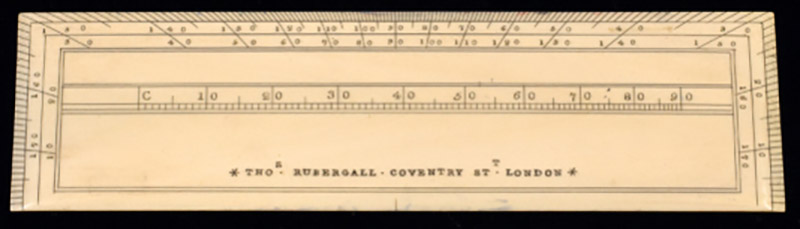
Figure 20.
An ivory ruler marked “Thos. Rubergall, Coventry Stt, London”. Adapted for nonprofit, educational purposes from an internet sale site.
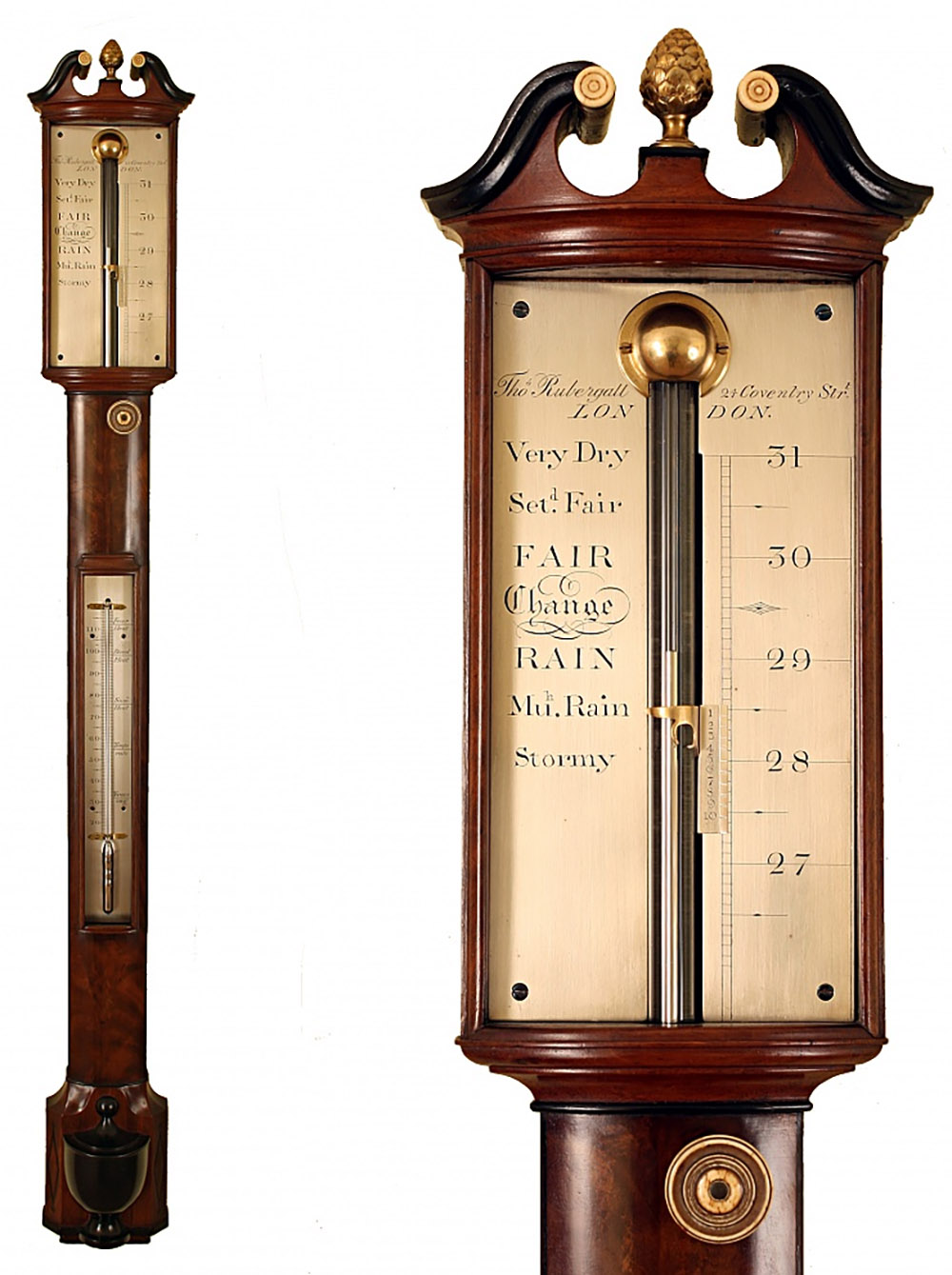
Figure 21.
A barometer signed “Thos. Rubergall, 24 Coventry Strt, London”. Adapted for nonprofit, educational purposes from an internet sale site.
Resources
The Athenaeum (1863) Auction of stock of Thomas Rubergall, Vol. 42, page 419
Clifton, Gloria (1995) Directory of British Scientific Instrument Makers 1550-1851, Zwemmer, London, pages 56, 239, 296-297, and 275
Debrett's Illustrated Peerage and Baronetage of the United Kingdom of Great Britain and Ireland (1864) Advertisement from Nathaniel Whitehouse, Advertiser section page 18
Economic history: Farm-gardening and market gardening (accessed February, 2026) in A History of the County of Middlesex, Vol. 12, Chelsea, ed. by Patricia E.C. Croot (London, 2004), British History Online https://www.british-history.ac.uk/vch/middx/vol12/pp150-155
England census and other records, accessed through ancestry.com
Hudson, John Thomas (1834) Spectaclaenia; or the Sight Restored, Assisted, and Preserved by the Use of Spectacles, page 20
The Illustrated London Almanack (1867) Advertisement from J. Whitehouse, advertising section
Journal of the Royal Microscopical Society (1884) Schieck‘s revolver school and drawing-room microscope, pages 113-115
Journal of the Royal Microscopical Society (1884) Winter's, Harris‘s, or Rubergall's revolver microscopes, page 284
Kent’s London Directory (1823) “Rubergall Tho. optician, 27, Coventry-street, Picadilly”, page 288
The Lancet (1855) Advertisements from Bithray and Steane, multiple editions
Morning Chronicle (1854) Deaths, “On the 25th inst., Mr. Thomas Rubergall, of 24, Coventry-street, in the 80th year of his age”, April 29 issue
National Library of Ireland (accessed January, 2026) “Major Mahon London Aug. 31st 1840 / Bot. [bought] of Tho. [Thomas] Rubergall, Optician, Mathematical & Philosophical Instrument Maker to His Majesty 24, Coventry Street, Haymarket [London]. Pair of Turpin [?] steel spectacles...case for ditto...steel spectacles, new, case...case for folding land spectacles...[Total] 1 " 7 " 0 [one pound seven shillings] Rec'd [received] for T. Rubergall Thos. Steane (Receipt, with engraved billhead (of royal coat of arms) issued by Thomas Rubergall, Optician, Mathematical & Philosophical Instrument Maker to His Majesty 24, Coventry Street, Haymarket, London to Major Mahon [a member of the Mahon family of Strokestown House, Co. Roscommon] for purchases to the value of one pound seven shillings in 1840)", https://catalogue.nli.ie/Record/vtls000816674
Post Office Directory of London (1843) “Rubergall Thomas, optician to their majesties, 24 Coventry street, Haymarket”, page 354
Post Office Directory of London (1851) “Rubergall Thomas, optician to her Majesty, 24 Coventry street, Haymarket”, page 962
Robson's London Commercial Directory (1830) “Rubergall Thos. Optician, 24 Coventry st, Haymkt”
Tallis' London Street Views, 1838-1840 (2002) Second edition, London Topological Society
Will of Thomas Rubergall (1854) obtained through ancestry.com